Since the United States and Israel attacked Iran three weeks ago, at least 23 oil and natural gas facilities across nine countries in the Middle East have been hit by military strikes from Iranian, Israeli, and U.S. forces, according to an ABC News analysis.
Experts say the strikes and the threat of further attacks risk throwing global energy markets into a state of protracted chaos.

ABC News/FELT – Map showing locations of targeted energy infrastructure, verified by ABC News.
The broadening of the conflict to include critical energy infrastructure targets – combined with the shutdown of the Strait of Hormuz – could lead to a costly, months-long strain to the world’s supply of oil and natural gas, energy experts told ABC News.
“Every day that this continues, we need at least a week, probably two weeks on the other side to make it up,” said Philip Jones-Lux, a senior analyst at Swiss-based market intelligence company Sparta Commodities. “We are not getting back to the oil price that we had before this conflict any time this year, and probably also not by mid-2027, either.”
Iran live updates: Tehran vows to respond if Trump strikes Iran’s power plants, state media reports
By cross-referencing social media videos and satellite imagery with official statements and open-source data, including maritime data, ABC News verified the targets and geolocated many of their exact locations. This analysis enabled ABC News to date every incident and map the extent of the attacks on energy infrastructure.
While reciprocal attacks on natural gas facilities in Qatar and Iran last week triggered concerns about the broadening scope of the conflict, oil and gas facilities throughout the region have been targeted by strikes by Iranian as well as U.S. and Israeli forces since the initial days of the conflict.
According to ABC News’ analysis of satellite imagery and verified videos, Iran and its proxies have targeted at least 17 oil and gas sites across nine countries in the Middle East. At least six oil and natural gas sites within Iran have been struck by Israeli and U.S. forces since the conflict began, as of March 22.
The damage to those facilities comes amid the ongoing virtual shutdown of the Strait of Hormuz, a critical maritime chokepoint through which more than 20% of the world’s oil and liquefied natural gas is transported. With Iran threatening to strike vessels that attempt to navigate the strait, at least five oil- and gas-carrying tankers have already been targeted by Iranian strikes in the Persian Gulf, according to an ABC News analysis.
With the Strait of Hormuz effectively closed, alternative routes pose little help
Even if the conflict were to end immediately, the shock to the supply chain stemming from the shutdown of the Strait of Hormuz, as well as the damage to oil and natural gas facilities, could impact energy prices through next year, energy analysts warned.
“This is one of those things that the longer the conflict goes on, the longer the strait is closed, the more damage there is to the facilities in the Gulf, the more extreme this gets, and the market will respond,” said Kristy Kramer, the lead of LNG Strategy and Market Development at research and consultancy firm Wood Mackenzie, which focuses on the energy and natural resources industry.
Liquified natural gas
The two most consequential attacks on energy sites, according to experts, occurred last week with Israel’s attack on the South Pars Gas Field in Iran, and Iran’s strikes on the Ras Laffan Industrial City in Qatar, the world’s largest LNG processing facility.
Video verified by ABC News showed fire engulfing the South Pars Gas Refinery in Asaluyeh, Iran, on March 18 following an Israeli strike.
This South Pars gas field is considered a lifeline to Iran’s economy, supplying 70% of the country’s gas consumption, according to the Middle East Council on Global Affairs.

Verified by ABC News. – Screenshot from a video verified by ABC News, posted on X, showing smoke and fire engulfing the South Pars Gas Refinery in Asaluyeh, Iran on March 18, 2026, following an Israeli strike.
“The significance of striking the South Pars Gas Field lies not in the immediate loss of output, but in the systemic role it plays. South Pars is the backbone of Iran’s power generation,” said Dr. Nima Shokri, an environmental expert at Hamburg University of Technology in Germany. “When that flow is disrupted, the effect propagates through the systems that sustain daily life. The risks, however, do not stop at Iran’s borders: any disruption to South Pars carries the potential for escalation.”
Though satellite images do not clearly show the damage to the Ras Laffan site in Qatar, data collected by NASA detected an uptick in heat signatures following the reported strike on the facility on March 18. In a statement, state-owned QatarEnergy said an Iranian missile attack damaged two LNG trains and is expected to decrease their export capacity by 17% and result in an annual revenue loss of $20 billion.
Although the LNG from Qatar is mostly bound for Asian markets, the impacts on the price of natural gas could be felt globally, according to Jones-Lux.
“It’s a very critical engineering part of that facility,” Jones-Lux said about the damage to Ras Laffan. “There’s no ready-made manufacturing capability to get it done. It’s a bespoke unit.”
Gabbard doubles down on deferring to Trump on whether Iran posed ‘imminent threat’
According to Kramer, the attack on Ras Laffan shattered the market consensus that the impact of the conflict would be confined to a few months, with QatarEnergy now projecting that the repairs could take up to five years to complete.
“That this looked like it was probably an outage that was maybe around a couple of months,” she said. “Given the attacks on the facilities this week, things are looking to change. It’s a pretty pivotal moment.”
Alex Munton – director of research at D.C.-based energy market, policy and geopolitical analysis firm Rapidan Energy – described the attack on Ras Laffan as a “worst-case scenario.” The multibillion-dollar LNG facility is not only the heart of Qatar’s export industry but also vital to process the natural gas extracted from across the Middle East by Qatar’s neighbors. Despite its importance to the region, Ras Laffan is inherently vulnerable to an attack due the nature of processing combustible natural gas into a liquid through miles of pipelines.
“Things will be built around that facility to protect it against reasonable risk. A ballistic missile strike is not what you’re going to plan from the outset in protecting this facility,” he said.
Oil and gas prices surge as Iran escalates strikes on Gulf refineries
According to Munton, Qatar’s strategy to protect Ras Laffan has been to embrace a foreign policy that reduces the chance it might be targeted during a conflict. Maintaining positive relationships with geographic neighbors, hosting peace talks, and allowing foreign companies to invest have all contributed to that overall strategy, he said.
“All of that is an insurance policy against the thing which has just happened, and it’s failed,” Munton said. “Ras Laffan’s vulnerability has now been fully demonstrated. It is totally within Iran’s capability to pretty much lay waste to that facility, if it chose to.”
Oil refineries and depots
Satellite imagery reviewed by ABC News showed damage to 19 oil refineries and depots across nine countries.
According to the Kuwait Petroleum Corporation, Iranian drones struck two of the country’s three major refineries — Mina Abdullah and Mina Al-Ahmadi — that are responsible for more than half the country’s refining output. Video verified by ABC News on Thursday showed flames and a plume of black smoke rising from a unit of the Mina Al-Ahmadi Refinery, which has the ability to produce 346,000 barrels per day, and the facility was struck for a second time on Friday. The extent of the damage is not immediately clear, with Kuwait Petroleum Corporation saying they have taken “all necessary measures” to ensure continued operations.
In the UAE, falling debris from intercepted drone strikes has caused fires at least four times at the Fujairah Oil Industry Zone, which is the Middle East’s largest storage facility for refined oil products.
GOP Sen. Tillis says objectives of Iran war unclear: ‘It’s a real problem’
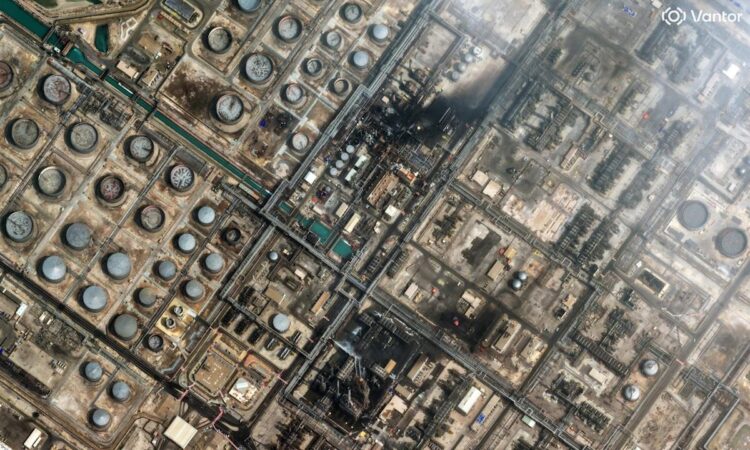
At least two major refineries in Saudi Arabia have also been targeted by Iran. Satellite images showed extensive damage to the country’s largest refinery, Aramco Ras Tanura — which has the capacity to refine 550 million barrels per day — after two drones targeting the facility were intercepted. Video verified by ABC News also showed smoke plumes rising from Saudi Aramco–Exxon’s refinery in Yanbu, leading to a brief pause in crude loadings at the crucial Red Sea port.

Vantor – Damage to Aramco Ras Tanura Refinery in Saudi Arabia on March 2, 2026.
Across the Gulf, ABC News also verified strikes on facilities in Bahrain, Israel, Iraq and Oman. The BAPCO facility in Manama, Bahrain, gave notice of force majeure after being hit in the first week of the conflict. In Oman, multiple silos storing oil were set on fire by air strikes at three different ports. In Iraq, at least two refineries were targeted. Most recently, the Haifa refinery in Israel was damaged by an air attack on March 19, according to Bazan, the group operating it.
Within Iran, Airbus DS satellite imagery revealed damage to the Aqdasieh fuel depot in Tehran following a strike to the area on March 7. In addition to at least nine fuel depots damaged at Aqdasieh, strikes have also targeted at least three other large fuel depots across the country, according to videos verified by ABC News.

Airbus DS and Pléiades © CNES 2025 – Airbus DS Images showing the destruction at the Aqdasieh fuel depot in Tehran, Iran.
Following U.S.-Israeli airstrikes on oil storage facilities in Tehran, the Iranian capital has experienced a dangerous amount of pollution, with acid and toxic rain reported by local authorities. Verified videos show smoke plumes so dark it blocked sunlight following the strikes in Tehran.
While the extent of the damage to the facilities varies, the impact of strikes to the oil sites, combined with the shutdown on the Strait of Hormuz, has rippled across the supply chain, according to Jones-Lux.
“You’ve got damage to facilities, which means supply is permanently lower or will be lower for a while, even if [the Strait of Hormuz] opens. You’ve then got kind of this backlog that you have to get through,” said Jones-Lux. “We’re not getting back to oil prices that we had pre-conflict anytime in the next year, at least.”
ABC News’ Helena Skinner and Gaby Vinick contributed to this report.