About 75 people attended a Thursday night meeting to ask questions, seek information and give their thoughts on the U.S. Environmental Protection Agency and Indiana Department of Environmental Management’s plans to clean up lead in yards of about 160 homes near the former Federated Metals facility.
The EPA held a public hearing at Whiting High School about the Federated Metals superfund site. The Federated Metals property was named a superfund site in late 2023, according to Post-Tribune archives. About 10,000 people live within a mile of the property, and the site is near a bike trail, parks, a church and Calumet College of St. Joseph.

The agency plans to remove soil at properties where sampling found concentrations of lead higher than 200 parts per million.
“This is just for a portion of the site,” said EPA Community Involvement Coordinator Adrian Palomeque. “It’s not the overall final cleanup for the entire site.”
According to cleanup plans, the EPA will remove up to 12 inches of soil underground at selected properties, dispose of the soil at an approved landfill, cover soil with a visual barrier if the site team finds contaminated soil below 12 inches, backfill excavated areas with up to 12 inches of clean topsoil and restore yards.
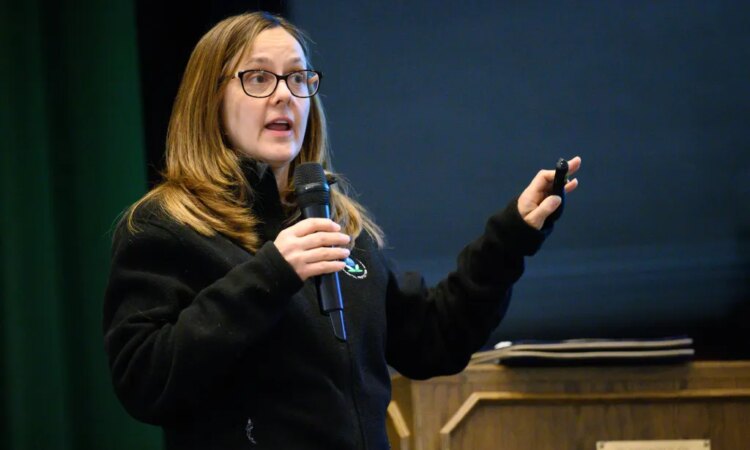
Leslie Patterson, EPA remedial project manager, presented hearing attendees with the agency’s proposed cleanup plan for the area near Federated Metals. Following the about 25-minute presentation, attendees could ask questions for about an hour, followed by less than 10 minutes of public comment.

Christin Nance Lazerus / Post-Tribune
A sign at the former Federated Metals smelting plant on the border of Hammond and Whiting warns visitors to not trespass on an area of the property that is heavily contaminated with lead and other toxic chemicals. The U.S. Environmental Protection Agency placed the property on the Superfund National Priorities List, a list of sites where releases of contamination pose significant human health and environmental risks, in 2023. (Christin Nance Lazerus / Post-Tribune)
Public comment was scheduled for half an hour, but it ended early after no additional attendees wanted to comment. The cleanup plan has already received IDEM approval, and the community engagement portion is the last step before implementation.
Patterson told attendees that the EPA is focused on cleaning residential areas, and they’re concerned about the effects lead has on developing children. Following cleanup of residential areas, the EPA will focus on testing non-residential areas, including George Lake and the former facility. The site is located across George Lake from Lost Marsh Golf Course, which would be in the footprint of the proposed Chicago Bears stadium location.
The EPA’s goal is to clean the facilities closest to the Federated Metals site first, Patterson said, and they’ll shoehorn more properties in, if possible. The agency expects to start digging up soil in about summer or fall 2027, and they’ll move to other properties in later years, Patterson said.
“Unfortunately, we can’t go out there and start excavating,” Patterson said. “You actually have to draw up a little picture of the yard, mark up where all the plants are, and then you need to add access routes and where the trucks are going to go. … There’s just a lot of details that need to be worked out and remedial design.”

Ed Williamson, a Robertsdale resident, said his yard is scheduled to get tested on April 15. He asked EPA staff if that means he’ll be included in the first round of remediation, but Patterson said his cleanup would probably be in 2028 unless the agency can shoehorn his property in.
“It might depend on how high the results are or if there’s sensitive populations at the house,” Patterson said. “Those kinds of things we take into consideration, so I can’t say a simple yes or no. … The first step for anybody is to properly get tested.”
Carolyn Boiarsky, author of “Lead Babies and Poisoned Housing: Environmental Injustice, Systemic Racism, and Governmental Failure,” attended Thursday’s meeting and asked why the EPA is only digging 12 inches into yards.
“At least several years ago, for residential areas, the survey was 24 inches,” Boiarsky said. “Why is that not being done here?”

Zbigniew Bzdak / Chicago Tribune / Chicago Tribune
Jeff Myers (left) and Steve Krajnik were photographed in their Hammond’s Robertsdale neighborhood, which sits in the shadow of the former Federated Metals plant, in this 2018 file photo on Tuesday, May 1, 2018. Lead and arsenic contamination led the U.S. Environmental Protection Agency to label the site a federal Superfund site in September 2023. (Zbigniew Bzdak / Chicago Tribune)
Patterson told her that the EPA uses different depths at different locations, and that by digging 12 inches, the agency is taking into account any time someone plants something new and soil is tossed around.
Maria Rios, a Whiting resident, said she’s concerned about how lead might affect animals in the area.
“Unfortunately, we lost two family dogs within six months,” Rios said. “Is this a concern for our animals? I mean, they might be dogs, but they’re family to us. … I’m pretty sure there’s a lot of families that have the same concerns.”
Patterson said the EPA doesn’t believe that animals are harmed by lead in the soil, and the agency is focused on protecting developing children.

Michelle Arnold, deputy administrator of the Lake County Health Department, told hearing attendees that the department offers lead testing through its mobile clinic and Crown Point location. The health department also provides education and prevention methods to those who are worried about lead.
“If you have kids at home, please just wash their toys, and when coming into your home, it’s best practice to take your shoes off and not walk through your entire house,” Arnold said. “Have a good, balanced diet and little things like that. … The best way to prevent lead exposure is to be aware of it and get tested.”
In June 2025, the EPA announced that it planned to sample 250 homes primarily in the Whiting-Robertsdale area for toxic soil. The agency plans to expand its residential soil sampling to areas north of Lakeview Avenue and Steiber Street, and EPA officials will provide sampling results to property owners who give approval to sample their soil.
Federated Metals was a metal smelting, refining, recovering and recycling facility for about 50 years along George Lake. It was originally owned and operated by Federated Metals Corp. until it was sold to HBR Partnership in 1985 and used by multiple businesses, including Northern Indiana Metals and Whiting Metals, according to Post-Tribune archives. The operation was permanently shut down in 2020.
Smelter operations have emitted lead, arsenic and other heavy metals from their buildings and waste piles, according to the EPA.
Between 2016 and 2018, soil samples taken by the EPA found 163 yards with soil lead levels higher than 400 parts per million, according to Post-Tribune archives, and they’ve found properties with lead levels at least three times above the benchmark.
The agency removed contaminated soil from 33 residential properties in Whiting and Hammond with lead levels above 1,200 parts per million or were home to pregnant women or children younger than seven years old in 2018 and 2019, according to Post-Tribune archives. The city of Hammond launched a soil removal project in 2021, with $5 million in American Rescue Plan Act funds, and by 2024, it cleaned up 69 properties.
The EPA will accept public comments on the cleanup plan from March 16 to April 15, according to its website.