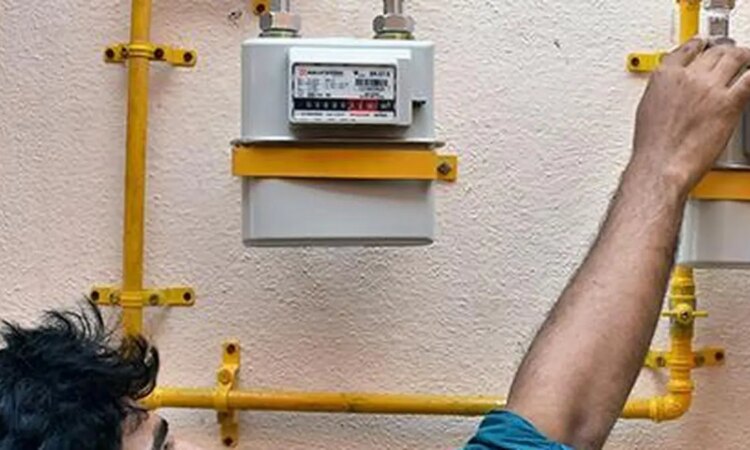
The blockade of the Strait of Hormuz following conflict between the US, Israel, and Iran has directly triggered India’s aggressive push for increasing the availability of Natural Gas and petroleum products. The Natural Gas and Petroleum Products Distribution Order, 2026 has been specifically designed to tackle several historical hurdles that have stalled the country’s transition to a gas-based economy.
What is the government trying to do through the Natural Gas and Petroleum Products Distribution Order, 2026?
The government’s primary goal through this order is to accelerate India’s transition to a gas-based economy by mandating a shift from LPG cylinders to Piped Natural Gas (PNG) where infrastructure is available.
Issued under the Essential Commodities Act, 1955, the order focuses on the following key objectives: Mandatory PNG Transition, LPG Discontinuation, Faster Infrastructure Rollout, Access Rights, and Energy Security.
By promoting PNG, which has a higher domestic production than LPG, the government aims to reduce vulnerability to global supply disruptions, such as those caused by recent conflict in West Asia.
What were some of the challenges in expansion of infrastructure for distribution of gas and petroleum?
The persistent challenges include: Right of Way (RoW) and Land Access, Residential Resistance, Compensation Disputes, Regulatory and Administrative Hurdles, Economic and Financial Barriers, coupled with Technical and Operational Constraints.
Securing the “Right of Way” for pipelines is often the single largest bottleneck for utilities. There have been instances where Resident Welfare Associations (RWAs) and housing societies have frequently denied access for last-mile connectivity in the urban areas.
If it is an agriculture land, then land acquisition from farmers often leads to legal disputes. To the lay the network multiple approvals from various authorities like National Highways, Railways, Forest Department is required which typically takes a year or more. Then there is issue of varying charges and procedures across different municipal corporations that create high administrative friction. Lack of time-bound clearances meant projects could stall indefinitely while awaiting municipal permits.
On the economic front, expanding networks into rural or sparsely populated areas is often not economically viable for private entities due to high capital costs.
Laying underground pipelines in congested urban areas is difficult due to existing water, electricity, and telecommunication lines. Many authorised Geographical Areas (GAs) still lack connection to the national trunk pipeline, leaving them without an assured gas supply.
Will the order address these challenges?
The Order targets these infrastructure bottlenecks by introducing a time-bound, legal framework under the Essential Commodities Act, 1955.
For example, eliminating approval delays. Public authorities must grant “Right of Way” (RoW) or pipeline permissions within a fixed timeline. If they fail to respond, the approval is automatically considered granted. To ensure authorities don’t simply ignore applications, the rules include strict protocols as well.
The order moves oversight from local bodies to central and quasi-judicial authorities. There will be Nodal Agency Monitoring by the Petroleum and Natural Gas Regulatory Board (PNGRB) to ensure local authorities aren’t blocking progress through inaction.
While it helps gas companies, it also penalises them, if after receiving approval, the entity fails to start work within four months. The company faces penalties and may lose their exclusive rights to that area. Simply put, the order replaces fragmented local rules with a uniform national framework, reducing administrative discretion and complexity across different jurisdiction.
Why is the Centre trying to shift people from using LPG to PNG?
The move is primarily to strengthen national energy security and reduce the massive import bill. India imports approximately 60 per cent of its LPG, with nearly 90 per cent of those imports passing through the Strait of Hormuz.
Unlike LPG which arrives via ship and truck, PNG is delivered through fixed underground infrastructure that can be fed from diverse sources, mostly domestic fields and multiple import terminals, making it far more resilient to global shocks.
By forcing consumers with pipeline access to switch to PNG, the government can redirect limited LPG stocks to rural and remote regions where laying pipelines is not economically viable. In major metros, PNG is currently roughly 12 per cent to 15 per cent cheaper than non-subsidised LPG. Besides, Consumers pay only for what they consume, eliminating “dead stock” left in cylinders and the need for upfront lump-sum payments.
A typical household consumption for 4–5-members is about 15 standard cubic meters per month. One domestic LPG cylinder is 14.2 kg LPG. While the PNG billing is bimonthly and based on “use and pay” based on consumption, LPG is a fixed rate.
How will the larger issue of gas availability be addressed?
The shift to PNG while gas supplies are tight may seem contradictory. But the government is using a Priority and Efficiency strategy to make it work.
For example, Mandatory Sectoral Prioritization done under the Natural Gas Control Order, 2026. Domestic PNG and Transport (CNG) now have the first right to all available gas (both domestic and cheap long-term imports). Experts say, it takes far less gas to power a kitchen than a factory. LPG is actually a heavier and more expensive fuel to manage than Natural Gas. The shift will also help in Supply Chain Savings.
Every urban household that shifts to PNG frees up a cylinder for a rural household where pipelines can’t reach. This balances the total energy basket without needing an immediate 100 per cent increase in total gas volume.
According to information available as of March 2026, India has crossed 1.6 crore (16 million) domestic Piped Natural Gas (PNG) connections. The government aims to reach 5 crore (50 million) domestic PNG connections by 2030.
The gas for PNG and CNG comes from two main pools: Domestic administered price gas and Imported gas.
Gas produced from domestic fields is sold at regulated, lower prices. Under the Order, 100 per cent of this gas is diverted to City Gas Distribution (CGD) companies. India has secured 20-year contracts with countries like the UAE and Qatar. This gas is ring-fenced — it cannot be sold to factories until the needs of homes and cars are met.
The government is mandating that domestic fields (like those in the KG Basin) prioritize City Gas Distribution (CGD) companies. Previously, gas producers sold to the highest bidder, mostly power plants. The government is shrinking the gas pool for industry to ensure the domestic PNG pool remains full.
India already produces 92 MMSCMD of natural gas domestically out of a total daily requirement of 191 MMSCMD. City gas distribution has expanded from 57 geographical areas in 2014 to over 300 today, according to the government.
Published on March 27, 2026