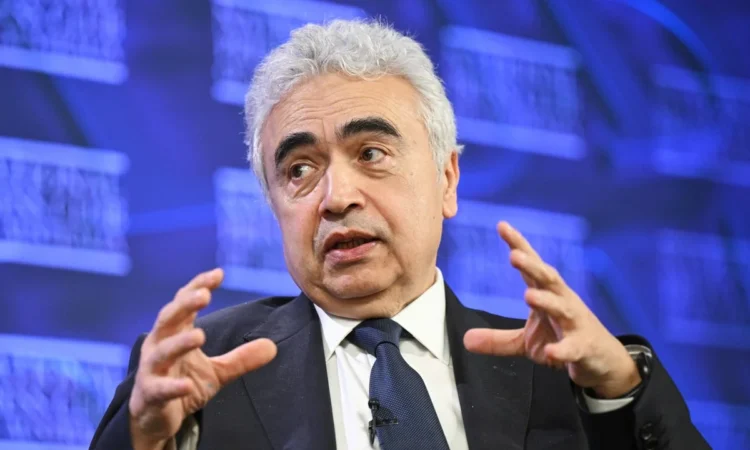
The global energy crisis sparked by the US-Israeli war on Iran could accelerate a shift towards renewable and nuclear power, the head of the International Energy Agency said.
Fatih Birol said the current shock, driven by Iran’s closure of the Strait of Hormuz in retaliation for the attack, would reshape the global energy system.
“There are reasons to be optimistic,” Mr Birol said in an interview with Le Figaro, arguing that the crisis would speed up investment in cleaner energy sources.
Renewables such as solar and wind could be deployed relatively quickly, he said, meaning many countries could begin shifting away from fossil fuels within months. He, however, cautioned this would not resolve the current crisis.
“It will take years,” he said, “but the geopolitics of energy will be profoundly transformed.”
Mr Birol said the scale of the disruption was unprecedented, describing it as more serious than the crises of 1973, 1979 and 2022 combined.
On Wednesday, the US and Iran agreed a ceasefire that could reopen the Strait of Hormuz, a critical maritime route through which nearly 20 per cent of global oil and gas supplies pass, providing some relief to the markets. However, the number of vessels transiting the waterway is expected to be far lower than before the war.
“The world has never experienced a disruption to energy supply of such magnitude,” Mr Birol said.
(Getty)
Member nations of the International Energy Agency are already releasing strategic reserves in an effort to stabilise markets.
While the impact was set to be felt globally, Mr Birol warned, developing nations were particularly vulnerable.
“They will suffer from higher oil and gas prices, higher food prices and a general acceleration of inflation,” he said.
He warned of the risk of a “black April” if the strait continued to remain closed, with global markets potentially losing far greater volumes of oil and refined products.
The waterway is not only vital for oil and gas shipments but also for commodities such as fertilisers, raising the risk of knock-on effects on global food prices.
Previous energy crises – in 1973 and 1979 following oil embargoes, and in 2022 after Russia’s invasion of Ukraine – reshaped global markets.
Mr Birol said the current shock could produce an even deeper and more lasting impact, accelerating changes already underway in the global energy transition.