Daniel Munch
Economist
Shelby Hagenauer
Senior Director, Government Affairs
Key Takeaways
- Snowpack across much of the Western U.S. is well below historical averages, limiting runoff and tightening irrigation supplies heading into the growing season.
- Western agriculture plays an outsized role in the production of fruits, vegetables and tree nuts while maintaining a substantial share of dairy, cattle and wheat output.
- Farmers and ranchers face difficult decisions this year amid ongoing uncertainty around water availability across the West.
With snowpack running well below normal in many basins in the Western U.S., expected and much-needed runoff is limited, reducing the water available for irrigation and rangeland. Reduced water allocations for irrigated farmland, tighter forage supplies and elevated drought risk all increase the likelihood of difficult production decisions in the months ahead.
Western Agriculture’s Role in the U.S. Food System
Western agriculture plays a central role in U.S. food production, spanning both high-value specialty crops and key livestock and field crop systems. Across 12 Western states, the region accounts for the majority of U.S. fruit, vegetable and tree nut production by value — typically over 70% overall and more than 90% for many individual commodities. At the same time, the region supports a significant share of U.S. cattle and calf inventories, dairy production, wheat and hay output — all of which are closely tied to forage conditions and irrigation reliability. Production is distributed across diverse systems, from irrigated specialty crops in the Southwest and Pacific states to rangeland-based livestock and dryland wheat across the Mountain West and Northern Plains.
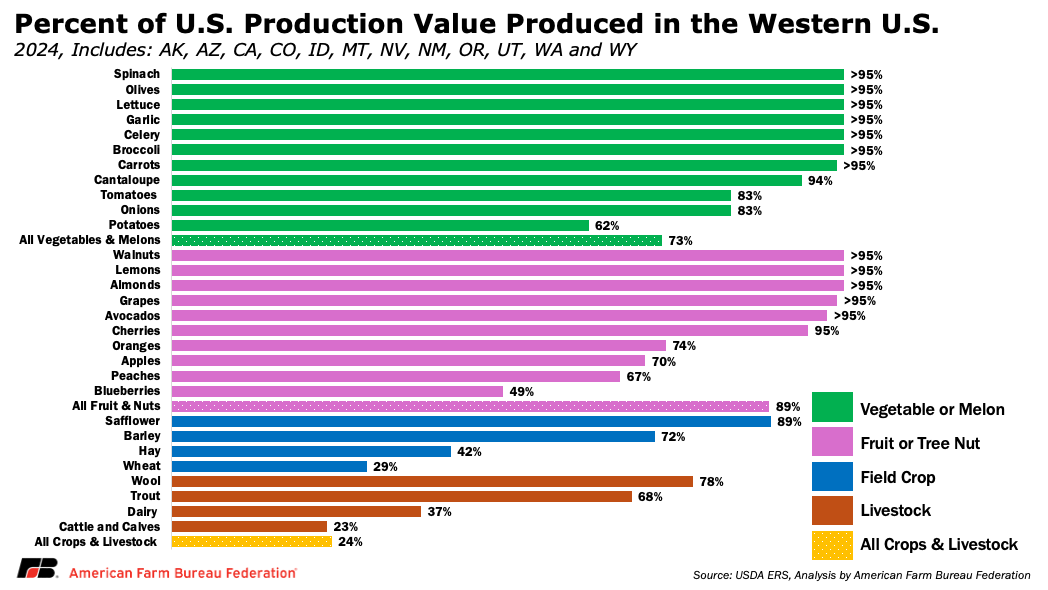
The major similarity across these disparate landscapes is their dependence on snowmelt-fed surface water. In many Western states, snowmelt supplies as much as 75% of total water availability, making winter snow accumulation a critical determinant of how much water is available later in the year. Much of the region does not receive enough in-season rainfall to support consistent production on its own, so irrigation supplied by river systems like the Colorado, Columbia, Sacramento and San Joaquin is what stabilizes output year to year.
For most of these crops, the practical alternative to Western production is not a quick shift to other U.S. growing regions, but greater reliance on imports. That matters because imported supply can be more exposed to trade disruptions, transportation costs and differing production standards, while offering less domestic control over timing, volume and quality. The U.S. already imports roughly 35% of its fresh vegetables and nearly 60% of its fresh fruit, with a significant share of supply concentrated in a small number of trading partners. Over time, even temporary supply gaps can lead to more durable shifts in sourcing relationships, as buyers establish new suppliers and supply chains that may not quickly revert once domestic production recovers.
In that sense, Western agriculture does more than add supply; it helps anchor a stable domestic supply of nutritious foods consumers rely on every day.
Snowpack Shortfalls Signal Weak Runoff Potential
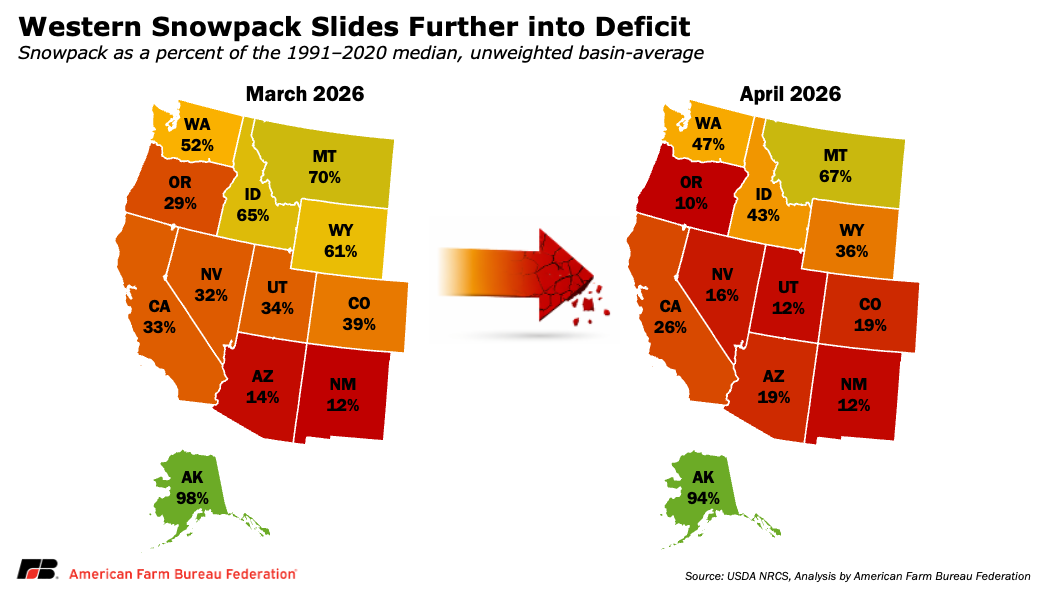
Snowpack across much of the Western U.S. entered April well below historical norms, raising concerns about water availability during the critical irrigation season. Basin-level conditions vary, but much of the region is now tracking between roughly 10% and 50% of the median. Several key states, including Utah, New Mexico and Oregon, are reporting snowpack near or below 10% to 15% of normal, while even traditionally stronger northern basins remain below average.
Comparing April to March values shows conditions have worsened across much of the region. In Oregon, snowpack fell from roughly 29% of median in March to just 10% in April, while Utah dropped from about 34% to near 12% and Colorado from around 39% to 19%, further limiting runoff potential heading into the spring melt period.
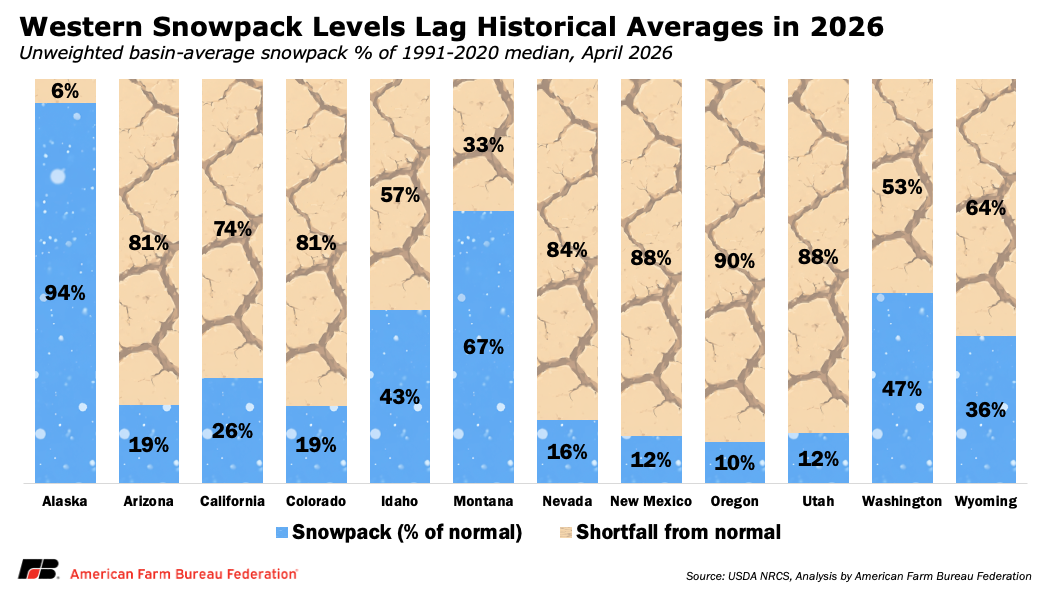
Mountain snow accumulates through winter and releases gradually during spring melt, supplying rivers, reservoirs and irrigation systems such that it is often described as a “frozen reservoir.” That same slow release is also critical for soil moisture recharge, supporting pasture, rangeland and hay production as temperatures rise. When snowpack underperforms, both the timing and volume of runoff shift unfavorably; with earlier melt, there are reduced late-season flows and less total water available.
Current conditions point to elevated risk across many major river basins in 2026. Below-normal snowpack, combined with warmer and drier spring conditions, has accelerated melt and reduced runoff efficiency. In response, water managers are issuing conservative initial allocations in many regions, reflecting uncertainty around how much water will ultimately be available. That leaves farmers making planting decisions now without knowing whether sufficient water will be available to carry crops through harvest.
In the Colorado River Basin, those constraints are especially impactful. The 250,000 square mile basin supports roughly 5.5 million acres of farmland, more than $10 billion in annual agricultural production and major population centers like Phoenix and Las Vegas, making water availability a central driver of both agricultural output and regional stability. In addition to providing water storage, the major dams on the river, Glen Canyon and Hoover, generate critical hydroelectric power, which keeps the lights on in many Western states.
Water managers are facing difficult decisions this year on how to manage a very constrained resource, with the key metric of unregulated inflow into Lake Powell projected to be historically low. Longer-term, the operating agreements for managing water in the Colorado River Basin expire in 2026. With no agreement yet in place among the seven basin states and the federal government on how to manage the river when supply is short, the basin enters this year with both limited water supplies and limited long-term certainty.
Drought Tightens the Margin for Agricultural Production
For farmers and ranchers, drought does not show up as a single shock. It compounds across the business, tightening margins and forcing a series of difficult tradeoffs that shape both near-term production and longer-term capacity.
On the crop side, reduced water availability directly limits how much can be planted, irrigated or brought to harvest. In irrigated systems, smaller allocations often mean prioritizing higher-value acres while idling others. In perennial systems like orchards and vineyards, the stakes are even higher. When water is insufficient, farmers may be forced to remove trees or vines, sacrificing years of investment and future production potential to preserve the long-term viability of the operation. During the height of drought conditions in 2022, roughly one-third of crop farmers reported the removal of orchards or other multiyear crops as prevalent in their area, underscoring how quickly water shortages can translate into long-term production losses.
For livestock producers, pressure builds quickly as forage conditions deteriorate, forcing greater reliance on more expensive purchased feed and, in some cases, additional water hauling. As costs rise, the economics can shift rapidly, making herd reduction the only viable option. Those decisions extend beyond the current year. A smaller breeding herd means fewer calves in future seasons, and rebuilding takes time, often requiring multiple years between retention and realized supply.
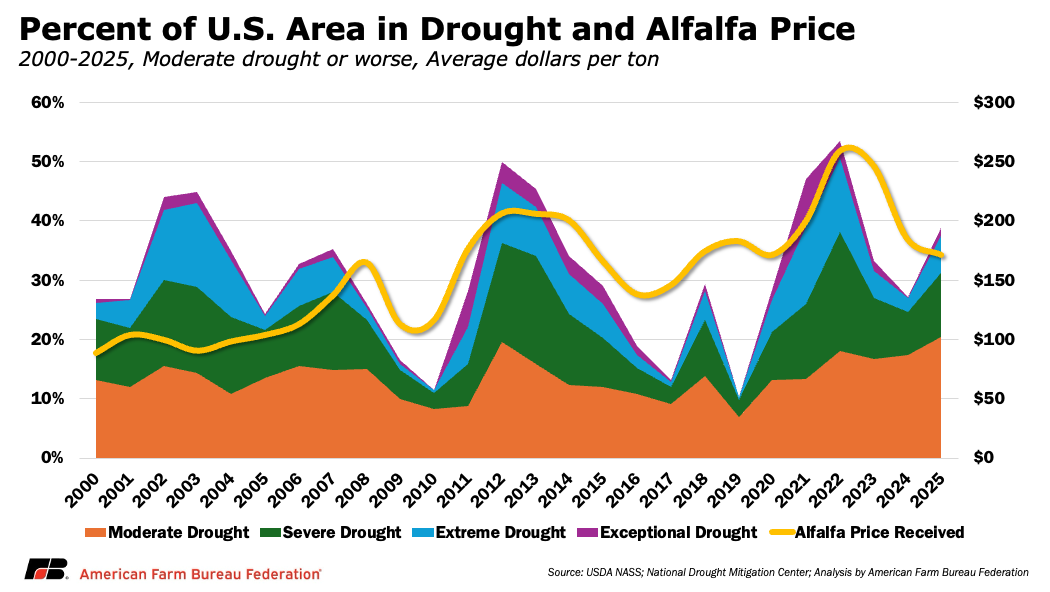
Recent years highlight how quickly this can unfold. Drought was a key driver of herd liquidation from 2021 through 2023, pushing cattle inventories to multi-decade lows. While cattle prices are currently strong, expansion depends on the ability to carry animals at a reasonable cost. When forage is limited and feed must be purchased at elevated prices, the cost side of the equation can outweigh favorable price signals. Without improvement in pasture and water availability, the ability to rebuild the herd remains constrained despite strong market prices.
These decisions also carry a human cost. Liquidating breeding animals often means selling genetics built over decades, with limited ability to recover those gains in the short term. What appears in aggregate data as “herd reduction” reflects thousands of individual decisions made under pressure, where preserving cash flow in the short run can come at the expense of long-term productivity.
Taken together, drought does more than reduce output in a single season. It reshapes production capacity, delays recovery and increases the volatility of food supply in the years that follow.
Conclusion
Western agriculture is uniquely dependent on water supplies managed and allocated through shared river systems and policy frameworks, and when those supplies fall short, the impacts extend well beyond a single season. Acreage shifts, orchard removal and herd liquidation shape production capacity for years to come, while constrained output cannot easily be replaced elsewhere in the U.S. Instead, supplies tighten, markets adjust and reliance on imports can increase. Absent meaningful improvement in water conditions, Western agriculture is likely to face another year defined by constrained supply, difficult production decisions and limited ability to rebuild capacity lost during recent drought cycles.