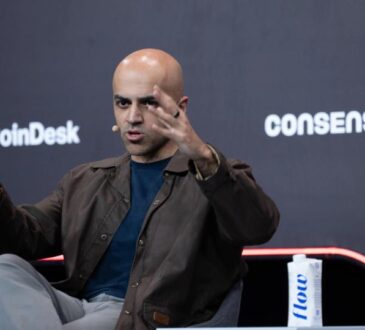

From left: Nicole Glaros, Chris Erickson and Seth Levine.
For Chris Erickson, co-founder of Denver venture capital firm Range Ventures, 2025 was a good year.
“Last year was easily the busiest year we’ve had from deal flow, deals that we did and just what we saw across the entire Colorado ecosystem,” said Erickson, who started Range with Adam Burrows in 2020.
In 2025, Range invested in seven new companies and put additional money into four businesses within its existing portfolio, which primarily focuses on software and tech firms. Erickson and company have invested about two-thirds of their $39 million Fund II, which Range announced in 2024.
But not every VC’s year was as busy as Erickson’s.
Things still haven’t come back to the heyday of 2020, 2021 and 2022, when interest rates were near zero and venture capital investment was at an all-time high. Erickson said 2025 represented a turn toward normalcy, even though the markets for initial public offerings and mergers and acquisitions between private companies still leave something to be desired.
“Everything takes slightly longer than you think it’s going to until it happens,” he said. “All those things are trending in the right direction.”
According to data from industry intelligence firm PitchBook, the $250 billion that young companies across the country raised through the third quarter last year has already surpassed totals from each of 2022 through 2024. But much of that money has been concentrated in larger deals around artificial intelligence firms.
Two Colorado companies were prime examples of this. In the fall, Crusoe, the Denver-based firm that makes data centers for artificial intelligence companies like OpenAI, announced it raised $1 billion of an eventual $1.4 billion round.
Boom Supersonic, which was founded in 2014, raised $300 million at a $1.5 billion valuation, according to previous BusinessDen reporting. The money will be used to build turbines for data center energy — a pivot for the company still attempting to make affordable fast-speed commercial travel a reality.
Boom’s first customer? Crusoe, which expects to receive its first of 29 eventual turbines in 2027.
“AI clearly is the black hole of capital right now. It’s sucking much of the energy,” said Nicole Glaros, a partner at the Boulder-based firm Matchstick Ventures.

Boom Supersonic is pivoting to data center energy production with its Superpower turbine. (Courtesy Boom)
Glaros, a former Techstars veteran who started at Matchstick in the spring, said local chipmaker Great Sky is one company to watch; her firm invested in the Golden business last year. Erickson said MagicSchool, the Denver-based AI ed-tech company that raised $45 million nearly a year ago, is the fastest growing business he’s ever seen.
“You’d be hard-pressed to find a company that isn’t leveraging AI in some way. And I think that’s really exciting, right?” Glaros said. “It’s also really scary because everything is changing really quickly.
“There’s an amazing opportunity to generate great returns for our investors,” she continued. “And there’s also an amazing opportunity to lose a bunch of money.”
Colorado’s startup scene is more than just AI, though.
The state’s quantum industry is internationally recognized and has a 70-acre facility in Arvada meant to be a hub for the technology. Last year, Broomfield-based Quantinuum raised $600 million at a $10 billion valuation to continue building out its computers. Maybell Quantum, the Denver quantum infrastructure startup, announced a $40 million raise in September. And Boulder-based Infleqtion went public by merging with a special purpose acquisition company, commonly known as a SPAC deal, at a $1.8 billion valuation.
Colorado is home to some of the most renowned research institutions in the country, such as Golden’s National Laboratory of the Rockies, formerly the National Renewable Energy Laboratory. Erickson and Glaros said defense and space are two premier industries to watch as well.
“This year, it’s not only the emergence of Colorado deep tech but the dominance of CO deep tech across a bunch of categories,” Erickson said. “Whether it be quantum or space or robotics, we have a very strong reputation that’s only growing.”
The fundraising market for venture firms themselves remains a bit bleaker, he and Glaros said. Seth Levine, a founding partner at Boulder legacy firm Foundry Group, echoed the same, citing a lack of liquidity as the main reason.
Without a robust IPO market, the capital held up in later-stage private companies remains stagnant, Levine said. In an ideal world, those companies would seek additional investment from public markets, leading to a return for those who invest in venture firms and allowing the firms to raise more funds in the future.
Although 2026 could see private titans SpaceX and Anthropic go public, Levine said he doesn’t think the IPO picture overall will change drastically.
Levine, who started Foundry in 2007 alongside Brad Feld, Jason Mendelson and Ryan McIntyre, won’t be raising any new funds with his group. But he’s still deploying what’s left of a $500 million fund. He also advises venture firms and has his own startup, GoodBread, which makes loans to small businesses. He recently published “Capital Evolution” – his second book in recent years.
Another challenge is Colorado’s impending AI law, which seeks to protect consumers from AI-system discrimination. It passed in the 2024 legislative session, but lawmakers and industry leaders denounced it soon after. They vowed to amend it in 2025, but didn’t.
The law was supposed to take effect this Feb. 1, but that got pushed back to the summer to give legislators more time to hammer out a deal.
Erickson said his partner Adam Burrows is part of a mediation group meeting since the fall to prepare for the legislative session, which begins Jan. 14. President Donald Trump signed an executive order last month aiming to block states from passing AI regulations, but it is unclear how that will affect Colorado’s law, Erickson said.
“I think what Colorado is doing is absolutely stupid,” Levine said. “And what we are doing is we are telling technology businesses … that they are not welcome to do business in Colorado.”