
-says 15 new processing facilities, expanded market access, major financing support positioning Guyana as a regional food-production hub
AGRO-PROCESSING infrastructure is expanding beyond Guyana’s coast with the establishment of 15 new agro-processing and packaging facilities across multiple regions, according to Minister of Agriculture Zulfikar Mustapha, who has signalled the government’s aim to boost value-added production and open up opportunities for farmers to access regional and international markets.
The minister made these remarks during a recent video address in which he highlighted government’s economic diversification strategy.
“Today, across the country, we are seeing processors who are creative, determined and committed to transforming our local produce into high-quality products, whether it is pepper sauce, cassava flour, fruit mixes, coconut product, or any of the new lines emerging across our region, our agro-processors are proving that Guyana has what it takes to compete and to win.”
To support this momentum, he said there has been the construction or retrofitting of 15 agro-processing and packaging facilities in various regions, including Regions One, Two, Six, Seven, Nine and 10, among others.
With that said, the minister pointed out that it is evident that the developments are not only occurring in the urban areas alone, but across the country.
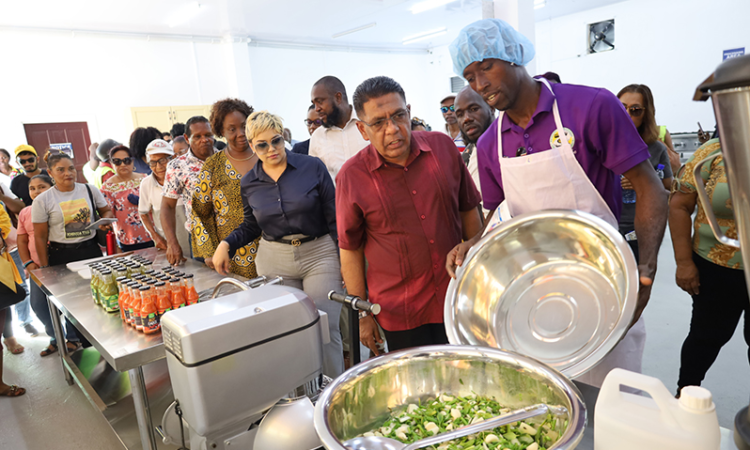
These facilities are now being used to produce and package cassava bread, pepper sauce, green seasoning, coconut oil, jams, coconut flakes, and many other value-added products that reflect the richness of Guyana’s agriculture, Minister Mustapha stated.
“Our strategic focus now is to build a vibrant value-added industry and expand market access. This includes completing the food hub supporting food, pulp, juice and coconut-based industries, and promoting certification so that our products can enter regional and international market,” he added.
The agriculture minister then shifted his attention to the government’s target to strengthen the domestic market through expanded Guyana shop outlets.
“Now, let me be clear, going forward, Guyana will be positioned as a major food-producing hub in the region,” he said.
The plan revolves around building the next generation of Guyanese food brands that stand proudly in supermarket shelves across the Caribbean and beyond, the minister said, while emphasising that the People’s Progressive Party/Civic (PPP/C) government’s ambition is “bold and achievable.”
The minister also noted that the government has invested in a cassava-processing facility at Parika, which will support more than 200 farmers by purchasing fresh cassava and producing over three tonnes of cassava flour per day. This facility will become operational in early 2026 and will help promote a healthier and locally produced alternative to imported flour.
Over the past month, he said there has been engagements with ANSA McAL and Massy Stores to create new opportunities for Guyanese products to reach supermarket shelves across multiple Caribbean destinations.
“These partnerships open doors, but it is now up to our agro-processors to seize these opportunities and scale up production,” he stated.
With the government committed to converting Guyana into a leader in value-added food production and producers requiring access to capital, Minister Mustapha said this is where the Guyana Development Bank stands as a critical pillar of this transformation.
Micro, Small and Medium Enterprises (MSMEs) will be able to access up to $3 million in zero-collateral loans through this bank, which is expected to become fully operational before the end of the first quarter of 2026 and will receive an initial injection of US$200 million from the government.
“This is the missing link in the value-added, chain-affordable financing that empowers our people to produce, innovate more and earn more,” the minister stated.
Additionally, to accelerate this transformation, the government has extended to agriculture and agro-processing, the same fiscal space traditionally reserved for health and education, Minister Mustapha said.
He first pointed to the removal of corporate tax within agriculture, along with the implementation of unprecedented incentives that cover a number of elements from primary production to manufacturing, packaging and distribution, and fertiliser.
Beyond tax relief, the government went a step further by directly supporting producers with the provision of free fertilisers, planting materials, and shade houses.
“We are building a system that gives every processor a fair chance to compete globally as part of our broader diversification agenda,” he minister said, adding, “We are building infrastructure, the partnership and the market pathway; now together, we must build the product, the scale and the global present that will define Guyana as a leader in value-added food production.”
GUYANA BECOMING A REGIONAL LEADER
Last week, President, Dr Irfaan Ali had said that Guyana is positioning itself to become the Caribbean’s leading food production and distribution hub, as the country leverages its raw agricultural output, expanding agro-processing capacity and major infrastructural investments to reach global agro-industrial scale.
Speaking on the country’s long-term development strategy, President Ali noted that the wider Caribbean Community (CARICOM) region is increasingly looking to Guyana to play a central role in ensuring food security.
He explained that this ambition is closely tied to strategic partnerships, including with Brazil’s Roraima state, which has significant agricultural capacity on a global scale.
“The entire CARICOM region is now looking at Guyana as the production and distribution hub for food, and this is closely integrated with Roraima because whilst we are building out the mega farms, it’s important that we have a partnership with a state like Roraima. That is huge in agriculture, and their productive capacity is at a global scale,” he said adding,
“We are now leveraging that advantage to add value and create new wealth through agri-processing opportunities.”
He highlighted too recent investments aimed at strengthening the entire food ecosystem, from production to processing, storage and distribution.
Among them is the abattoir at Onverwagt, which is capable of processing between 60 and 100 animals per day, supported by the ongoing development of cold-storage facilities.
“We now have the food ecosystem being developed to support large-scale processing, production, storage, and distribution. So, we are also building out the infrastructure. We’re
talking about the airport at Lethem, so we can export directly to the Caribbean. We are looking at creating an agro-industrial hub in Lethem to bring raw produce, add value, and handle all packaging for the Caribbean and North American markets, “he explained.
According to President Ali, these initiatives are part of a broader, integrated plan to modernise agriculture and scale up exports.
Looking ahead, President Ali expressed confidence that agriculture, alongside tourism, will drive unprecedented growth over the next five years.


