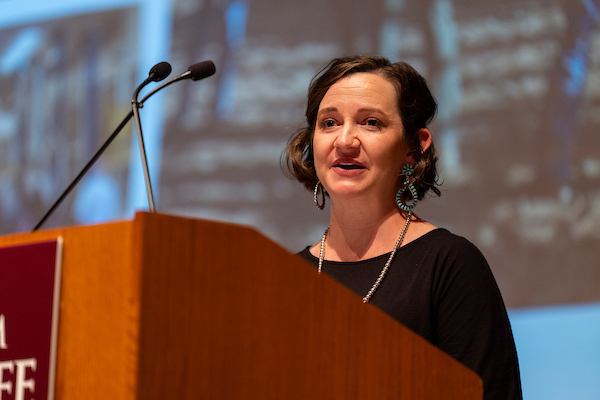
Food and agriculture shape the stability of nations, economies and communities. Shannon Norris Parish ’20, Ph.D., assistant professor in the Texas A&M College of Agriculture and Life Sciences Department of Agricultural Leadership, Education and Communications, is working with the military to see how these systems are also essential to national defense and security.

Parish studies how agricultural literacy and social science contribute to national defense by influencing conflict, stability and long-term resilience. Agricultural literacy goes beyond knowing where food comes from.
According to the American Farm Bureau Foundation for Agriculture, agricultural literacy includes understanding who produces food and how agriculture shapes the economy, environment, technology and daily life, as well as its connection to livestock.
Parish’s work — developed for the U.S. Department of Homeland Security, the U.S. Army Special Operations Command and emergency response teams — applies those insights to real world challenges. It helps military planners, first responders and communities strengthen food systems that are more resilient and secure, both locally and globally.
Parish sat down with AgriLife Today to discuss her research and why food systems enhance modern security and defense strategies, and why agricultural literacy matters more than ever.
Why is food security a national security issue?
Food and agriculture systems are the backbone of a stable society. When those systems weaken or collapse, communities become vulnerable. Food security isn’t just an agricultural concern; it should be a cornerstone of national defense and national security.
An informed and food-secure population creates a more stable nation, from local communities to the global stage.
“The word “agriculture” literally contains the word “culture.” No matter where you are in the world, the common denominator in any society is people. The more we understand people, the better we can help strengthen their food systems, and ultimately, their stability.”
Shannon Norris Parish ’20 , Ph.D.
assistant professor
What can happen when a society becomes food insecure?
When a society becomes food insecure, the risk of conflict rises. It then creates opportunities for individuals to exploit instability.
In some situations, there are indicators of causality where, if a nation or a culture is food insecure – whether from drought, economic collapse, displacement or conflict – the likelihood of unrest increases, disrupting the standard of that society or culture.
Strengthening food security is a long-term strategy for reducing these risks. However, this endeavor is not easily obtained.
Many scholars and practitioners across generations have devoted their lives to achieving secure food systems. Food insecurity is a wicked problem that must be approached with an interdisciplinary focus. Similarly, it must be sustained once it is achieved.
How did the U.S. Army use your research on agricultural literacy and social science?
I worked with soldiers in the U.S. Army 5th Special Forces Group-Airborne to create an assessment framework for the U.S. Army Special Operations Command that elevates food insecurity from a minor consideration to a key stability indicator.
My research on this topic is currently pending publication and was overseen by my chair was Holli Leggette, Ph.D., associate professor. My thesis committee members were assistant professor Tobin Redwine, Ph.D., associate professor Lori Moore, Ph.D., professor Gary Briers, Ph.D., and Danny Davis, Ph.D., professor of practice and director of the Graduate Certificate in Homeland Security at The Bush School of Government and Public Service.
When military personnel evaluate a community, this tool is designed to prioritize food security with other key operational considerations, such as political, social and economic factors. With this perspective, instead of being a small element in a larger picture, food security becomes a major priority for assessing the stability of a community.
Where do the social sciences fit into this work?
Social sciences provide a human connection. Agricultural communications, my area of research, is an applied form of science communication that helps people understand how food systems function and how decisions affect them.
The word “agriculture” literally contains the word “culture.” No matter where you are in the world, the common denominator in any society is people. The more we understand people, the better we can help strengthen their food systems, and ultimately, their stability.
You also train first responders and agencies for agricultural emergencies. What does that involve?
In partnership with the Southwest Border Food Protection and Emergency Preparedness Center through the National Animal Disease Response and Preparedness Program, we train law enforcement, federal agencies, agricultural educators and emergency managers to respond to agricultural emergencies – many of whom have little or no agricultural background.
The training provides a working understanding of the food system, so they know what to look for and who to contact during an agricultural crisis, whether it’s a disease outbreak, biosecurity threat or livestock incident.
For example, if a cattle trailer tips over on the freeway or responders encounter a livestock disease risk, we want them to recognize key issues quickly and bring the right experts on board in response to that emergency.
How does this work strengthen communities in the U.S. and abroad?
When communities build their own food production capacity and agricultural literacy, they become less dependent on outside actors. That improves stability, boosts security and lowers the risk of conflict. It is a similar principal to what Norman Borlaug championed through the Green Revolution: agricultural innovation can build peace by reducing hunger.