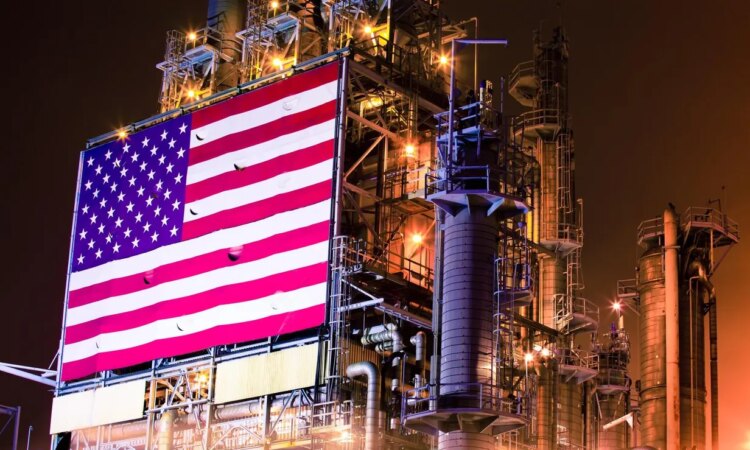

American energy policy’s unabashed re-embrace of fossil fuels is one of many trends to watch in 2026.
getty
The rise of AI, the shift from renewables to fossil fuels and nuclear, and other changes in Trump Administration policies indicate that 2026 will continue to reshape U.S. energy. The growing focus on energy as a national security instrument is driving a chain reaction, shifting priorities across sectors, easing restrictions, and prioritizing the expansion of conventional energy infrastructure. In 2026, nuclear energy and reactor development, as well as grid build out, will be at the forefront, generating winners and losers in capital markets.
Data Centers, such as this one pictured in Northern Virginia, can be expected to grow in 2026.
Getty Images
Growing AI Data Centers Reshaping the U.S. Market
The rapid expansion of AI data centers in 2025 will remain a dominant trend. Competition, especially from China, is prompting the U.S. to strengthen its position in this top-priority high-tech industry. The substantial computational power and energy required for AI development will sharpen the focus on investing in new infrastructure to maintain America’s competitive edge. Expect AI development to drive growing electricity demand.
Advanced Private Funding in Nuclear Energy
One of the most notable shifts in U.S. energy policy will be increased private-sector funding for nuclear energy research and development. The administration has made efforts to publicize its growing interest in nuclear, but hasn’t done enough to ensure appropriate spent-fuel storage and reprocessing, or to trim overregulation, to make nuclear power profitable.
Small modular reactors and microreactors are the primary focus of private investment in nuclear energy research. They offer an efficient way to generate energy compared with large-scale infrastructure, though the price per kWh remains high.
As nuclear becomes increasingly vital to U.S. national security and competitiveness, private investment will bridge gaps left by federal funding, driven by the sector’s growth, rising visibility, and the promise of future financial returns. In late 2025, nuclear engineering companies such as the Bill Gates/HD Hyundai nuclear energy play TerraPower and X-energy, focused on high-temperature gas-cooled reactors, secured combined investments exceeding $1 billion from private investment firms, including NVentures, NVIDIA’s venture capital arm, for TerraPower, and Jane Street for X-energy.
The expansion of American nuclear power has stalled significantly in the last 30 years. That trend may be ending.
AFP via Getty Images
Pressure to Build Out the Energy Grid Will Intensify
AI’s advance is intensifying pressure on the U.S. energy grid. Data centers are creating unprecedented electricity demand and grid development needs that will affect the market in 2026. Current grids are already experiencing strain as power demand outpaces infrastructure development, raising the risk of bottlenecks. Grid congestion, arising when electricity transfer capacity is not enough to transmit all available power from one point another, combined with grid development capacity that cannot currently meet AI development needs, may lead to increased market volatility and electricity price spikes in 2026.
States such as Texas, Virginia, and Georgia have become the focus of new grid development. The need for electricity is already driving up regional prices. Meanwhile, opposition to expansion from environmentalists in these states, as well as national environmental groups, may exacerbate supply-chain issues and grid congestion. In 2025, states leading in data center development, such as Virginia and Texas, experienced increased community opposition, contributing to delays in projects worth nearly $100 billion. Amazon faced snarls in data center development, with the Virginia Board of Supervisors halting negotiations. The pace of development will play a critical role in energy market stability in 2026 and beyond.
Regionalization and Fragmentation Will Increase
Regional politics will play an increasingly decisive role in U.S. energy sector development trends in 2026, as restructuring of the national energy landscape draws attention to areas such as the Midwest, where “the world’s most powerful AI datacenter” is projected to go online in Wisconsin in 2026.
States are asserting increasing autonomy over grid development and governance, reflecting the rapid growth in electricity demand. Leading this phenomenon is the Electric Reliability Council of Texas (ERCOT), which supplies nearly 90% of the state’s electricity. Although not entirely isolated from interstate grids, ERCOT essentially operates as an isolated entity to avoid federal oversight. This limits its ability to import power during periods of emergency demand, reinforcing a regionally bound supply model. With Texas serving as the nation’s largest energy producer and electricity demand rising substantially, ERCOT may further leverage its role as an electricity powerhouse.
Increased difficulties, such as transmission backlogs, have contributed to the growth of regional cooperation and interstate compacts. These will be central to the relationship between energy development and regional politics in 2026. An example of interstate coordination is the Midcontinent Independent System Operator. MISO is a nonprofit independent system operator and regional transmission organization that coordinates the operations of the high-voltage electric grid and wholesale electricity markets across fifteen states in the U.S. Midwest and South and the Canadian province of Manitoba, conducting transmission planning to ensure the grid meets reliability and economic needs in the short and long term, including an Expansion Plan process with five- and twenty-year time horizons.
In addition, natural gas availability is the key to electricity generation. Legislation passed by the House of Representatives in early December 2025 signals federal support for the build out of critical interstate energy pipeline infrastructure projects by establishing a more efficient regulatory pathway. H.R. 3668, Improving Interagency Coordination for Pipeline Reviews, sets approval deadlines for the Federal Energy Regulatory Commission. This legislation will have to move forward in 2026 to clear the way for comprehensive proposals to be put on the table.
Venezuelan and Iranian Oil Keeps Global Prices Contained
The recent capture of Venezuela’s President Nicolás Maduro will impact U.S. and global energy markets in 2026. Venezuelan oil production remains far below historical levels. At less than 1 million barrels per day, the country’s output is no longer sufficient to influence global markets. However, as President Trump seeks to involve U.S. oil majors in reviving the sector, which deteriorated significantly under Hugo Chávez and Maduro, a future increase is likely. Caracas will need to undertake much-needed legal, regulatory, and technological reforms.
The reintroduction of Venezuelan oil into a market already characterized by high U.S. output, along with U.S. refineries’ ability to process Venezuelan heavy crude, can increase overall supply. Similarly, if the regime in Tehran falls and sanctions are lifted, Iran will be able to supply an additional 500,000 barrels a day within a year, and eventually more.
Looking a bit further forward, Venezuelan crude can compete most directly with Canadian oil sands producers, and American control can divert oil from Chinese refiners to U.S. refiners. Combined with potential U.S. influence over Iranian oil policy if the theocratic dictatorship falls, this could be a painful blow to Beijing’s efforts to build an independent petroleum supply chain.
As for 2026, it is difficult to see how the mullahs will stay in power in Iran given the collapsing economy, failing infrastructure, and increasing popular resistance to the Supreme Leader’s insistence on pursuing aggressive policies against Israel and America, as well as expensive weapons and nuclear capabilities, at all costs. These, combined with the draining of wealth from the country by the Iranian Revolutionary Guards and a small circle of entrenched elites, have impoverished Iran. As of this writing, the regime claims it has the mass demonstrations that have spread across the country “under control” and is simultaneously ready to attack American bases and Israel and is willing to negotiate with Washington. The clock is ticking, an untold number of protestors have been killed in Iran’s streets, and time will tell.
Energy Security Becomes the Dominating Factor in Energy Production
Reducing emissions and investing tens of billions of dollars in renewables are no longer a priority, as the Inflation Reduction Act (IRA) of 2022 under former President Joe Biden projected. The IRA, a $391 billion climate investment package, provided tax credits for renewable energy (solar, wind, storage), electric vehicles, and energy-efficient home upgrades, and established the Greenhouse Gas Reduction Fund for clean energy projects.
Under President Trump, the brakes were applied. A clear example was the July 7, 2025, Executive Order Ending Market Distorting Subsidies for Unreliable, Foreign-Controlled Energy Sources. That title says it all. The focus is now on supply chain resiliency and using the energy sector for security and geopolitical gain.
As tensions with China persist, the emphasis on energy security has sharpened. Conflicts such as the Russia-Ukraine war and heightened geopolitical tensions are driving the Trump Administration’s focus on developing domestic energy sources and shaping which projects and developments will dominate the sector. As noted by the White & Case law firm in their recent analysis of the FY 2026 National Defense Authorization Act, the Act “…reinforces the treatment of energy and infrastructure as core national security assets.”
A recent example of this approach was the 44-month extension granted to Woodside Energy by the Department of Energy, allowing the project to build out export capacity to 3.88 billion cubic feet per day of natural gas as Liquid Natural Gas from Louisiana.
Clearly, the Woodside project plays to America’s strength as the world’s largest producer and exporter of natural gas. Just as clearly, the Trump Administration will continue to work to secure the United States’ advantage in other energy sectors in the coming year. The results of the 2026 midterm elections may accelerate or hinder that effort.