
The Beef Checkoff funds a high school level “greenhouse gases” education project that raised red flags for some in cattle country.
The project of note is a part of a large educational initiative with a number of agriculture-related focus projects. This journalist reviewed a number of the projects but unfortunately did not screenshot them. Currently the website is “experiencing technical glitches,” so it is impossible to look over the varied projects, but if memory serves correctly, some of the projects focused on water usage, dairy production and a multitude of other agriculture-related topics.
Some of the methane and cattle related projects still viewable online:
How can we Design Cattle to Better Meet Human Needs?
(In this high school Storyline unit on genetics and heredity, students are introduced to ‘SuperCows’. As they explore the vast variety of cattle breeds, students discover that cattle are specialized for different purposes and while similar, the ‘SuperCows’ are clearly unique. Students wonder what caused this diversity and specificity which leads to investigations about the role of inheritance, DNA and proteins.)
What do Prairie Chickens Need in Order to Survive Today’s Prairie?
(Middle school students will be figuring out why prairie chickens have a very unique dance and understand the role cows play to help ensure the dance takes place. Using this approach, students engage in science concepts to help ensure the survival of the prairie chicken.)
In a “Beef Phenomena Toolkit” teachers are given lessons they are encouraged to fit in with other science or STEM (science, technology, engineering, math) projects they teach. Some of these focus on the fact that grazing can improve plant health, reduce invasive species and benefit wildlife including birds. One segment poses the question, “How are modern grazing techniques different from traditional grazing which was often detrimental to wildlife?”
Another part makes the claim: Biotechnology allows for the development of more efficient beef cattle. The students then consider the following questions: How can we engineer a more efficient beef cow? Why do cattle today look so much different from cattle 20 years ago? What traits are desirable in efficient beef cattle? How do cattle producers engineer beef cattle?
Further project areas focus on what causes milk to sour, why meat turns brown when cooked or exposed to oxygen, why real beef tastes different from lab grown “beef”, what beef is made of, how lab-grown “beef” is made, the potential to use methane digesters on feeding operations to create useable gas, the benefits of eating a protein-rich breakfast, and more.
Some cattle folks took to social media to express concern over the methane portion of the project.
That multi-lesson project guides students through the ruminant stomach’s ability to break down grass. The lessons then continue into teaching about the methane produced in the process, how much of the earth’s methane is produced by cattle and asks students to recommend how cattle owners can change their management techniques so as to cause their cattle to lower their methane output.
Another piece asks “what is the cost of a burp?”
One guiding question is: “How do the beef animal system’s energy inputs and outputs impact social, economic, and environmental realities? What can cattle raisers, scientists, and consumers do to reduce the amount of methane gas produced by cattle?”
While the project explains that large herbivores help maintain healthy, productive ecosystems, it also says, “Rather than eliminating methane, reducing the amount of methane produced during food production is a sustainable goal.”
Travis Maddock, a Maddock, North Dakota producer, small business owner who serves as the Vice Chair of the Federation of State Beef Councils and sits on the National Cattlemen’s Beef Association Beef Promotion Operating Committee which is a group of 10 individuals who work with 10 Cattlemens Beef Board members to vote up or down on Authorization Requests (ARs). ARs are the “grant” ideas from groups such as the NCBA and can include promotion, research and education projects.
He described the process where the ARs are reviewed. “It’s a long process,” he said. “You look at those projects and say, ‘is this worthy of funding and is it going to increase demand for beef?’ They are a couple of long days,” he said.
He gave details about the Federation of State Beef Councils which is a division of NCBA that receives state checkoff dollars and uses those to tail up Beef Checkoff projects.
“It’s complicated,” said Maddock.
Following up on ARs is a “normal part of the process,” said Maddock. Contractors are “constantly” working with the CBB to keep them abreast of each project’s progress.
When asked if he is comfortable with the project that called on students to develop a “plan” to show cattle producers how to raise cattle with less methane emissions, Maddock said the project doesn’t state anything that isn’t factual. “I’ll stand by that,” he said. “Yeah, we stand behind the project, of course we do,” he said. “It’s a large project that provides tremendous value to kids that have never seen a cow, they have never seen a pig.”
Maddock said that although the law prohibits the Beef Checkoff from influencing policy, research and data from Beef Checkoff research can be used by policy-influencing organizations to educate policy makers.
He said the new dietary guidelines arlle a good example of a situation where Beef Checkoff research was helped by “all of the science” funded by Beef Checkoff over the past 25 years.
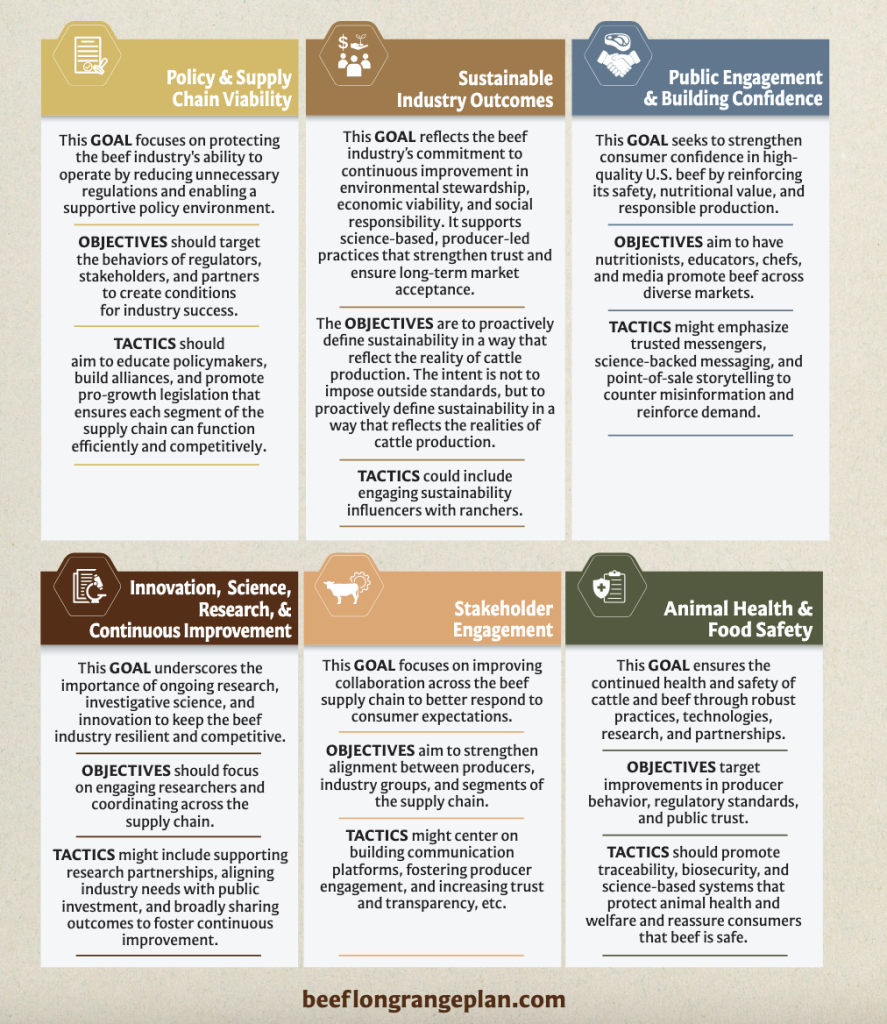
The Beef Industry Long Range Plan is divisive among those who do and do not support the Beef Checkoff. The Long Range Plan is “in part” a checkoff product, said Maddock. “It encompasses the entire industry,” and is a “tool” used by the Checkoff, he said.
Maddock said the Checkoff website links to the Long Range Plan because “we look at that Long Range Plan to help us make decisions…It is a document that we do look at, that we do rely on to say ‘where should our dollars go to best fit.’”
“We can’t influence the policy side,” he said. “The Long Range Plan is created by a big group of producers. It’s driven by NCBA. It’s by invitation. There are folks on there that have Checkoff experience, there are folks on there that have policy experience…it’s a wide representation of the industry that develop this guidebook. It provides guidance to both sides of the aisle, both the Checkoff and the policy side as to ‘where should we be going?’”
He said there are members of the CBB and the Federation on the Long Range Plan committee, but they aren’t representing those entities while helping write the Long Range Plan. He wasn’t sure who finalized the decision that the Long Range Plan will influence the spending of Checkoff dollars, but the Long Range Plan has been used in part by those overseeing spending of the Beef Checkoff for years and years.
He said the Checkoff can’t use every single point on the Long Range Plan.
Current beef demand is “unbelievable,” he said, which is a “heck of a testament” to producers.
“Consumers love beef,” he said. “Whether US labeled beef would become a brand or not, that’s up to anybody who wants to do that.”
“Overall, you look at 350 million people in the United States. Generally speaking…consumers shop based on price. Most consumers are more concerned about price than they are about brand name or origin or anything like that. That’s absolutely true. That doesn’t mean that there isn’t value in brands. But beef is a commodity. What we’ve done a really good job of with the Checkoff is we’ve created the brand of ‘beef.’ ‘Beef it’s what’s for dinner is a valuable brand.’ So we have the ability to brand these commodity products in a way that triggers the consumers’ buying preference even at higher prices compared to other proteins. But at the end of the day, consumers do shop price,” he said.
“Of course I’m interested in promoting US beef in other countries,” he said. “That lets more dollars flow back to US beef producers. Would I be interested in having Checkoff dollars promote US beef and US beef only in the US? No. I wish there was some function in here that allowed us to do some differentiation. I’m not going to lie. I’ve struggled with this. But at the end of the day, we have to promote all beef consumption in the U.S.,” he said. “I didn’t write the law, you didn’t write the law,” he said. “I do know that because the Checkoff is audited from top to bottom 10 times by USDA that because we can do it, it must be legally sound,” he said.
R-CALF USA Checkoff Committee Chair Brett Kenzy said according to rules and case laws, the U.S. Department of Agriculture is responsible for the Beef Checkoff’s content.
R-CALF USA led an effort to obtain enough signatures for an up or down vote on the checkoff in 2020. The group didn’t reach the minimum number of signatures needed, and producers have never had the chance to vote to support or end the checkoff since its creation.
“Traditionally, my entire life, USDA has operated as largely a captive agency, where certain policy organizations have great sway over the regulators,” said Kenzy. “But Brooke Rollins seems to want to manage USDA with integrity. She is not telling ranchers and farmers ‘get big or get out.’ It’s pretty refreshing that she ended her last interview ‘God bless America’s farmers and ranchers.’”
“As ranchers, it’s our job to express to her our discontent. And that’s why we’ve been digging into this Checkoff, is to show her that she has tremendous authority over this. Technically, that methane project, that is Brooke Rollins’ speech. According to the lawsuits…she has to oversee every period, every comment, every word and every letter that comes out of the Beef Checkoff,” he said.
“It’s time for USDA to shoulder that burden and make sure the Beef Checkoff is behaving,” he said.
“I don’t think she (USDA Secretary Rollins) would approve of this. It’s a pretty big slap in the face to the people who face droughts, blizzards, herd health, economics, the markets, the day to day of trying to produce cattle to put this accusation of somehow ruining the environment through methane,” he said.
“I think there is a growing sentiment among producers that we need to get this Checkoff under control, probably punctuated by…this methane study,” he said. “Our checkoff needs to be celebrating the ruminant, not trying to change it.”
“Wow, talk about failing to read the room. We’ve had an election of a president that has changed the trajectory of our country away from all this climate alarmism and put it back on the emphasis toward abundant, affordable food and energy and freedom. This methane study…the way I explain it…it’s like if we were on a stage and you had the microphone and you looked at me and said, when did you quit beating your wife?” he said. “You cast an accusation that is so ugly and then all of the sudden it’s on the accused to prove they are innocent. That’s what almost all this climate garbage is. None of us want to pollute, but the climate has been here since we were here, and will be here long after we are gone. I think the establishment sees President Trump as a speedbump,” Kenzy said.
He added that the opening language in the Beef Act explains that the Beef Checkoff was created “To enable cattle producers to establish, finance, and carry out a coordinated program of research, producer and consumer information, and promotion to improve, maintain, and develop markets for cattle, beef, and beef products.”
Kenzy said that whether producers like it or not, “This methane and C02 and climate neutrality is a new market that is being developed. It’s a market of invitation, a market of vertical integration and concentrated power. That’s what I see this as, and I hope that this will draw people to reform this Checkoff because it’s not fair claiming that cows are harming the environment because they’re not. Methane is a naturally occurring greenhouse gas that’s been around forever. It has a cycle. This is nature. To say that cattle are to blame and that cattlemen need to change everything they are doing to create less of it is folly,” he said.
Kenzy said “you can see that the establishment – the groups put in charge of administering the Checkoff – wants this methane thing really bad. They want this greenhouse gas obsession really bad because it’s going to help them capture the industry, in my opinion.”
“…they are trying to turn cows into pigs. The miracle of a cow is to be able to eat roughage, convert that into protein…”
I’m upset about this. I didn’t vote for this methane study, you probably didn’t vote for this methane study, but the 100 members of the CBB probably did.
Kenzy points out that the Beef Act prohibits any funds collected from being used for the purpose of influencing government action, with the exception of recommending amendments to the order.
“But then, we go to that Beef Industry Long Range Plan, linked in the CBB website…right at the top, it lauds ‘strong policy advocacy.’”
“As Americans, we have grown numb to government waste, fraud and abuse…but it’s different when they take our dollars and shoot them right back at us,” he said.
“Everybody has their feelings about the Checkoff. Some people want to get rid of it, some want to give $2…I have thought that we need a checkoff. The whole idea started out voluntary. I appreciate a lot of what these state beef industry councils do. I think there are a lot of good people at the state level, I think South Dakota people do a really great job, right up to the point where they send state funds to the Federation.”
Kenzy said that he hopes those involved in state beef councils can see that he is trying to protect their ability to continue to promote beef. “A lot of them are volunteers, and I appreciate them. If the national Checkoff doesn’t get cleaned up, I see a day when it all goes away, and then we don’t have any beef promotion, education and research via the checkoff,” he said.
Kenzy believes the ‘poison pill’ happened when the 1985 language required that “existing organizations” are used to implement checkoff projects. “When you have lobbying organizations and all of the sudden a pool of money appears, it’s just too much temptation to lobby with checkoff funds…and impossible to “firewall” ideology. It was doomed from the start,” he said.
“The Beef Industry Long Range Plan talks about ‘American beef quality’ but it can’t promote USA beef,” pointed out Kenzy.
“They do a good job talking about America and trust, but then these establishment organizations come out against MCOOL. Basically what they are saying is, what the consumer doesn’t know won’t hurt them. There is a lot of money to be made by the entities that can sort, that can bring in the foreign meat, unwrap it, re-wrap it. Then…if we want to gain any income from being an American cattle producer, we have to pledge our cattle to the integrated system,” he said. “It’s all about global consolidation, concentration and control.”
Source link


