
Benefits of eating less meat
Eli Pivnick – Jan 20, 2026 / 11:00 am | Story: 595096

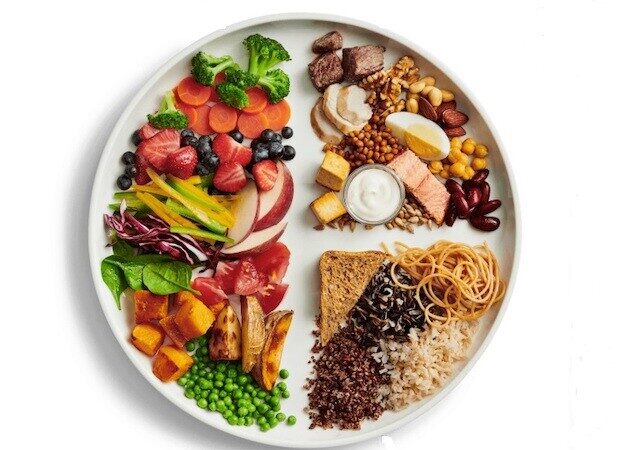
Photo: Canada’s Food Guide website
An example of Canada’s Food Guide recommendations.
According to University of Waterloo professor and author, Seth Wynes, the most impactful actions individuals can take to reduce their climate impact are, in order of importance:
1. Have fewer children
2. Live car-free
3. Reduce air travel
4. Adopt a plant-based diet
According to Madre Brava, an international climate action advocacy group, air travel and a plant-based diet are tied for third place for their climate impact. But, as the group points out, the importance of reducing meat consumption, especially if that meat is produced as part of the industrial meat industry, is vastly under-reported by media.
Why less meat? Animal agriculture world-wide, is responsible for about one third of greenhouse gases and the issues are numerous. For one, forests are very important for absorbing and storing carbon. Meat production is one of the primary drivers of deforestation, especially for beef production—not in B.C. but in many parts of the world. It has the biggest impact on climate. In fact, humans directly use three quarters of the ice-free land on the planet and most of that is for agriculture and the forest industry.
Cattle and other ruminants (including sheep and goats) produce a lot of methane. Methane, over 20 years, is 80 times worse than CO2 for its climate impact. Roughly a third of methane caused by humans is produced by cattle and is responsible for one-third of the warming of the planet to date. Add to that the enormous amount of arable land which is destined for animal feed (roughly 80% globally), and the substantial fossil fuel use for farm machinery, food processing and transportation.
Of course, not all livestock raising methods are equal. Where cattle are used in regenerative agricultural methods in grasslands, the impact can actually be positive for the climate over time. The soil can improve through managing grazing and other techniques and fossil fuel use reduced. There is now a push to raise insects (mainly crickets and black soldier flies) for animal feed. An acre of land, according to a US study, can produce 250-500 times as much insect protein as beef.
All meat sources are not the same. On average, cattle require 40 kilograms of protein in their diet to produce one kilogram of protein. For pigs, it is 12 kilograms and for poultry it is five kilograms. For dairy and eggs, it is only four kilograms.
Water requirements also vary. For cattle, 15,000 litres of water are needed per kilogram of meat. For pork, it is around 6,000 litres and for poultry it is around 4,000 litres. Consequently, the price of beef and beef’s climate impact is much worse than pork, which is worse than poultry, dairy or eggs.
Meat consumption, according to 2024 data from the Food and Agriculture Organization of the United Nations, is much higher in industrialized and meat-producing countries, with the highest consumption being in the U.S. and Mongolia. Canada is not far behind.
Converting from a high meat diet to reduced meat, as recommended by Health Canada, will reduce the food-related GHGs that you are responsible for, by one-third. A vegetarian diet (including eggs and dairy) will reduce GHGs by two-thirds. It makes a substantial difference.
Would you like more reasons to reduce meat consumption? A vegetarian or reduced-meat diet will reduce your risks of heart disease, diabetes, dementia, high blood pressure, obesity and some cancers.
Michael Pollan, a University of California at Berkeley professor, has studied the health effects of diet extensively and has published several books on the subject. In The Omnivore’s Dilemma, he concludes with the following simple recommendation: “Eat food, mostly plants, not too much.”
By food he means the unprocessed stuff. In his abbreviated book, Food Rules, he summarizes his findings in a thoughtful yet humorous manner.
“Don’t eat anything your great-grandmother would not recognize as food.” Also: “Avoid food products with ingredients that a third-grader could not pronounce.” And: “Avoid foods that are pretending to be something they are not,” with margarine being the classic example.
My favourite rule though is: “Avoid food products that make health claims.”
This seems counter-intuitive until you realize that carrots, raspberries, peas, chicken, milk and eggs do not make any health claims. Only processed foods do.
Earlier, I mentioned the many benefits of reduced meat consumption are vastly under-reported in the media. Why might they be? At the annual global conference on climate change, there was a substantial presence of lobbyists for the meat industry.
In one document, the industry acknowledged the global meat sector had “a job to do” in making sure governments are positioned to push for what it described as “balanced, science-based outcomes” rather than what it characterized as “ideologically driven solutions”.
Do yourself a favour and eat less meat. Your body will thank you and so will the planet.
This article is written by or on behalf of an outsourced columnist and does not necessarily reflect the views of Castanet.


