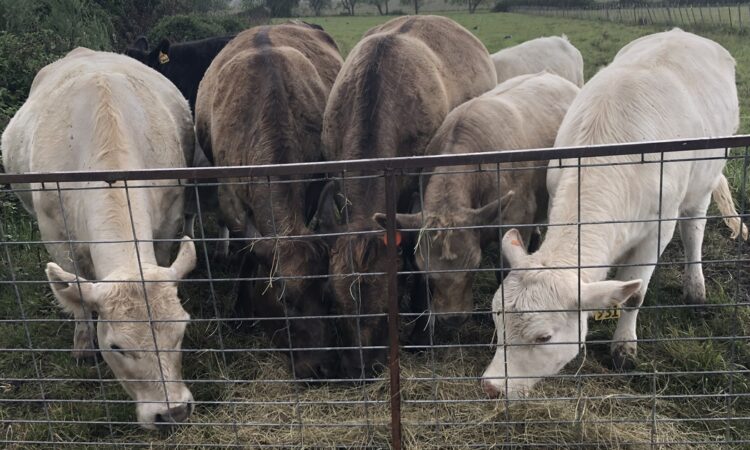
There are many ways to market the cattle produced on a beef operation, and a growing number of producers are venturing into direct marketing–growing beef from pasture to plate, selling directly to consumers.
This is a way to get full value for genetically superior animals—which is not always possible when selling weaned calves or yearlings. If you finish your own animals, you not only know how they perform for beef production (which can guide your genetic selections in the future) but you can also learn from your customers whether you cattle provide a good eating experience.
Direct marketing, involved with the animals from start to finish, takes more effort but can also provide more profit. This is being done by some large outfits and a lot of small ones, selling meat at their farm, local farmer’s market, online or to restaurants.
Farm-to-table beef
Here are a few examples.
Whitney Byrd grew up with cattle on a farm in Oregon where her family had Limousin cattle. She liked their growth traits and coat color – they had more heat tolerance than black-coated cattle – but not their challenging temperament, she said.
“We phased out Limousins and got commercial cattle,” including Red and Black Angus, Charolais and a few Hereford crosses, “but still had problems with temperament and inconsistency,” Byrd said. “So a few years ago we tried Murray Greys.”
There are many reasons she likes Murray Grey besides their gentle temperament. “Many people are health conscious today, wanting grass-fed beef, and these animals do well on grass,” she said. “We still have a few commercial Charolais, but they grow all their frame first.”
They won’t finish until they have that growth, she said. By contrast, a Murray Grey can be harvested anywhere along the way and still have an excellent carcass—just smaller.
“Doing grass-fed genetics and some farm-to-table beef works really well for us,” she said.
Murray Grey produce tender, tasty, marbled beef on grass or grain, without excess fat. Steers finish in less time, on less feed, than most beef breeds. They have exceptional dressing percentages and high yields. A study in the U.S. showed Murray Grey steers have a 12% larger rib eye than the average U.S. beef steer and twice as likely to grade Choice or Prime. In Australia and other countries Murray Grey have dominated high placings in most carcass contests.
David Pawelek raises Murray Greys in Texas. “Growing up we had traditional commercial cattle and my three brothers and I helped with the family feedlot. In 1973 we bought a small slaughterhouse and started a retail-wholesale meat market to sell meat to our customers,” he said.
“Recently we discovered Murray Grey, but all the Murray Grey breeders I knew were pushing grass-fed because these cattle are very efficient on grass,” Pawelek said. “Many people think grass-fed is better for you than grain-fed beef. I like a grain-fed steak, however, and wondered how these animals would do in the feedlot. I called a Murray Grey breeder in Australia and she said they gain faster than most cattle and finish quicker. Their ratio of feed to gain is much better. So I put five Murray Grey-Charolais cross cattle on feed and 90 to 120 days later they were finished, grading Choice or higher. We processed some and sold some as halves, and that’s what we’re doing now in our small operation, mainly with Murray Grey cattle.”
Breeding for gain
Plateau Cattle Company – John Smith and his wife Laura Laing, Alberta Beef Producers recipients of the 2025 Environmental Stewardship Award, are third generation on their 450-head commercial cow-calf operation near Nanton, Alberta.
“We’ve changed our focus on genetics and test our cattle for the leptin gene–breeding for animals that have lower feed intake and higher gain,” Laing said.
The leptin gene regulates several traits in cattle, including feed intake, energy metabolism, body fat mass, milk production, and reproduction. Variations in this gene can impact these traits and can be used as markers in breeding programs to improve growth efficiency and carcass composition.
Plateau Cattle Company animals are marketed through two quality beef programs: Benchmark Angus and Trails End Beef. These are value-added programs that supply beef to top restaurants throughout Alberta, where consumers want to know how the beef was raised. Smith and Laing enjoy telling how they raise cattle with care, under humane and low-stress production practices, in a grazing system designed to protect and enhance the land’s natural resources.
Frank’s Butcher Shop in Wyoming is a family-owned business started in 2020 with a meat processing facility that was state inspected. “We became a USDA processing facility, which allowed us to sell meat across state borders,” said Bryce Brenton, the business’ vice president.
“Since we could ship all over the country as well as have a store, we decided to do the whole retail operation,” he said. “One thing led to another and we opened our retail stores in Hudson and Casper, Wyo. In Casper our store has a bar and grill, and a private room where we serve a buffet and a 5- course dinner. We do a special called Pick-a-steak; customers go to the meat case and select the steak they want us to cook for them. We process all types of beef, but put the most emphasis on our F2 cross Wagyu cattle that are 75% Wagyu genetics.
“In the Hudson shop we serve breakfast burritos and deli products in addition to meat sales,” he said. “We source the cattle from our own herd and some of our neighbors—the high quality beef we all produce.”
Black Angus and Wagyu
The Brenton family ranch supplies a lot of the cattle, raising Black Angus and Wagyu crosses.
“We care about what meat looks like in the case, and we tailor our entire program in terms of breeding stock and commercial cattle to generate a high-quality steak. Most ranchers want fast-growing big calves to sell in the fall—cattle with low birthweight and high weaning weights. Instead, we use Wagyu crosses to produce an excellent carcass, and it’s a local product born and raised right here.”
The enterprise provides a ranch-to-table experience with the family’s two stores and online store shipping nationwide.
“This sets us apart from other meat processers because we give our customers that whole experience—at the shop eating something we raised and processed,” Brenton said. “We’ve spent a lot of selection (genetics) and time to raise the animals, and our customers can pick the steak they want us to cook for them.”
Their meat business evolved partly because of meat shortages in grocery stores and inability to get meat processed during COVID-19. “There was a huge demand for meat. We wanted to get 20 of our cattle processed that spring, in 2020. Our local processor didn’t have an opening until September 2021—a year and a half. One thing led to another and we bought that processing facility,” Brenton said.
By converting it into a USDA-inspected facility, able to ship meat out of state, they almost doubled production; currently they can process 50 to 60 beef animals each week, and some pork.
“We were selling whole beef and halves to family and friends, then decided to do individual cuts,” Brenton said. “We opened our first store in 2021 during COVID. People needed food and were panicking at grocery stores. We wanted to offer our meat.”
It was perfect timing. There was a huge need for locally-grown food, readily available.
“Part of our success is because people can taste our product,” he said. “We are small but our meat is carefully processed and tastes better than what you find in a grocery store. Customers try a steak and exclaim how amazing it is.”