
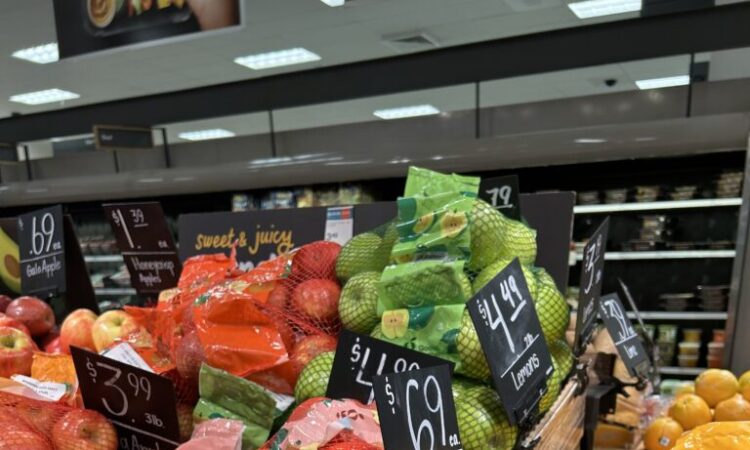
A state program allows school districts to partner with local agriculture producers in an effort to provide students access to fresh fruits, vegetables and meats.(Photo by Kennedy Thomason/Oklahoma Voice)
OKLAHOMA CITY — Several hundred Oklahoma schools have signed on to participate in a new state program that aims to put fresh meat, fruits and vegetables on students’ lunch trays.
The Oklahoma Department of Agriculture, Food and Forestry’s Local Food for Schools Program, which launched last year, connects local agricultural producers and farms with school cafeterias.
Brady Womack, rural economic development coordinator for the Department of Agriculture and approver for the program, said one of the program’s goals is educating students about the culinary “farm-to-table or farm-to-school” movement, which emphasizes the importance of using locally sourced ingredients and supporting local economies.
Oklahoma’s program is modeled after a larger one managed by the U.S. Department of Agriculture, which the state participated in from 2022 through 2025.
Oklahoma’s Legislature allocated $3.2 million for the program, which allows approved schools to use state funding to purchase minimally processed foods such as fruits, vegetables, eggs, meat, dairy products, and nuts.
Minimally processed refers to foods that haven’t been altered in a way that significantly changes the fundamental properties, Womack said. He said his agency works directly with its Food Safety Division to choose which farmers and ranchers are approved and to ensure they have completed all requirements to be able to sell food to schools or the public, Womack said.
“The Food Safety makes sure they have all their verifications or classes taken to be able to sell food to schools or the public,” Womack said.
The program allows schools to request a maximum of $25,000 per month in increments of $5,000, with a limit of $100,000 per fiscal year. After the initial allocation, schools can then only apply once monthly.
Meriruth Sellers, director of market development for the state Department of Agriculture, said schools can choose which farms or ranches to purchase from as long as they follow the program’s requirements.
“Many schools are able to buy from nearby farms, while others may have to travel farther,” she said.
The program reimburses schools for purchases of local food so it only saves them the exact dollar that they purchased, Sellers said.
“This program is not intended to cover entire food costs … it is intended to help schools build relationships with local farmers by offsetting the cost of food,” she said.
To meet higher consumer demand resulting from utilization of the new program, some producers have had to adjust their production rate but most have been able to maintain their normal daily operations, according to the American Farmers and Rancher’s Cooperative.
Katie Whitfield, a field representative and coordinator with the Oklahoma Certified Beef Association, said that the program has a significant positive impact on the Oklahoma farmers and ranchers who participate.
“It provides them with stable, consistent buyers who purchase substantial quantities of their products, helping to create financial security while also allowing them to support their local schools and communities,” she said.
Whitfield said the biggest challenge is logistics — getting the product to the schools efficiently. Some districts require large quantities of beef, which can pose transportation or delivery challenges, but these are manageable as the program continues to grow, and infrastructure improves.”
“Programs like this shorten the supply chain, making the food system more resilient, transparent, and sustainable,” Whitfield said. “They keep food dollars circulating within the state, support local economies, and reduce dependence on out-of-state suppliers—all while giving students access to fresh, nutritious, locally produced food.”
She said her organization views Oklahoma’s Food for Schools Program as becoming an essential part of the state’s food supply chain.
“As more schools participate and more producers get involved, we anticipate expanded product offerings, stronger local supply networks, and deeper partnerships between agriculture and education,” Whitfield said. “Ultimately, the goal is for locally sourced food to become the norm in Oklahoma school cafeterias.”
Editor’s note: This story was produced through a reporting partnership between Oklahoma Voice and the University of Central Oklahoma’s journalism program.
SUBSCRIBE: GET THE MORNING HEADLINES DELIVERED TO YOUR INBOX


