
Women, producers and applied science shape the future of sustainable agriculture at EcoFarm 2026
Growers, researchers and community organizations shared a clear message at the 46th annual EcoFarm Conference: organic and sustainable agriculture in California is advancing through collaboration, science-based knowledge and diverse leadership – particularly from women and new generations of farmers. The conference was held Jan. 21-24 at Asilomar Conference Grounds in Pacific Grove.
One of the main sessions was themed around the International Year of the Woman Farmer and featured the panel “How Women Are Rebuilding Our Regenerative Supply Chains,” highlighting the role of female leadership in strengthening food system resilience and equity.
In a follow-up interview, Glenda Humiston, University of California vice president for agriculture and natural resources, said women’s participation strengthens agricultural systems worldwide.
“There are numerous studies around the world showing that when women participate in food systems, those systems are stronger, better serve communities and make agriculture more efficient,” Humiston said.
She also emphasized that opportunities in agriculture extend far beyond field production.
“There are many ways to be involved in agriculture; it’s often assumed it only means being a farmer or producer, but that’s not the case,” Humiston said. “Cooperative Extension is a good example – people can contribute as researchers, agricultural technicians, food processors and through many other roles across the food system.”
More than 1,500 people participated in the four-day conference, which brought together farmers, farmworkers, advisors, researchers and community organizations, as well as others interested in organic and regenerative agriculture. Attendees sought to address current challenges and share practical approaches to strengthening agricultural sustainability in California.
Participants included both established organic producers, as well as farmers exploring a transition to organic systems. Specialists from several UC ANR programs participated, including the Sustainable Agriculture Research and Education Program, the UC Organic Agriculture Institute and the UC Integrated Pest Management Program.
The conference also offered a full slate of Spanish-language workshops and simultaneous interpretation services aimed at expanding access to science-based technical information for Spanish-speaking farmers, farmworkers and anyone who plays a role within agriculture.
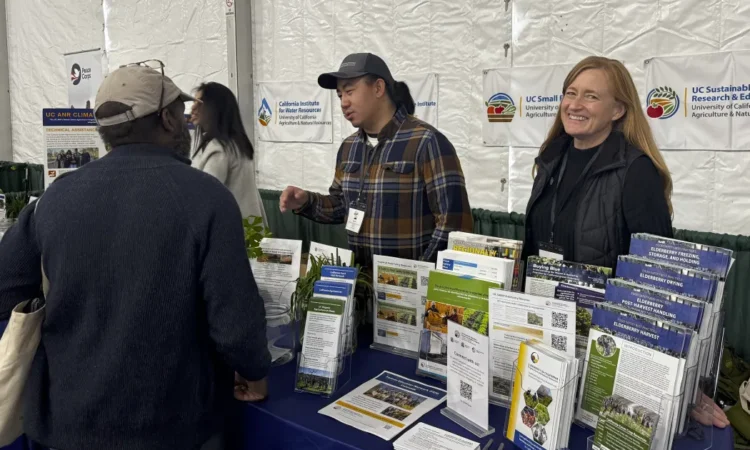
In the exhibition area, UC ANR hosted an information booth where attendees learned about programs and projects supporting producers and agricultural communities across the state.
For many participants, EcoFarm also served as a space for direct exchange of field experience.
Jose Juan, a grower with Dulce Organic Farm in Watsonville who has produced strawberries for eight years, attended the conference for the second time.
“The conference is very complete. There are many workshops where you learn things you didn’t know,” he said. “What I would like to see is more buyers – whether for strawberries or other products. For farmers, that is often the biggest challenge.”
EcoFarm also drew new farmers motivated by health and sustainability. Teresa Lozano, who is beginning her agricultural career, attended for the first time because of her interest in food sourcing and nutritional value.
“I grew up eating whole foods, always prepared from scratch. Food was our medicine,” she said. “Everything on our plate had a purpose, and now I’m trying to model that for myself and my family.”
Educational programs were also represented. Researchers from the Sustainable Agriculture Research and Education Program highlighted the importance of statewide technical support networks for farmers navigating regulations, policies and production challenges.
“A lot of our work focuses on supporting farmers who must interact with many different systems, which can be overwhelming,” said Claire Tuohey-Mote, a UC ANR program associate. “We’re here to help them navigate those systems.”
UC ANR representatives also highlighted partnerships with community-based organizations to expand access to education and technical resources in historically underserved communities, including projects supported by the California Department of Conservation’s Climate Smart Land Management Program.
Throughout the conference, participants took part in field tours, technical workshops and collaborative sessions between growers and researchers, all focused on strengthening organic and sustainable agriculture in California.


