
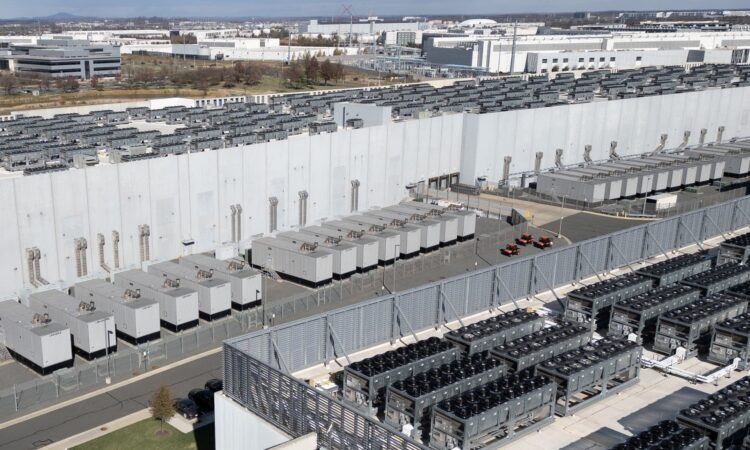
The AI data center boom likely means burning a whole lot more fossil fuel.
A pair of recent reports track the explosion of new gas-fired power capacity under development in the U.S. The nonprofit Global Energy Monitor found proposals for new natural gas-burning facilities in the U.S. tripled in 2025 compared to a year earlier. Much of that is due to data centers building their own natural gas power plants, according to a report from market intelligence platform Cleanview.
The U.S. is planning more than 250 gigawatts of new natural gas energy, enough to power every home in America and about a hundred million more, according to research analyst Jenny Martos with Global Energy Monitor. She tracks projects that have been announced and those already under construction.
“There’s a race going on, and what we’re seeing is a petro-tech build out,” she said.
Big Tech is spending hundreds of billions of dollars to build out the infrastructure of AI, and they want it up and running as soon as possible. Natural gas has been one of the only solutions for that in the near term, said Andy Cvengros, who follows data center development for commercial real estate firm JLL.
He said getting energy from a local utility has been getting harder, with up to a five-year wait. So a lot of data centers are going “behind the meter” — building their own power plants on site.
Hyperscalers are investing in clean energy solutions like small modular nuclear reactors, Cvengros said.
But “that’s 7, 10, 12 years out,” he said.
Natural gas generation can fire up in a fraction of the time. That’s if you can get the required turbine, said Michael Thomas, Cleanview founder.
“The lead time has exploded to as long as 5 or 7 years,” Thomas said.
Thomas analyzed permits and site plans for dozens of data center generation facilities. Most of the equipment was natural gas-powered, he said, and many developers are getting creative to get online as quickly as possible.
“We found plans of data center developers that are going to strap gas engines and turbines to semi trucks,” he said. “We found plans to use turbines that are built for jet engines and for, in some cases, warships, in other cases cruise ships.”
These are less-efficient means of generating power from a fuel that is not the cleanest at baseline, said Emily Grubert, associate professor of sustainable energy policy at the University of Notre Dame.
“It is less greenhouse gas intensive than coal, but it’s still greenhouse gas intensive enough that if we need to take climate seriously, it needs to be phased out as well,” she said.
Grubert said that even if data centers switch to clean energy in the future, someone’s going to buy up that surplus natural gas capacity for decades.


