Unlock the White House Watch newsletter for free
Your guide to what Trump’s second term means for Washington, business and the world
Hedge funds are seeking out billions of dollars’ worth of financial claims tied to Venezuela, as investors bet that Donald Trump’s bid to reshape the country could prompt it to repay old debts.
Investors seeking exposure to a potential turnaround in the embattled nation have this week begun hunting for instruments that would profit if Venezuela and its state oil company make good on years of unpaid bills.
The clamour for these claims has come amid a rally in the country’s bonds as the investors hope that the US capture of strongman Nicolás Maduro brings the country closer to a long-delayed restructuring of its debt following a default in 2017. Venezuela also owes several big corporations money after nationalising assets in 2007.
The burst of interest underscores how Trump’s brazen operation in Venezuela on Saturday has unleashed business opportunities stretching from oil companies to investors who have long shunned the country.
“In the last 48 hours, I’ve received a lot of calls, a lot of questions and a lot of indications of interest from investors,” said José Ignacio Hernández, head of public debt markets at Aurora Macro Strategies, referring to investors’ demand for non-traditional Venezuelan debt.
Venezuela’s more esoteric debt — which includes promissory notes, receivables and arbitration claims — has historically been of little interest to investors because it is far less actively traded than its sovereign bonds.
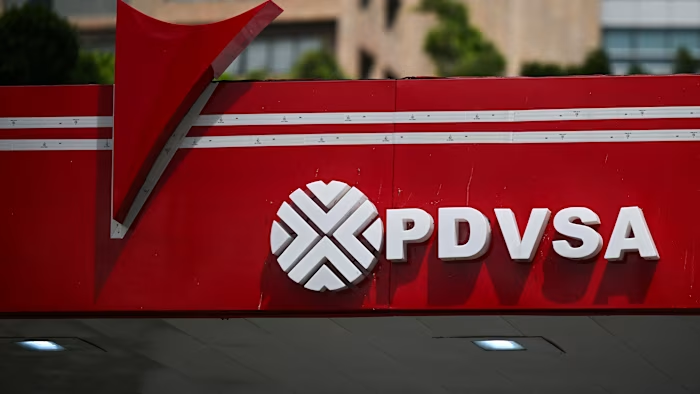
But the prospect of revitalising Venezuela’s oil industry could put pressure on the country to settle these outstanding liabilities, particularly claims held against state oil company PDVSA.
Some of the most sought-after claims are those that have been awarded by the International Centre for Settlement of Investment Disputes (ICSID), an organisation run by the World Bank that settles arbitration disputes.
Maduro’s predecessor Hugo Chávez confiscated billions of dollars’ worth of private assets in 2007. The seizure led oil majors and energy services companies, gold miners and other expropriated investors to bring dozens of these claims against Venezuela over the years through the World Bank platform or other investment treaties.
Some investors estimate there are roughly $30bn worth of these claims scattered globally, many of which are held in amounts less than $500mn. After years of fruitless efforts to extract cash from Maduro’s government, many companies sold them on to specialist investors, including hedge funds.
“There is a huge amount of debt out there that is disputed and uncertain,” said Celestino Amore, co-founder of Canaima Capital, a fund that trades Venezuelan assets.
He added: “The process of restructuring will be so complex because they will have to go through this pile of receivables and no one knows what is real or not. The ICSID arbitration claims are more easily quantifiable.”
With the apprehension of Maduro on Saturday, the market for these claims has come back to life as the chances of a windfall increase.
Funds including Carronade Capital Management and Canaima Capital have been tracking down these international claims, believing they could eventually rise in value if the country moves closer to restructuring, according to people familiar with the matter.
Seaport Global, an investment banking and trading firm that is well known for brokering sovereign bonds, was one of the most active players trying to find potential sellers and facilitate trades, several people familiar with the matter said.
Seaport did not respond to a request for comment. Carronade and Canaima declined to comment.
US energy group ConocoPhillips has the largest single claim, a $8.7bn judgment, or more than $10bn with interest. Last year Venezuela lost an appeal against the award for expropriation of oil projects.
Separately, almost $20bn of claims are linked to efforts to collect money from Citgo, the US refiner owned by PDVSA, as part of a forced sale overseen by US courts to pay back Venezuela’s creditors.
Hedge fund Elliott Management last year won a contest to take control of Citgo with a $5.9bn bid plus an agreement to give certain bondholders about $2bn. This deal, which is under appeal in US courts, would leave many claims unpaid.
Still, a big advantage of owning arbitration claims is that they are not subject to bondholder votes in a restructuring, meaning that investors can act independently in demanding repayment. But some experts are more sceptical that there will be an easy resolution even for the non-bond debt.
“This kind of scramble to differentiate between trade claims and ICSID awards and bond claims I think is really meaningless,” said Jay Newman, a significant figure in Elliott’s long battle with Argentina for a payout on its defaulted debt.
He added: “What we’re seeing is that the [Trump] administration has a big interest in making sure that things go well in Venezuela for Venezuelans. And that desire is antithetical to giving creditors a good deal.”
Additional reporting by George Steer