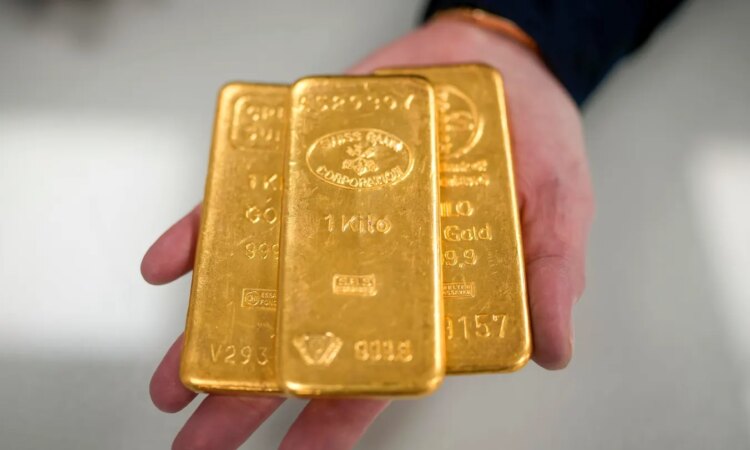

BIRMINGHAM, ENGLAND – DECEMBER 13: A jewellery quarter gold dealer poses with three 1kg gold bullion bars on December 13, 2023 in Birmingham, England. Gold prices have increased since the Ukraine War but have soared to record highs since the start of the Hamas-Israel war. Other factors are the weakening US dollar and expected rate cuts from the Federal Reserve. (Photo by Christopher Furlong/Getty Images)
Getty Images
At conservative current prices, Venezuela’s proven oil reserves carry a notional value of roughly $18 trillion–comparable to the combined market capitalization of Apple, Microsoft, Nvidia, Amazon, Alphabet, Meta and Tesla, the Magnificent Seven.
That comparison establishes scale.
What is less appreciated is that oil is not Venezuela’s only latent asset. The country also sits atop one of the largest undeveloped gold provinces in the Western Hemisphere. Gold does not alter the oil story, but it meaningfully adds to it at the margin.
As global energy demand rises and capital markets reprice scarcity, the breadth of Venezuela’s resource base is becoming newly relevant.
If oil is the cake, gold is the cherry on top–and that cherry represents an additional prize worth as much as half a trillion dollars.
The Oil Base: A Magnificent Seven–Sized Asset
To keep the analysis conservative and comparable, this article relies on proven oil reserves only, not speculative “oil in place” estimates.
Venezuela holds approximately 303 billion barrels of proven oil reserves, the largest officially reported total in the world. At a current price of $60 per barrel, that base alone supports a valuation of roughly $18 trillion–on par with the combined value of the Magnificent Seven.
That is the cake.
Gold: Smaller Than Oil, But Material As An Add-On
Gold is not large enough to compete with oil in scale. But it is large enough to matter.
It is important to distinguish between proven gold reserves, which reflect central-bank holdings, and expected in-ground gold resources, which reflect geological endowment.
Venezuela’s official gold holdings are modest. However, geological estimates for the Orinoco Mining Arc frequently cite on the order of 7,000 to 8,000 tons of gold as potential in-ground resources.
At current gold prices, that translates into roughly $0.5 trillion of notional value.
That figure does not replace the oil story. It layers on top of it.
In equity terms, it is the equivalent of adding another mega-cap company to an already dominant group, turning a Magnificent Seven–sized oil asset into something closer to a Magnificent Eight.
Oil Plus Gold: A Global Comparison
The table below combines proven oil reserves with expected gold resources, valued consistently and without double counting. Oil values reflect a conservative $60 price per barrel. Notably, in 2008, the price was 2.5x higher approaching $150 ppb. Gold is valued at current prices.
Oil Plus Gold—Potential Combined Economic Value
EntrepreneurShares LLC
Oil values reflect proven reserves only. Gold values reflect expected in-ground resources, not central-bank holdings.
History shows that resource scale alone does not determine outcomes; institutions determine whether assets become national wealth or stranded value.
The Takeaway
Gold does not change the hierarchy created by oil. Venezuela’s oil endowment remains the dominant asset by orders of magnitude.
But gold meaningfully adds to the picture.
An incremental $500 billion of largely untapped gold resources is not a rounding error. It is larger than most public companies on earth. And it sits on top of an oil base already comparable to the combined value of the largest technology firms in the U.S. stock market.
If Venezuela’s oil is the equivalent of the Magnificent Seven, its gold effectively adds an eighth mega-cap–sized prize to the balance sheet.
Markets are only beginning to understand what that scale implies.
———————————————-
Author Disclosure: The author previously served as a consultant to PDVSA (Venezuela’s state-owned oil company) and to the World Bank on energy and capital-market development in Kazakhstan in the early 1990s. He is also the author of a Harvard case study on Kazakhstan’s oil sector, “From Genghis to Tengiz: The Case of Chevron Oil.”
Disclosure: The views expressed are the author’s own and do not constitute investment advice. The author may hold positions in energy or equity related securities. This article is for informational purposes only and does not consider the investment objectives or financial circumstances of any individual investor.
Disclosure: Past performance is no guarantee of future results. Please refer to the following link for additional disclosures: https://lnkd.in/e29X6rN
Disclosure: Risk Note: Private-market valuations can be volatile. Fees, holdings, and pricing mechanisms differ by vehicle. Investors should review fund disclosures before investing.
Additional Disclosure Note: The author has an affiliation with Babson College, ERShares, the XOVR ETF, the Entrepreneur 30 Total Return Index (ER30TR) and Signal Markets. The intent of this article is to provide objective information; however, readers should be aware that the author may have a financial interest in the subject matter discussed. As with all equity investments, investors should carefully evaluate all options with a qualified investment professional before making any investment decision. Private equity investments, such as those held in XOVR, may carry additional risks—including limited liquidity—compared to traditional publicly traded securities. It is important to consider these factors and consult a trained professional when assessing suitability and risk tolerance.