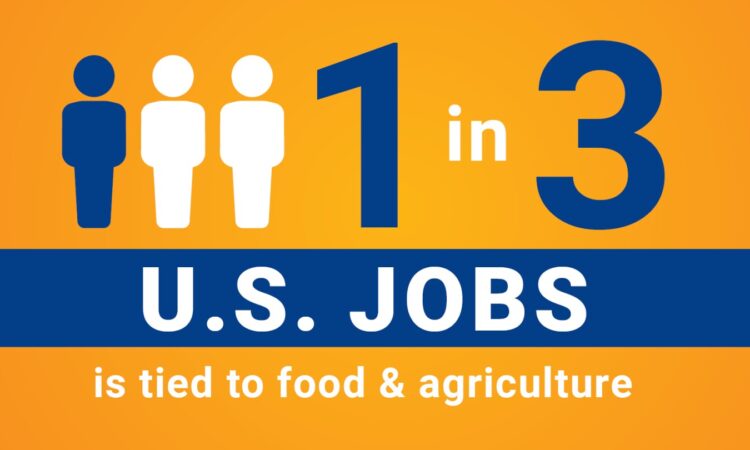
Did you know that close to one in every three jobs nationwide is tied to food and agriculture? The latest Feeding the Economy Report says food and agriculture support about 49 million jobs, which is about 30% of total U.S. employment. Although less than 2% are on the farm, when you add food manufacturing, wholesale and retail, that adds another 24 million jobs, or about 15% of the workforce.
Each year, the Feeding the Economy Report measures the downstream, off-the-farm economic impact of U.S. agriculture. Danny Munch, an economist with the American Farm Bureau Federation, says the report tracks three layers of impact.
“When you combine those layers, ag supports about $10.4 trillion in economic output, or about one-fifth of the entire U.S. economy,” Munch said on the Newsline podcast.
2025: $900-Billion Growth in U.S. Agricultural Industry
The U.S. agricultural industry grew by nearly $900 billion over the past year, according to this study led each year by the Corn Refiners Association and sponsored by three dozen agriculture and food organizations, including the National Pork Producers Council (NPPC).
The first layer is direct activity, which includes the base level of food and ag production that is traditionally measured. It also measures supply industries like transportation, finance, equipment manufacturing and inputs in the second layer. The third includes the ripple effects of those two stages on how wages are earned and spent throughout the rest of the system.
“So, all the benefits we were talking about – jobs, wages, tax revenue – they’re tied to where that production happens,” Munch says. “If production shifts overseas due to cost pressures, regulatory burdens or competitive challenges, that economic activity moves with it. So, it’s not just about the food supply, it’s about all these other jobs, tax revenue and economic commerce that supports industries across every corner of every state.”
The report includes a state-by-state breakdown of agriculture’s economic impact, showing total jobs, wages, output, taxes and exports. Key findings include:
- Food and agriculture generated more than $3 trillion in wages for U.S. workers, with wages rising 4% year-over-year and 13% over the past decade.
- Food manufacturing remains the largest manufacturing sector in the U.S., employing almost 2.3 million workers.
- U.S. food and agriculture exports were more than $177 billion, though exports declined by $5.4 billion year-over-year, underscoring the need for maintaining strong trade agreements and expanding market access for American products.
- The food and agriculture sector produced $1.35 trillion in tax revenue for federal, state and local governments, a 7% increase year-over-year.
“The report confirms the incredible, positive impacts of agriculture on our country,” says NPPC CEO Bryan Humphreys. “America’s 60,000-plus pork producers are proud to help drive this force that provides our food and other agriculture products—and the opportunity to be part of something bigger than themselves by carrying on a tradition of taking care of their families, neighbors, animals and land, and at heart, a way of living that often has been passed down for generations.”
U.S. pork producers annually generate more than $37 billion in personal income, contribute more than $62 billion in GDP, and support more than 573,000 jobs in the U.S. economy, NPPC adds.