The U.S. Bureau of Labor Statistics released its latest consumer price report Wednesday, providing a closer look at how energy costs, grocery prices and other everyday expenses have changed in the last month.
Inflation accelerated in February, with costs rising 0.3% — a slight increase from the 0.2% reported in January. Consumer prices are also 2.4% higher than they were a year ago, primarily due to soaring food, housing and energy costs. Expenses like gasoline and utility gas are up month-over-month and ground beef remains at record highs, while grocery staples like eggs and milk are cheaper.
But some of that could change as a result of President Donald Trump’s recent economic and foreign policy decisions.
Notably, the February consumer price index data doesn’t factor in the latest shocks to global markets after the United States and Israel launched a major attack on Iran on Feb. 28, killing Supreme Leader Ayatollah Ali Khamenei and kicking off a war that has lasted more than two weeks.
The biggest economic impact thus far has been on the already volatile energy sector, with oil prices skyrocketing to $100 a barrel, gasoline prices steadily climbing and natural gas expected to follow. Rising fuel costs mean shipping and transportation will be more expensive, and companies may look to pass those hikes off to customers. That could translate into higher prices on all kinds of goods and services.
How the Iran war and surging oil prices are affecting consumers at the gas pump and beyond
Also in late February, the Supreme Court struck down Trump’s sweeping tariffs, ruling that he didn’t have the authority to implement country-specific import rates under an emergency powers law.
In response, the president signed an executive order imposing a 10% global tariff rate using a federal trade law that allows the executive branch to enact temporary import taxes for 150 days unless extended by Congress. Trump later threatened to raise the rate to 15%, but has yet to do so.
As with his previous reciprocal tariffs, there are a slew of goods that are exempt from these new duties to account for the “needs of the U.S. economy,” including certain critical metals and minerals, energy products, pharmaceuticals, some agricultural items and natural resources not grown in the U.S.
As a result, how much of an impact these levies will have on consumers is unclear. However, a study released Friday estimates that Trump’s trade war could cost Americans an extra $2,500 this year.
The Tribune is tracking 11 everyday costs for Americans — eggs, milk, bread, bananas, oranges, tomatoes, chicken, ground beef, gasoline, electricity and natural gas — and how they are changing, or not, under the second Trump administration. This tracker is updated monthly using CPI data from BLS.
To see the average U.S. price of a specific good, click on the dropdown arrow below and select the item you wish to view.
Eggs:
Egg prices have fallen for a tenth month, down another 8 cents from January — marking a two-year low.
Unfortunately for consumers, higher prices could be around the corner. Bird flu cases surged again last month, more than doubling from January to February. There were confirmed outbreaks in 23 states, with more than 11.4 million birds affected, according to U.S. Department of Agriculture data. What’s more, the vast majority of newly-reported cases were among table egg-layers.
Still, that’s roughly half the size of last year’s outbreak that led to a massive spike in egg prices. In January 2025, approximately 19.5 million egg-laying hens were culled, significantly reducing the egg supply and leading to shortages in grocery stores, triggering record costs for consumers.
Currently, a dozen large Grade A eggs costs $2.50 — about 50% less than when Trump was sworn in.
Milk:
The cost of milk dropped 7 cents month-over-month, settling at $4.03 per gallon of fresh, fortified whole milk. That price is exactly the same as it was a year ago.
Bread:
The price of bread saw a minimal bump from the previous month. Even so, at $1.85 per pound of white bread, the national average hasn’t seen much fluctuation during Trump’s term, registering price changes of just a few cents.
Bananas:

Banana prices were unchanged in February, remaining at $0.65 per pound. Year-over-year, however, costs have increased by nearly 5.5%.
Bananas, which the United States heavily imports from Central and South America, have been hard hit by tariffs. Amid a global trade war, prices swung to all-time highs, peaking at $0.67 per pound in September. But since the Trump administration added the potassium-rich fruit to a list of tariff-exempt commodities in November, prices have cooled somewhat.
That could change. While a variety of goods are said to be free from the president’s new 10% global tariffs — including “certain agricultural products” — it’s unclear if bananas are included in that.
Which Trump tariffs did the Supreme Court strike down? Here’s what to know.
Oranges:
At $1.51, the average price per pound for navel oranges is down 3 cents since January.
A decrease in cost is to be expected for the fruit this time of year. Oranges are cheapest in the winter months, increasing in price throughout the late spring and summer and eventually peaking in September or October.
Moreover, unseasonal price spikes are unlikely here, as oranges were one of the goods specifically named by the White House as being exempt from import taxes. So enjoy your citrus while it’s cheap and in season!
Tomatoes:

Tomato prices, meanwhile, jumped 11 cents in February. But don’t fret, lower prices should be around the bend.
The cost of tomatoes peaks annually in the early winter months, with prices falling dramatically in the spring as the harvesting season begins. Additionally, tomatoes were listed alongside oranges as produce allowed to enter the country duty-free.
Despite the monthly markup, costs are actually lower than usual for this time of year, with a pound of field-grown tomatoes priced at $1.90. That’s roughly a 7% decrease in price since Trump took office.
Chicken:
After months of consistent price drops in the latter half of 2025, chicken prices are trending upward again, notching another small increase from January to February.
A pound of fresh, whole chicken now costs $2.05, according to the latest consumer price data. That average is just 1 cent less than it was when President Joe Biden left the White House.
Ground Beef:

On the flip side, the cost of ground beef is at all-time highs, surpassing the previous record logged just last month.
Elevated prices are the result of low domestic beef production. The U.S. cattle inventory is the lowest it’s been in 75 years, and severe drought in parts of the country has further reduced the feed supply and water access, per the National Agricultural Statistics Service’s latest cattle report. This means the United States is importing more beef and cattle to meet demand, primarily from Australia, Brazil, Canada and Mexico. Some good news? Beef is allowed to enter the country duty-free despite tariffs.
As of February, a pound of 100% ground beef chuck would set you back about $6.70. Since the change of administrations, that price has ballooned by 22% — or an increase of more than $1.20 per pound.
Electricity:
The current price of electricity is a fraction of a cent off last month’s record high at approximately 19 cents per kilowatt-hour. With the average American household using roughly 899 kWh every four weeks, that translates to a monthly bill of about $170 before delivery charges, taxes and other fees.
Meanwhile, prices in Chicago are climbing. In December, the Illinois Commerce Commission approved a $243 million rate reconciliation request for ComEd, the city’s primary electric utility. That hike will be passed along to residents this year via a delivery charge increase of $3.10 per month.
But it’s not just Chicago. Across the country, electric costs are on the rise. Since January 2025, the national average price of electricity per kilowatt-hour has increased by 1 cent. While that may not seem like a lot, it equates to around a $10 per month surcharge for the average residential customer.
Gasoline:
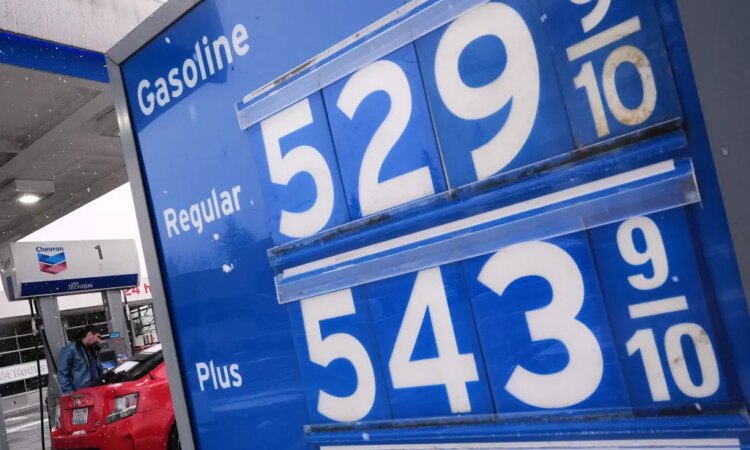
After several months of tumbling costs, the price at the pump is going up again.
The average nationwide cost of gasoline increased by 11 cents month-over-month, registering at $3.07 per gallon of regular unleaded. In Chicago, the price of a fill-up saw a 3-cent jump from January to February, landing at $2.97 a gallon, according to data from the U.S. Energy Information Administration.
Higher prices are also forecast for March. The war with Iran has disrupted oil production and distribution as the Islamic Republic targets shipping traffic and energy infrastructure with the intention of inflicting economic pain on its adversaries.
Rising gas costs have consequently become a point of contention for the president, who prior to the war oversaw consistently lower prices compared to his predecessor — something the White House often touted. Just last month, prices fell below $3 per gallon for the first time since early 2021.
Still, the national average remains 2.5% lower than it was in the last full month under Biden. Whether those gains will last remains to be seen.
President Trump bragged about low gas prices. The Iran conflict has him doing an about-face.
Natural Gas:
Piped utility gas, or natural gas, is another expense that’s steadily rising. Prices now sit at $1.75 per therm after shooting up another 5 cents to their highest in three years and the second-highest on record. Across the country, Americans are paying nearly 13% more to heat their homes, ovens and stovetops than when Biden left the Oval Office.
That number could increase, as the Iran war is also expected to take a toll on natural gas costs. Qatar, a major supplier of liquified natural gas, has halted exports, and Iranian strikes have effectively closed the Strait of Hormuz, a key oil and gas shipping route in the Persian Gulf.
In Europe, natural gas has already rocketed up 60% since the start of the war, indicating we may see similar spikes stateside.