
Breckenridge eyes proposal for an energy network that could take some town-owned facilities off the natural gas pipeline


Kit Geary/Summit Daily News
Breckenridge is continuing to vet if a system aimed at decommissioning parts of the gas pipeline is a feasible undertaking for the town as it and other communities in Summit face a gas shortfall.
Breckenridge Town Council received an update on the first phase of a thermal energy network feasibility study, and insight into phase 2 at a Tuesday, Jan. 13, meeting. According to the Building Decarbonization Coalition, thermal energy networks involve “a shared network of water-filled pipes that transfer heat in and out of the building.”
Sustainability manager Jessie Burley said the town has been talking about thermal energy networks and geothermal energy for the last year in three different contexts: the town’s energy initiatives, Xcel Energy’s Mountain Energy Project and a pilot program with the Colorado Energy Office.
First, Breckenridge is less than a decade out from a goal it set for itself to reach 100% renewable energy community-wide by 2035. It is also aiming to reduce carbon emissions by 80% by 2050.
Second, the town is on Xcel Energy’s Eastern Mountain Gas System, which the energy provider’s Mountain Energy Project targets because of the potential for gas shortages in the system. Shortages would only occur if the town were to experience consistent temperatures below approximately -39 degrees for numerous days in a row. Burley said there’s not much consensus on the exact temperature that triggers the shortage and it’s unlikely at this point in time.
To mitigate the potential for future shortages and to meet its own energy goals of being a net-zero provider by 2050, Xcel plans to introduce more non-pipeline alternatives for natural gas to ease demand on the Eastern Mountain Gas System. The project also looks to avoid having to expand the gas pipeline to meet demand, which could have been an estimated $300 million project.
Lastly, in June, Breckenridge was one of five communities chosen by the state to participate in a pilot program directed by the Colorado Energy Office meant to explore neighborhood-scale alternatives to traditional gas infrastructure. Projects in the program aim to decommission portions of a gas system to avoid having to expand it.
Burley said the thermal energy network the town is currently considering would seek to get town-owned facilities, like town hall, off the gas system, not residences.
The town brought on the GreyEdge Group to conduct its thermal energy network feasibility study, and CEO Matt Garlick presented the opportunities the town has at its disposal at the Jan. 13 meeting.
While the first phase of the feasibility study examined different thermal opportunities, the second phase will be more granular with a narrow scope. A staff memo stated the cost will not exceed $142,000. The town secured a $32,000 grant from the state to put toward the cost.
The proposal
Garlick said the town has “really ambitious energy goals” that can’t “be accomplished by simple and small efforts.”
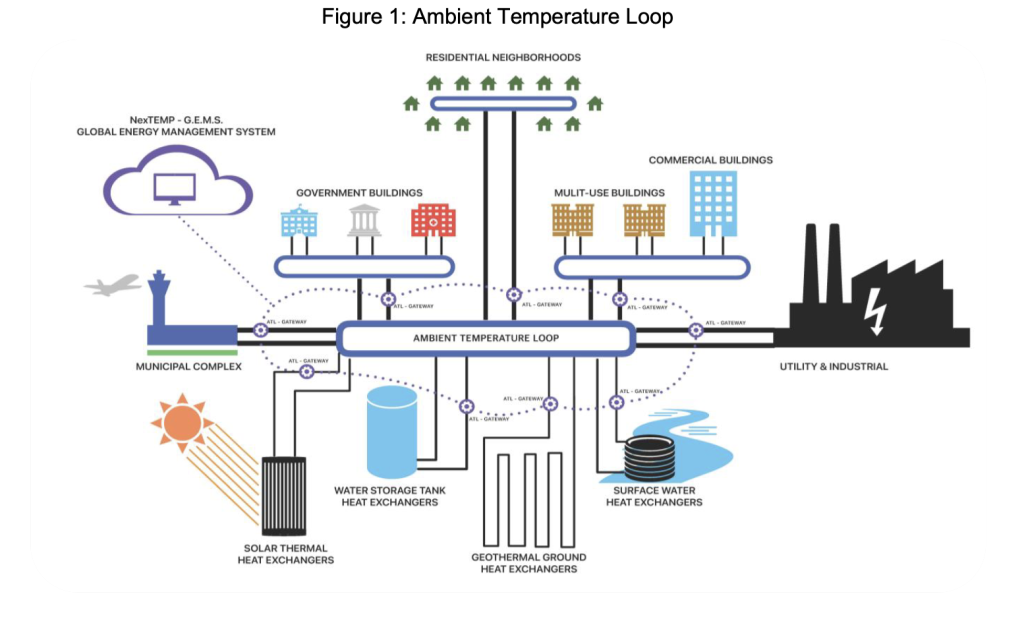
He said to meet its goals for electrification, the town’s most efficient and most cost-effective option is an ambient temperature loop, a system that can bring energy to several structures at once.
Put simply, the ambient temperature loop is a buried water pipe loop that serves as the central conduit for energy to be delivered to numerous buildings and structures in a given area. The loop pulls energy from diversified sources including solar-thermal heat exchangers, geothermal ground heat exchangers and water heat exchangers. The energy taken from those sources is delivered to the buildings via heat pumps.
The ambient temperature loop also includes energy sinks, which Garlick described as essentially places where energy can be stored when it’s not needed.
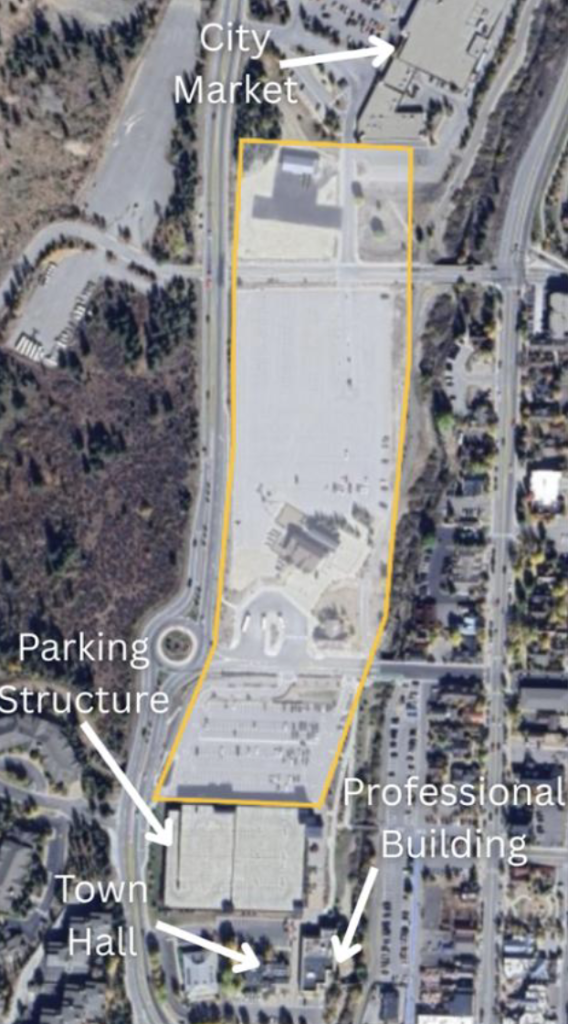
Based on the findings from the first phase, the GreyEdge Group recommended a thermal energy network for a “microdistrict” consisting of town hall, the South Gondola parking structure, the transit center, City Market and the town’s professional building next to town hall.
Part of the reason GreyEdge identified a microdistrict near town hall is because it and the professional building have snowmelt systems, which require significant energy loads.
Additionally, there are numerous opportunities to pull energy from surrounding areas. The parking structure could serve as a solar energy collector in the summer if it were equipped with solar panels, and the lot north of the BreckConnect gondola could be used as a site for a geothermal heat exchange system. There are also opportunities near the microdistrict to pull water energy through a mechanism that couples ground source heat pumps with ground water without drawing any water above ground.
Mayor Kelly Owens wondered who would own and operate the loop if the town were to take GreyEdge’s recommendation.
Garlick said the ownership model could take a few different forms. He said the loop would need to be financed, owned and operated. He said involved parties could be a public entity like a municipality, a utility like Xcel Energy and a third-party like an energy performance company.
Any of the involved parties can take on any of the responsibilities. For instance, a municipality could finance a loop, a utility could own it and a third party could operate it.
Council member Todd Rankin asked Garlick if utilities in Colorado have been willing to shoulder the cost, or if it has fallen mostly on municipalities.
“Third parties are really eager to do this kind of thing. … Utilities are still kind of looking at this,” he said. “They’re trying to convince their board of directors, their investors, that this is a viable utility business model.”
Burley said the town of Hayden is installing a similar geothermal system that it plans to own as a municipal utility.
Garlick said there’s already an ambient temperature loop in Colorado that is considered a success at Colorado Mesa University, who have had theirs for nearly 20 years. He said it saves the university $2 million a year in energy costs.
He said Carbondale was also looking at a loop. Vail also engaged in a similar feasibility study for one.
Council member Dick Carleton asked Garlick about the capital outlay of a project like this. Garlick estimated it would cost $10,000 to $15,000 per heating ton. So, if a building required 30 heating tons, it could cost $300,000 or more.
He said there’s an opportunity for tax credits through the Inflation Reduction Act to recoup up to 40% of the cost and Xcel Energy has some incentives the town could tap into. Burley said the state also had tax credit for these types of initiatives.
Council feedback
Council members wanted to know what the return on investment would be for an ambient temperature loop.
Garlick didn’t have the exact return on investment but said “it is a lower cost operating system than anything else.” He said it depends on local resources.
Owens said she wished the council was given a return on investment estimate because it’s important to them to be good financial stewards for the taxpayers. She said the council wanted to ensure the initiative was cost competitive.
“We need (to) stop talking about this as a green energy, because that’s not maybe the number one priority. … The number one priority is to have a reliable energy source,” she said.
Rankin wondered how GreyEdge’s proposal would solve the gas shortage and energy problem the community at-large faced in a way that made financial sense.
“How do you get all that infrastructure out to all these homes that already have natural gas?” he asked, noting Gralick’s $10,000 to $15,000 per ton estimate.
Burley said it’s just one tool in the toolbox that will avoid a gas pipeline expansion. She said there will still be a supplementary gas supply facility in town for those who want to remain on natural gas.
“Xcel has this bucket of money as incentives to keep people from growing the gas system, or growing the demand on the gas system,” she said. “This is one opportunity to target a geographic area.”
She said incentives for electric upgrades could amount to $7,500 to $20,000 per heating ton for ground source heat pumps.
Council member Carol Saade wondered why the systems weren’t more prevalent, and asked Burley what challenges the town would need to overcome to tackle such a project.
Burley said there’s a lot of questions in the regulatory space with these systems, and because it’s so gray there’s been some hesitation in the U.S. around them, but noted they are popular in Europe.
“Conventional energy makes money for the utilities, and they are perfectly happy doing business as usual so long as (there isn’t) legislation or regulation pushing on them to do more, which is why they’ve come to the table with these (cleaner energy) pilots they are now required to do,” she said.
Carleton asked Garlick if Carbondale ended up doing an ambient temperature loop project.
Garlick said not yet because the town did not receive the second round of federal funding for it.
Owens said she’d like to continue the discussion and get more answers to some of the questions council raised.


