

Listen to this article
Estimated 6 minutes
The audio version of this article is generated by AI-based technology. Mispronunciations can occur. We are working with our partners to continually review and improve the results.
A contract between the Nova Scotia government and Dalhousie University for an onshore natural gas program shows the majority of its $30-million budget is earmarked for incentives to potential developers.
The agreement was released this week by the Department of Energy, which committed to doing so following calls from the public last month. Although the deal was announced late last year, the department said the details were not finalized until now.
Included in the document is a breakdown of the program’s multimillion-dollar forecast. Salaries and benefits, operating costs and external consultants add up to about $1.7 million, while research gets $4 million and exploration incentives get a bit more than $24 million.
The contract says that if Dalhousie underspends in other categories, it should redirect the leftover money to exploration incentives.
A citizen group that’s concerned about the risks associated with onshore natural gas development says the contract demonstrates that research is not the priority.
“If you look at the money, you look at the balance of the money, it’s really about finding a way to get fracking on the ground and get it started here without really giving people a chance to publicly voice their concerns,” said Jonathan Langdon, a member of the Nova Scotia Fracking Resource and Action Coalition.
He noted that the contract says if there’s “an insufficient number of proposals” following Dalhousie’s open call to exploration companies, the university is supposed to undertake a review and meet with industry representatives to find out why and rework the program.
“That really feels like this is more about trying to get people to come here to do this, as opposed to actually engaging in a process of asking questions about: is this the right thing to do?” he said.
A spokesperson for the Department of Energy said the budget is a reflection of exploration being more expensive than research.
“Without industry, we won’t be able to conduct research,” they said in a statement. “That’s why we’ve allocated funding to encourage industry to participate in the program. The amount allocated for research is lower simply because we can leverage the expertise of Dalhousie and their partners to maximize the benefits to Nova Scotians.”
“Critics don’t want any development or jobs associated with development so we are unsurprised by their statement,” the department said.
Langdon said a clause that gives the province exclusive ownership of all the information that’s “collected, created or produced by Dalhousie” adds to his concern that the program doesn’t have a “true research agenda.”
‘The timeline is so short’
The contract says Dalhousie is supposed to have the incentive program developed by the end of this month. Starting in March it’s supposed to market the offering and open a call for proposals from exploration companies.
By the fall, the province wants companies doing exploratory drilling, and for their data to be shared with Dalhousie researchers who would in turn compile a report for the government at the end of this year.
Langdon said the province did “the right thing” in releasing the contract. He said he would now like to see an opportunity for the public to give feedback on the program.
“It seems rather that the timeline is so short … there’s not going to be time for real engaged public discussion around it.”
Safety concerns
Mark Tipperman, another member of the coalition, said the agreement tells him the results are “preordained.”
“If we look at this contract from a stratospheric level, it looks like it’s a fairy tale about how fracking is safe and will bring profits and jobs for the province,” he said.
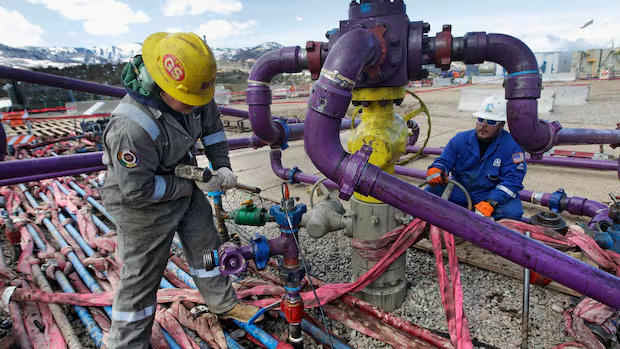
Fracking, or hydraulic fracturing, is a common commercial drilling method that uses blasts of water, sand and chemicals at high pressure to release gas from underground rock formations.
It’s controversial because of the risks it poses to human and environmental health; scientists have linked fracking to water and air pollution and seismic activity.
During a period of fracking interest in Nova Scotia, the province commissioned a report that concluded fracking should not proceed and more research was required to understand the economic, social, health and environmental impacts.
A ban was put in place through legislation in 2014, but Premier Tim Houston’s government lifted that ban last year.
“The government just seems to be completely ignoring the existing body of scientific knowledge,” said Tipperman.
Houston, who also serves as energy minister, has been pushing for natural gas exploration as part of his broader bid for more natural resource development, which he says is an economic imperative.
He has said that resource technology has advanced in recent years such that it may be possible to drill more safely, with fewer risks.
His department’s statement to CBC News echoed those arguments.
“It’s incredibly important that we take full advantage of our natural resources, in safe, responsible ways, to boost Nova Scotia’s economic and energy security,” it said.
“We want industry to bring the latest best practices to Nova Scotia for our researchers to evaluate their application here, so we can learn and make informed decisions going forward.”
The newly released contract describes seven specific areas the province expects Dalhousie to study and report back on, including:
- Geological studies. Specifically the geological and engineering viability of the Horton Bluff formations in the Windsor-Kennetcook basin — one of the areas that was the focus of a government study in 2017.
- Groundwater and wastewater studies to establish baseline data on water quality, with expanded monitoring during drilling “to quickly detect any changes linked to exploration activities.”
- Methane emissions studies, again with an emphasis on establishing baseline data, followed by monitoring during exploratory drilling. The contract says methane emissions are “the issue most critical to public trust, regulation and market access.”
- Seismic analysis to create a baseline before exploration begins. “This baseline is essential because activities like drilling, hydraulic fracturing and wastewater disposal can change underground stresses and sometimes trigger small or even felt earthquakes,” the contract said.
- Transport and infrastructure studies to analyze industry needs and examine how increased industrial activity might affect local communities.
- Community health impact studies with a focus on rural and lower-income populations. Dalhousie is supposed to provide “plain-language resources” for patients and caregivers and clinical guidance for health-care providers.
- Exploratory drilling analysis from datasets provided by companies and the province.
MORE TOP STORIES


