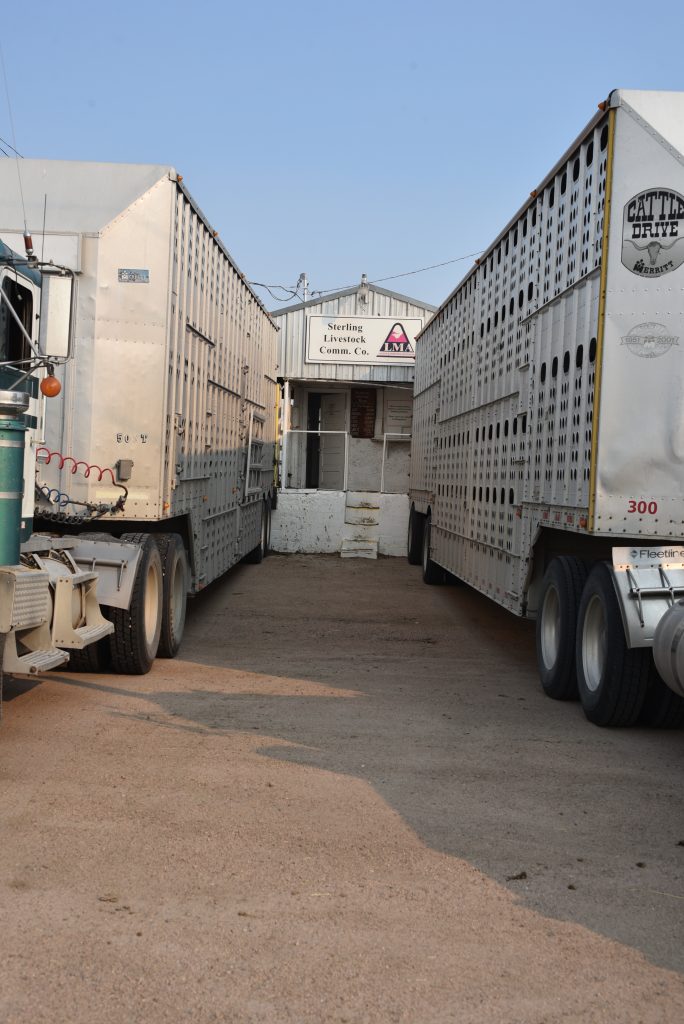
Kory Kessinger operates a cow-calf operation in northeastern Colorado. When he stopped feeding cattle several years ago, he needed to ensure some additional cash flow, though his wife said he needed to add some chaos to his life. He owns Slash Y trucking and owns 13 cattle trailers. Kessinger specializes strictly in livestock trucking.
“My business alone is trailers and I hire owner operators and those guys own the trucks, pay their own insurance and they’re self employed,” he said. “I have the trailers and the loads.”
He dispatches his 13 owner operators in addition to his cattle operation, which he admits makes for an incredibly busy fall when both the trucking business and the cattle operation are busy.
Kessinger dispatches the drivers who haul his trailers, primarily hauling fat cattle as well as cows to and from grass.
“I do the dispatching and during certain times of the year, I’m scrounging loads to keep 13 trucks running and to keep everyone’s gross over $6,000 per week,” he said. “Most of the year — 35 to 40 weeks of the year, that’s not too hard to do, but the other weeks it can get difficult. It’s a very seasonal business, like most of agriculture is.”
Most of Kessinger’s drivers run in a 250-mile radius but he also has four or five drivers who will run a longer trip to St. Louis, which is 780 miles, but it depends on the driver.
“We pull cattle from Colorado, Wyoming, Nebraska, Kansas, sometimes Utah and also haul to Hereford, Texas, periodically,” he said.
Kessinger reached an arrangement with Cargill and hauls predominantly fat cattle, which requires that the drivers who haul loads for Slash Y know cattle. On shorter hauls, like from the salebarn to a feedyard, drivers will load and unload the trailer multiple times per day.
“I try to hire guys who know livestock or are willing to learn,” he said. “They have to load and handle cattle, and they need to know when to get out of the way and when to push.”
A GOOD LIVING
Kessinger said his owner operators, all of whom are self-employed and contract with him, have the potential to make a good income.
“On the driver side, if they’re willing to put hours in — our days are 12-13 hour days — and the truck is mechanically sound, they’ll put 25% of that in their pocket,” he said. “That’s a good living over 52 weeks. There are times there are issues and they sock away money to be able to solve problems when they arise.”
He said most drivers save a portion of their income in a separate account so when mechanical issues, for example, arise, they have the savings to resolve it. That way, he said, if they have to rebuild an engine, the funds are there and they don’t have to dip into their personal savings to get back on the road.
“It’s a lot of hours, and it’s early mornings and late nights, but if you like being around livestock and driving, it’s a good fit,” he said. “Most of those guys couldn’t be talked out of doing it for a living.”
With that many hours and miles under their tires, Kessinger said safety is top of mind, especially with the incredibly valuable loads of cattle on the trailers. He said he doesn’t ever force a driver to accept a load and if they need time away, he tries to accommodate it. That time away, he said, translates into longevity of the drivers, keeps them from burnout, and keeps them safe.
OBTAINING A CDL
Kessinger said recent legislation changes have made it more difficult and much more expensive for potential drivers to obtain their Commercial Drivers License.
“I appreciate the push in rural America where schools are introducing and celebrating trades,” he said. “In Akron, they have a grant and they have their own semi-truck and trailer and have a class right there and you earn credits through Northeastern Junior College and can then take the CDL test. Neighboring schools are sending kids there and that’s a significantly less expensive route. NJC does their driving on the weekends to allow for a traditional classload. It can be costly if you don’t go through the program.”
Two of Kessinger’s owner operators are young, one is 19 and the other is 21, and he said they’re taking advantage of the opportunities and making a good living. Kessinger attended Colorado State University before deciding college wasn’t the route for him and returning home to the farm and ranch. He said young people need to figure out what they want to do and sometimes, college isn’t part of that equation.
“I went to college and hated class — I loved to party — and eventually got tired of wasting money and came home to work,” he said. “Today, these kids don’t go spend the money if it’s not necessary. Lots of those kids have really established themselves financially and are far ahead of the kids who spent years in college. Kids just need to decide what it is they want to do and figure out how to do it. There’s a lot of opportunities in rural Colorado and kids are doing the math. Making $60,000 in Denver is one thing, making $60,000 in Akron is another thing.”
This article is part of our commitment to young people interested in agriculture careers. It is articles and profiles like this one that will appear in Grounded Magazine this fall. Grounded will be distributed to agriculture classes around the readership area with the goal of encouraging great kids to work in the ag industry.