China has been preparing for a global energy crisis for years. It is paying off now | China
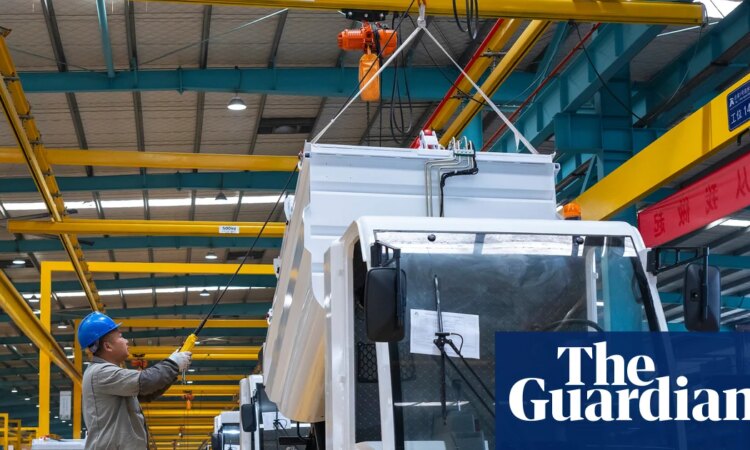
Xi Jinping has been preparing for a crisis like this for years. China must secure its energy supply “in its own hands”, its president was reported to have said during a visit to one of its vast oilfields in 2021.
The US-Israel war on Iran plunged the Middle East into a deep conflict, with the strait of Hormuz – one of the most important waterways in global trade – all but closed and key energy facilities across the region under attack.
Oil exports from the Middle East have tumbled 61% over recent weeks, according to maritime tracking consultancy Kpler – roiling countries across Asia, which relied on the region for 59% of its crude imports in 2025, and have been left racing to conserve energy.
But China, the world’s second-largest economy, appears to be in a very different position to much of the continent.
Its energy system has “significant buffers”, Michal Meidan, the head of China energy research at the Oxford Institute for Energy Studies, an independent research institute, explained in a recent paper – from huge reserves of oil and liquefied natural gas (LNG) to a robust domestic supply, including alternative energy sources, such as wind and solar.
China, which usually imports around half its crude supplies from the Middle East, is not as exposed as other Asian economies. “While a very high proportion, it is limited when compared to Japan, India or Korea,” said Meidan. Japan, for example, sources about 95% of its oil imports from the region.
Iran has continued to ship to China, the primary buyer of its oil, despite the war. China’s imports of Iranian crude have slipped only marginally, according to Kpler estimates, from 1.57m barrels per day in February to 1.47m barrels per day in March.
Chinese vessels operated by state-owned firms are meanwhile working to navigate the broader region. The Kai Jing supertanker diverted to pick up Saudi crude at a Red Sea port earlier this month, Chinese media outlet Caixin reported, and is set to dock in China in early April.
And even if Beijing is forced to confront an overseas supply crunch, it has quietly amassed an extraordinary hoard to mitigate the ramifications of a major shock.
Beijing does not disclose the size of its oil reserves, and estimates vary significantly. But it is widely agreed to be sitting on a massive stockpile: about 1.4bn barrels, according to Columbia University’s Center on Global Energy Policy.
After the war began, Beijing instructed its own refineries to stop exports.
At the same time, the Chinese state has sought to reduce its economic reliance on fossil fuels. More electric and hybrid vehicles are sold inside China each year than across the rest of the world, according to the International Energy Agency.
Its renewable sources of power have meanwhile expanded rapidly in recent years, curbing its dependance on fossil fuels. Energy thinktank Ember estimates that wind, solar and hydropower generated about 31% of China’s electricity in 2024.
But the longer this crisis drags on, the more complicated – and painful – it becomes. No country is immune.
Energy stockpile releases are “easier said than done”, according to Meidan, who said the mechanism for China’s strategic petroleum reserve (SPR) has been tested only once. “While another, larger, SPR release is not impossible, it would likely require a protracted supply shortage and a significant price spike.”
Independent refiners in China – the biggest importers of Iranian crude – are the most vulnerable, even as they turn to Russia. Industrial and chemical sectors reliant on LNG also face the prospect of higher prices and supply shortfalls.
“While a short disruption could be manageable, the prospect of lengthy disruptions and the associated price increases are raising alarm bells in Beijing,” said Meidan.
China is better placed than most to navigate the economic dangers thrown up by the US-Israel war on Iran. But its energy supply is not, despite Xi’s vision, entirely in its own hands.
Should weeks turn into months, and if the global energy market continues to creak, its resilience will be tested, just like the rest of the world.