Two federal agencies say a recently proposed $33.3 billion, 9.2 gigawatt (GW) natural gas plant in southern Ohio will eventually power a data center.
The facilities, including the behemoth proposed 10 GW data center, will be constructed on revitalized U.S. Department of Energy land in Piketon, where the Portsmouth Gaseous Diffusion Plant was.
There, the former enrichment buildings are in various stages of demolition. Some are nothing but rubble.
SB Energy, a subsidiary of Tokyo-based SoftBank Group, will lead the project. It will also invest $4.2 billion in new transmission lines across southern Ohio, in partnership with American Electric Power Ohio. SB Energy was attracted to Piketon because of the high density of the existing transmission infrastructure, among other reasons, an official said Friday.
To start, SB Energy said it will invest $10 billion in an 800 megawatt data center, creating 4,000 construction jobs and 300 to 400 operational jobs. That could grow to 35,000 construction workers and 2,500 operational staff, the official said.
Construction is scheduled to start this year, with the data center coming online in two years, according to a U.S. Department of Energy official.
“It’s just going to be a generational change for this area, and we’ve struggled economically, there’s no doubt about that,” Sen. Shane Wilkin (R-Hillsboro) said Friday. But Piketon, he said, “frankly, won the Cold War by the work they did here at this site.”
Wilkin he isn’t worried about where Ohio will get the workers. “I would much rather need the workers and have the jobs than not have the jobs,” he said.
The Portsmouth Gaseous Diffusion Plant, near Piketon, started enriching uranium in 1954 for the U.S. nuclear arms program, and later for commercial nuclear reactors. It shut down uranium enrichment in 2001.
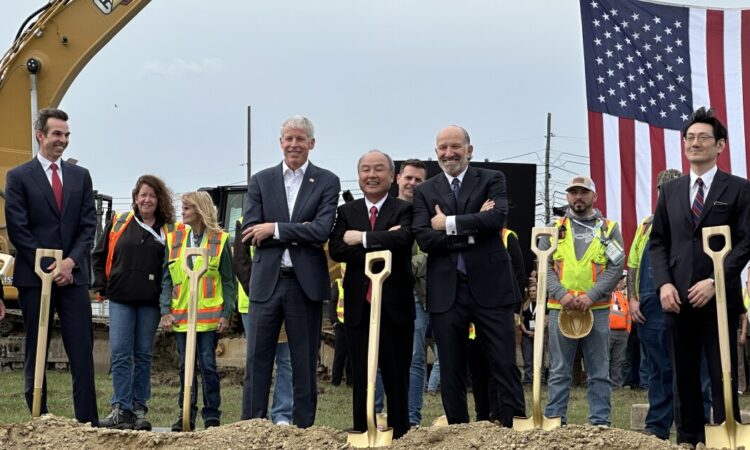
Current workers at the Portsmouth Site, most clad in a neon vest, filled the white tent Friday for the official announcement—which was also attended by government officials and SoftBank executives.
“I haven’t heard anything negative from the community,” Assistant Secretary Tim Walsh said in an interview. “Over the last 20 years, they’ve lost so many jobs, and now they see this as a way to really grow the future for themselves and their families.”
The investment was born from a $550 billion trade deal between the U.S. and Japan, according to U.S. Department of Commerce data.