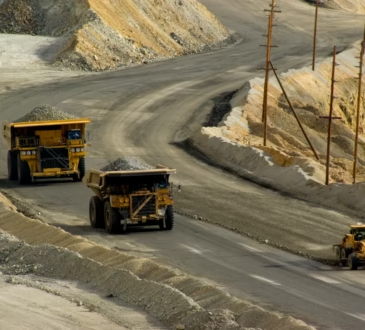
Regional analysts anticipate continued moderation in global commodity prices throughout the year.
Doha, Qatar: Commodity price movements in Qatar during early 2026 have reflected a mix of global market trends and strong domestic economic fundamentals, according to analysts, who point to both external pressures and strategic national positioning.
Qatar’s longstanding role as a leading LNG exporter, combined with its strategic long-term supply agreements, has helped mitigate volatility compared to broader energy market trends.
“Qatar’s diversified export framework and long-term contracts have acted as a buffer against short-term global price swings, especially in LNG,” Abdul Salam, a senior economist in Doha, told The Peninsula. “While oil markets face downward pressure, the focus on gas and petrochemicals has provided stability for Qatar’s export revenues.”
In addition to energy, global agricultural commodities have shown moderation, with indices indicating declines in food prices and softer movements in crop markets, a trend that could alleviate cost pressures in import-dependent countries.
“Lower global food prices can ease inflationary effects, but they also reflect weak demand and oversupply in multiple regions,” Salam said.
Domestic observers note that Qatar’s economic stability and diversified import sources have played a meaningful role in tempering the impact of global shifts on local commodity prices.
“The alignment of exchange rate stability, prudent fiscal policy, and diversified supply chains helps insulate Qatar from extreme commodity price turbulence,” the industry expert noted.
Regional analysts anticipate continued moderation in global commodity prices throughout the year. However, Qatar’s strategic positioning in the natural gas market and ongoing investments in energy infrastructure are likely to sustain more stable price dynamics relative to broader global fluctuations.
Salam stated, “The global outlook may be soft, but Qatar’s unique export profile and proactive economic planning position the country to navigate these trends effectively.”
The World Bank’s latest Commodity Markets Outlook, however, indicates that global commodity prices are forecast to decline for a fourth consecutive year in 2026, with overall prices expected to drop by roughly 7 percent amid weak global growth, an ample oil supply, and ongoing trade uncertainty.
Energy prices, a key driver for many markets, are projected to decline further, continuing to moderate inflation worldwide.
The global commodity price environment remains challenging, particularly for energy, which has a disproportionate impact on inflation and trade balances.
“The forecasted trend into 2026 underscores the influence of oversupply and challenging demand, especially in oil markets,” Salam added.