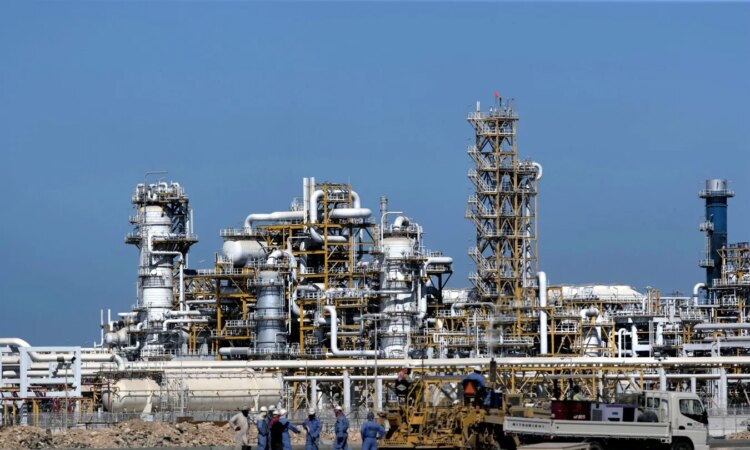

The Qatar Liquefied Gas Company Limited (Qatar Gas), a joint venture company set up by Qatar Petroleum and ExxonMobil Corporation, has expanded its facilities at the Ras Laffan industrial city natural gas liquefaction plant in Qatar. (Photo by Olivier Polet/Corbis via Getty Images)
Corbis via Getty Images
Iran struck Qatar’s Ras Laffan Industrial City—the world’s largest LNG export hub—with a barrage of missiles overnight this week, triggering fires across multiple liquefied natural gas facilities and causing what QatarEnergy called “extensive further damage” to a complex already crippled by earlier drone attacks.
The strike came hours after Israel hit Iran’s South Pars gas field—the first time Israel had ever targeted Iranian natural gas infrastructure. Now the world’s energy calculus has permanently changed.
The conventional coverage of this crisis is too narrow. While everyone is watching oil prices, the more consequential—and longer-lasting—impact is on global LNG markets. Gas infrastructure has become a weapon of war, similar to the fighting between Russia and Ukraine. But the world has no strategic reserves, no emergency stockpiles, and no quick fixes. The ensuing problems that unfold in the coming weeks and months will be measured not in barrels, but in heat, electricity, and fertilizer, while the ripple effect will resound worldwide.
Before the war began on February 28, global natural gas prices were relatively stable. When QatarEnergy halted production on March 2 following the initial drone attacks, prices nearly doubled in a single week. Asian LNG spot prices have since surged to roughly $20 per MMBtu—five times the current U.S. benchmark—according to Wood Mackenzie research director Miaoru Huang. After the missile strike on Ras Laffan, gas prices in Europe surged another 24% and in the UK another 23% within hours.
The combined disruption has removed approximately 5.8 million tons of liquefied natural gas from global markets in March alone—roughly 14% of what the world expected to receive this month. Meanwhile, the Strait of Hormuz, the narrow waterway through which a significant share of the world’s energy passes, has effectively shut down as a shipping lane, with dozens of tankers now idling offshore, unable to move in or out of the region, according to Kpler, which tracks vessel movements in real time.
“Unfortunately, there’s no spare capacity in the LNG market, so the disruption in the LNG market will be immediate and immense,” Florence Yu, LNG market analyst at Vortexa, told Lloyd’s List. Yu noted that 20% of global LNG and 90% of Qatar’s LNG exports pass through the Strait of Hormuz—the heart of the conflict. This is notable given that Qatar is responsible for 20% of global LNG supply.
Gas Has No Strategic Reserve
TEHRAN, IRAN – MARCH 01: Smoke rises from the area after it was targeted in attacks as a series of explosions are heard in Tehran, Iran on March 01, 2026. The Islamic Republic of Iran Broadcasting (IRIB) building after Iranian authorities said it was targeted in the attacks, as the Iranian army announced it had launched new strikes against U.S. and Israeli targets (Photo by Fatemeh Bahrami/Anadolu via Getty Images)
Anadolu via Getty Images
The oil world includes the International Energy Agency and hundreds of millions of barrels of strategic petroleum reserves that governments can release in emergencies. The LNG world has nothing equivalent. The international community spent decades building a safety net for oil shocks. It never built one for gas. That oversight just became everybody’s problem.
Even if the war stopped tomorrow, Ras Laffan cannot simply be switched back on. The facility requires a careful, weeks-long restart process before it can produce and ship a single cargo. But that is the least of the problems. The damage from repeated missile strikes is so severe that full repairs are estimated to take up to five years—and not a single repair crew can set foot inside until the conflict is completely over.
Qatar’s Energy Minister confirmed that disruptions to Qatari LNG exports may last far longer than initially assumed, and that a complete cessation of hostilities is required before restart operations can even begin. Production is one matter. Shipping the gas is another. Ali Jabbar, an Iraqi-born American citizen who works as a crisis management specialist, told me that shipping and insurance costs also factor into decisions.
“Chartering a vessel to transport LNG can be very expensive—sometimes around $400,000 per day,” he explains. “On top of that, insurance costs have gone up significantly, and many companies are hesitant to take the risk.”
The shortfall cannot be filled by other countries stepping up production. The United States and Australia—the two most obvious alternatives—are already pumping as much LNG as their facilities can handle. There is no spare capacity sitting idle waiting to be turned on. Nigeria, Algeria, and Trinidad face their own supply limitations. When you add up everything the rest of the world could realistically produce, it covers less than 2 million of the 5.8 million tons that have gone missing from the market this month alone.
The countries that face the sharpest immediate pain are not Japan or South Korea, as most coverage assumes. Taiwan is actually the most vulnerable, having relied on Qatar and the UAE
Alternative Suppliers Possible?
The Greek-flagged LNG tanker Maran Gas Pericles unloads liquefied natural gas from the Sabine Pass LNG terminal in the USA at the Revithoussa terminal near Athens, Greece, on March 12, 2026. The cargo is imported by DEPA Commercial, and via its joint venture with the AKTOR Group, Atlantic SEE LNG Trade, it appears likely that part or all may be destined for Ukraine’s Naftogaz via the Vertical Corridor. (Photo by Nicolas Koutsokostas/NurPhoto via Getty Images)
NurPhoto via Getty Images
Some analysts argued the market was overreacting and that alternative suppliers would eventually fill the gap. That view may have been plausible a week ago, but it is very difficult to make now that Qatar’s gas field has been bombed. Ras Laffan is not a pipeline that can be rerouted. It is not a tanker that can be redirected. It is a complex industrial facility that has been hit twice in three weeks, with damage that energy engineers say could take three to five years to fully repair.
The optimistic scenario requires a complete end to the conflict, the restoration of safe passage through Hormuz, and a two-week restart process—all without another strike. Goldman Sachs warns prices could more than double from here if the Strait stays closed another month. Europe survived a similar crisis in 2022—but only because it had months to prepare.
Tom Kloza, senior energy advisor at Gulf Oil, put the broader stakes plainly in Open Magazine: “Can you imagine the response in the world if Iran targeted something outside of the Persian Gulf—a refinery in Rotterdam or a facility somewhere in the United States? That’s when all bets are off and prices could go absolutely apocalyptic.”
The world has spent 50 years building a system to manage oil supply shocks—strategic reserves, spare capacity, and the ability to redirect tankers at a moment’s notice. It built almost nothing equivalent for LNG, because that type of infrastructure was considered off-limits to conflict. That assumption died during this war.
What is already clear is that the crisis will accelerate LNG investment in the United States, Australia, and Canada—countries with the resources and stability to become reliable global gas suppliers. The disruption is painful. The build-out it triggers may ultimately reshape global energy trade for decades.