Leafy greens budding inside a high-tech container farm could soon impact South Carolina’s agriculture industry, and it’s all starting deep behind a guarded gate at a Columbia women’s prison.
With the help of a team of collaborators, including the South Carolina Department of Agriculture, department of corrections, a nonprofit and a private company, a new vertical farming program is underway at Camille Graham Correctional Center. Besides planning to produce 40,000 pounds of fresh lettuce annually, the program features an opportunity for female prisoners to acquire training and skills in agriculture — toward securing employment following incarceration.
Why farmers should care
While mostly limited to leafy greens, such as arugula, cilantro and lettuce, vertical farming has increasingly become a popular alternative to traditional row farming.
The reason? It produces far more with way less. That’s to say, the process uses significantly less land and water to produce crops.
In some cases, a harvest could be 10 to 20 times more per acre in vertical farming compared to open-field farming, according to the U.S. Department of Agriculture. Not to mention, vertical raised crops are cleaner (with roots not buried in soil) and are much less likely to be contaminated by pathogens harmful to humans such as E. coli.
South Carolina is home to more than 22,600 farms across 4.6 million acres of land, according to the state’s agriculture department.
The state’s top industry, agribusiness — agriculture and forestry — accounts for 259,215 jobs and $51.8 billion in annual economic impact, according to the department of agriculture.
But those numbers could drastically change, for better or worse, as food distributors implement vertical farming.
In 2023, Columbia-based Senn Brothers Produce became the first wholesale produce distributor to operate a vertical farm, according to an article by The Packer. The distributor, which has been around for more than 80 years, serves over 800 restaurants, school districts, military bases, and prisons across the Southeastern region, the article said.
In a news release, announcing the vertical farm launch, the company’s manager, Zach Senn said, “The benefits of vertical farming allow us to control our supply and meet our food quality, food safety and distribution standards.”
Department of Agriculture Commissioner Hugh Weathers said that the vertical farm at Camille has inspired the creation of two others around the state — one is under construction and another in the planning stage — and may impact how farming evolves in South Carolina.
The program, Weathers said, will be incredibly useful in helping to train women to work these upcoming farms upon their release.
Vertical farming at Camille Graham CI
While many SC prisons offer inmates the opportunity to work on traditional row farms, the “Fresh Start” flagship farm at Camille is the first vertical farm inside any U.S. prison, according to department of corrections spokesperson, Chrysti Shain.

Camille Griffin Graham Correctional Institution is a South Carolina Department of Corrections state prison for women in Columbia, South Carolina.
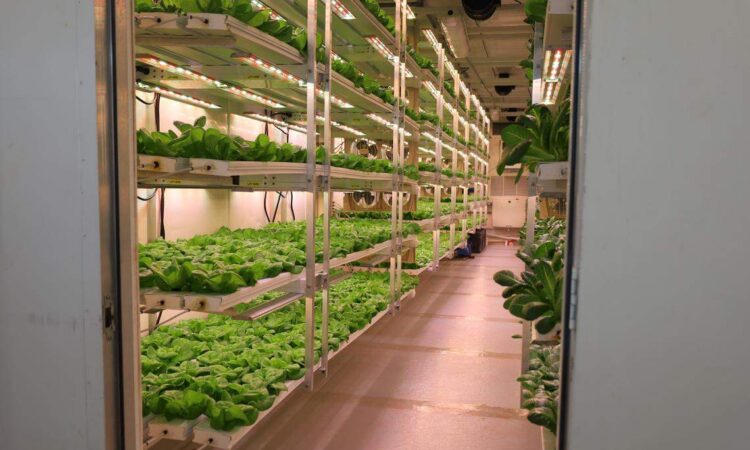
Vertical farming involves cultivating crops in vertically stacked layers within controlled indoor environments like shipping containers. The method uses hydroponics — nutrient-rich water delivered directly to the crop’s roots — instead of soil and LED lighting to grow crops year-round.
Each level inside the container also has fans attached to the end of the shelf, which helps to regulate temperature.
Containers at Camille were donated by Amplified Ag, a private company that specializes in indoor farming technology.

Vertical farm at Camille Graham Correctional Institution, March 19, 2026.
“This program is the most meaningful project I’ve been a part of in the last 10 years at Amplified Ag,” Amplified AG CEO David Flynn told reporters during a news conference Thursday, adding that the program has been in the works for the past four years.
The state contributed $350,000 to the program, and an anonymous donor gave another $850,000. And other than building the infrastructure required to house the containers, the program cost the corrections department nothing, Shain said.
Another project collaborator, Impact Justice — a California-based nonprofit focused on justice reform — helped in developing a training program for inmates, including in controlled environment agriculture and in GAP, or good agricultural practices. The nonprofit also offers inmates with ServSafe certification, workforce readiness preparation and direct, post-release employment support.
“When people leave prison with real skills and real opportunities, the people of South Carolina benefits,” said Alex Busansky, president and founder of Impact Justice.
Department of Corrections Director Joel Anderson analogized the program and the process of growing lettuce to the journey female inmates experience at Camille, calling it a “healing process.”
“The seed (of the lettuce) represents the time an inmate first arrives (at the prison), that’s their foundation,” Anderson said. “As the cultivation process continues, eventually they grow into a fully grown product, ready to rejoin society. “I want them better the day they leave (the prison) than the day they came in.”

From seed to head, lettuce vertically farmed at Camille Graham Correctional Institution takes around 36 days, compared to 55 to 65 days in the field.
With the program expected to produce 40,000 pounds of lettuce annually, Shain and others said the goal is to distribute portions to other correctional facilities around the state. Currently, a sizable portion of the produce goes to Camille’s kitchen, which collaborators say adds a much-needed source of healthy food.

Fresh lettuce vertically farmed at Camille Graham Correctional Institution packaged, ready for delivery.
State Rep. Patrick Haddon, R-Greeville, a 7th generation farmer, told reporters Thursday he’d only learned of the program three weeks ago and that, perhaps, was a good thing.
“This has been a major collaboration effort that worked,” he said. “Anytime we (reps.) are left out, things get done.”