
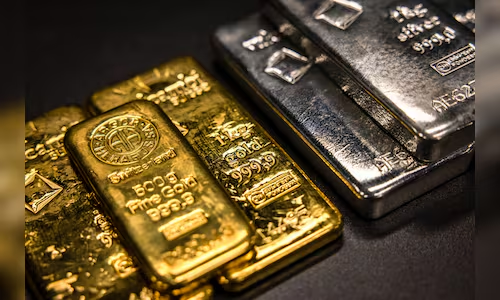
The spectacular rally in gold, silver and industrial metals is no longer just a story of inflation hedging or cyclical demand. Market experts say the surge reflects deeper structural anxieties around runaway US debt, the future of the dollar and a global shift towards hard assets — a trend they believe is far from over.
Gold has risen nearly 60% over the past year, silver has surged about 150%, and copper is up more than 50%, prompting investors to reassess metals as a core asset class rather than a tactical allocation. According to market participants, this is not a conventional commodity cycle but what many are now calling a global “metals melt-up”.
US debt and dollar fears drive rush to hard assets
At the heart of the rally lies growing concern over America’s fiscal trajectory. Kunal Shah, Vice President and Head of Commodities Research at Nirmal Bang Securities, said the pace at which US debt is expanding has fundamentally altered investor behaviour.
The US is currently sitting on debt of around $37 trillion, growing by $1.5–$2 trillion every year, while interest rates remain elevated. Servicing that debt, Shah argues, is becoming increasingly unsustainable.
“This was the starting point of the rally,” Shah said. “There was fear that the dollar could lose 10–15% of its value or worse. When paper currencies are perceived to be losing value, investors naturally gravitate towards commodities and hard assets.”
That shift has been reinforced by a broader move away from globalisation towards protectionism, as countries prioritise securing their own supply chains amid tariff wars and geopolitical uncertainty. In such an environment, commodities — particularly precious metals — are increasingly being viewed as a form of monetary insurance.
Shah added that the rise of alternative systems, including crypto assets and parallel payment mechanisms, has further weakened confidence in the dollar’s long-term dominance, pushing more capital towards tangible assets.
From safe haven to supercycle as metals behave like equities
What has surprised even seasoned market watchers is the sheer scale and speed of the move. Peter McGuire, Chief Executive Officer of Trading.com, said few analysts would have believed these price levels a year ago.
“Most were talking about $3,500 gold as a stretch and $40 silver as optimistic,” McGuire said. “We’ve seen silver touch $84. It’s extraordinary.”
According to McGuire, the rally is being fuelled simultaneously by central bank buying, retail participation and strong activity across both paper and physical markets — a rare alignment that typically underpins long, sustained bull runs.
He believes gold remains in the early stages of such a cycle and expects momentum to continue well into 2026. McGuire has flagged a near-term target of around $4,750 for gold, roughly $300 above current levels, arguing that the metal has firmly entered the global mainstream.
“This is no longer niche market chatter,” he said. “People across age groups are talking about gold. It’s on everyone’s radar.”
Also Read | Gold, silver trends explained: What’s supporting prices at elevated levels
Beyond precious metals, the rally has also been underpinned by tight supply conditions. Shah pointed out that there has been little to no incremental growth in the supply of gold, silver or copper since Covid, even as new sources of demand have emerged from data centres, electric vehicles, battery storage and energy transition technologies.
FOMO or fundamentals: should investors still chase the rally?
The sharp rise in prices has inevitably triggered fear of missing out among retail investors — a dynamic that financial planners are urging caution against.
Mrin Agarwal, Director at Finsafe India, said a large part of the current interest in metals is driven by investors trying to play catch-up after missing last year’s rally.
“Even after a 150% return, people are asking whether they should buy silver or get into copper now,” Agarwal said. “A lot of this is FOMO-driven.”
While Agarwal does not dismiss metals as an asset class, she cautions investors against chasing momentum without a clear allocation framework. Unlike equities or mutual funds, access to certain metals — especially base metals — remains limited for Indian retail investors, increasing the risk of poorly timed entry.
Experts broadly agree that metals can play a role in portfolios, particularly as a hedge against currency risk and macro uncertainty. However, they stress that allocation, diversification and discipline matter more than headline returns.
As global debt concerns, geopolitical fragmentation and supply constraints continue to collide, the metals rally may have strong macro legs. For retail investors, the key question is no longer whether metals matter — but how much exposure is prudent without letting FOMO dictate strategy.
Watch the accompanying video for the full discussion.


