
If You’d Invested $10,000 in This Nuclear Energy ETF 1 Year Ago, You Might Be Surprised How Much You’d Have Today

The nuclear energy sector is undergoing a resurgence.
An exchange-traded fund (ETF) lets you invest in a basket of assets, like stocks or bonds, through a single purchase. As such, ETFs can offer diversification, though they often don’t match the same upside as a single winning stock. And yet sometimes, an ETF can beat the market. That was the case for a nuclear energy ETF in 2025: the VanEck Uranium and Nuclear ETF (NLR 0.88%).

VanEck ETF Trust – VanEck Uranium And Nuclear ETF
Today’s Change
(-0.88%) $-1.22
Current Price
$138.21
Key Data Points
Day’s Range
$136.98 – $139.50
52wk Range
$64.26 – $168.12
Volume
9K
This ETF seeks to mirror the performance of the MVIS Global Uranium & Nuclear Energy index, which tracks companies involved in uranium mining, nuclear reactor construction, and generating electricity from nuclear power, among other nuclear-related services. The index has some heavyweight nuclear companies like Cameco and Constellation, as well as advanced nuclear start-ups like Oklo.
If you had invested $10,000 in the VanEck Uranium and Nuclear ETF one year ago, your investment would have grown to about $15,660 today. That would have beat the same investment in an S&P 500 index fund by a long shot.
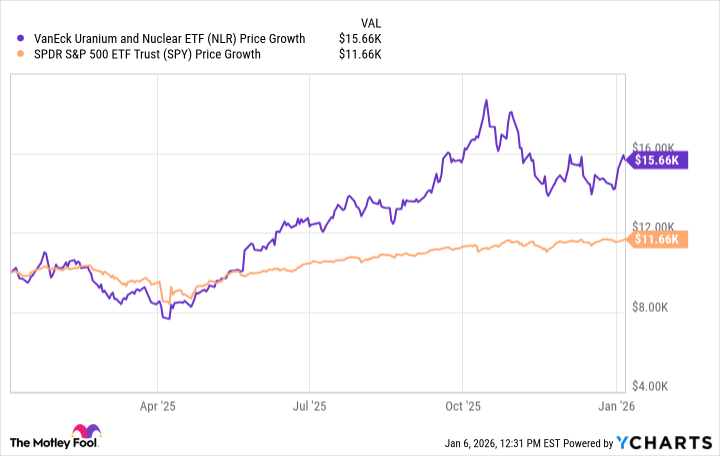
Nuclear energy stocks in general have undergone a sharp resurgence, helped in part by federal efforts to strengthen the U.S.’s nuclear supply chain. Nuclear reactors are also seen as a potential power source for artificial intelligence (AI) data centers, which require the kind of continuous power nuclear reactors can produce.
Image source: Getty Images.
Investors who want to tap into this sharp nuclear comeback may prefer a nuclear energy ETF, like VanEck Uranium and Nuclear ETF, especially if they’re bullish on the sector but don’t want to bet everything on one or two companies.
Steven Porrello has no position in any of the stocks mentioned. The Motley Fool has positions in and recommends Cameco and Constellation Energy. The Motley Fool has a disclosure policy.


