
Lomiko Metals Identifies New Rare Earth Element (“REE”) Anomalies at the Yellow Fox Critical and Precious Metals Property in Central Newfoundland

MONTREAL, January 13, 2026–(BUSINESS WIRE)–Lomiko Metals Inc. (TSX.V: LMR) (“Lomiko” or the “Company”) is pleased to announce results from additional REE analysis from the recently completed Phase II soil sampling and prospecting program (See News Release September 23, 2025) on the Yellow Fox Antimony property. Lomiko optioned Yellow Fox from Metals Creek as per the news release issued on January 21st, 2025.
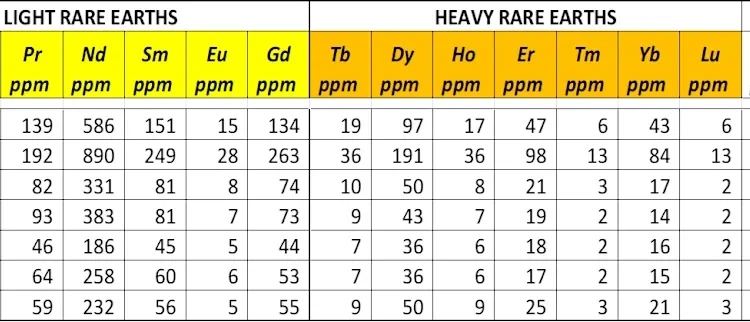
Gordana Slepcev, CEO, President, and Director, stated: “We were very pleased to see very high values in REEs Cerium and Lanthanum coming out from the soil sampling program that we completed in June and September, but even more encouraged with the results from the seven samples we decided to test for the full suite of testing in REEs. The results from Yellow Fox’s expanded REEs test suite came extremely high for Dysprosium (Dy), Neodymium (Nd) and Praseodymium (Pr), with samples approaching the assay results found in the rock samples and assaying from 1,697 ppm to 5,176 ppm or (0.52%) REEs. Encouraged by the presence of the suite of other REEs in those initial re-assay samples, we plan to re-run more samples with the REEs test suite to determine if the entire zone exhibits the high values in all REEs, in addition to Cerium and Lanthanum we obtained from the original samples. So far, we determined that the eastern zone is approximately 175 meters wide and 1,000 meters long, and the western zone is about 400-500 meters wide and about 1,300 meters long, totaling around 2,300 meters.”
Highlights:
-
7 soil samples were re-run for the Rare Earth Elements (“REE”) specific test package for assays outlining the cerium anomaly and to check for other REE elements, including neodymium, praseodymium, gallium, etc.
-
Soil samples assaying from 1697ppm to 5176 ppm or (0.52%) REEs.
-
NEW potential rare earth discovery.
-
Highly anomalous LREEs Neodymium (Nd) from 186 to 890ppm and Praseodymium (Pr) at 46-192ppm, which are instrumental in the manufacturing of magnets.
-
Elevated dysprosium (Dy) at 36 – 191ppm.
-
Identification of multiple highly anomalous REE soil anomalies (See Figure 1).
-
REEs hosted within Mount Peyton monzogranite.
-
REE anomalies roughly parallel to previously outlined Sb-Zn-Pb-Ag critical metal anomalies.
A two-phase soil sampling program in 2025, initially targeting the Mount Peyton monzogranite, prospective for critical metals (Sb, Pb, Zn, Au, Ag), resulted in the identification of several highly prospective critical metal soil anomalies with associated pathfinder elements, which exhibited a strong correlation to the Yellow-Fox showing. In addition, two REEs (Rare Earth Elements), Lanthanum (La) and Cerium (Ce) were also a part of the ICP package with assays indicating several highly prospective anomalies with Ce values up to 2,510 (See Table 1) parts per million (ppm) and La values up to 414 ppm. The largest anomaly (Anomaly#1) is approximately 500m in width and a minimum of 1300m in length (See Figure 1). The second anomaly (Anomaly#2), which is located immediately east of Anomaly #1, is approximately 175m in width and a minimum of 1000m in length. These new anomalies are trending roughly north (N)-northeast (NE), similar to that of the highly prospective regional structures, which also trend N-NE. Outcrops are sparse, especially on the eastern portion of the project. Many boulder trains are present, illustrating variable grain sizes and degrees of alteration, a further indication of a potential prospective host rock for both REE and critical metals mineralized systems.


