
Meat is at the heart of the disputes over the EU-Mercosur agreement | Economy and Business

Beef is a staple food in Argentina. It’s the jewel with which local cuisine seduces tourists and the star of the asado, the culinary ritual that brings families and friends together around a grill whenever possible. In 2025, each Argentine citizen ate, on average, 49 kilos of beef, more than 10 times the consumption in Spain. Argentina’s cattle ranchers, who allocate less than 25% of their production to exports, defend the local product and try to downplay the protests and boycott threats coming from across the Atlantic over the tariff reductions planned under the Mercosur-European Union (EU) agreement, which will be signed this Saturday in Asunción.
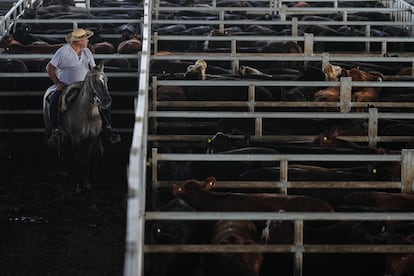
At the Cañuelas Livestock Market (MAC), the largest in Argentina, between 5,000 and 10,000 head of cattle arrive daily and are sold to meatpacking plants that then distribute them throughout the country. The price set there serves as the benchmark for all other livestock transactions in Argentina. In the MAC’s corridors, amidst the ringing of bells signaling the start of auctions by consignees, an unprecedented optimism is palpable this week. The reason is the record price of steers, close to $3 per kilo, and the more than $5.20 paid internationally per kilo of carcass weight, the highest value in decades. Looking ahead, the sector sees a clear horizon, with the EU as a market poised for renewed growth in the coming years.
Argentina exports 29,000 tons of beef annually to the EU under the Hilton quota, which carries a 20% tariff, and an additional 12,000 tons without tariff benefits. If the Mercosur agreement comes into effect, the tariff on the Hilton quota would be eliminated, and a new quota of 99,000 tons carcass weight — to be divided among the four Mercosur countries: Argentina, Brazil, Paraguay, and Uruguay — would be subject to a 7.5% tariff. “Argentina won’t export much more than it already does to the EU, but it will do so with lower tariffs,” says agricultural consultant Víctor Tonelli, who believes that, given the small volume, it will have little impact on Europe. “If you divide it per capita, it’s like a small hamburger a year,” he explains.
European farmers have protested with tractors in the streets of Brussels and other cities across the continent against the EU-Mercosur trade agreement. News has also emerged that some French supermarkets, including the giant Carrefour, will not sell meat from Argentina, Brazil, Paraguay and Uruguay in their French stores. “We’ve seen the tractors in the streets, but I think the protests related to the opening of Mercosur aren’t against the meat being imported. I think they’re more ideological, against EU politicians for the numerous restrictions they’ve imposed on their own farmers, who are now protesting to see what they can get out of it,” says Tonelli.
This consultant points out that Argentina’s producers have also suffered from local policies. He shares the prevailing view in the sector that the domestic price controls and export taxes imposed by the former Kirchner administration in Argentina were one of the main reasons for the loss of more than seven million head of cattle in a decade, bringing the total to the current 51 million.
The president of MAC, Carlos Colombo, agrees and believes there is a lack of understanding about the true scope of the creation of the world’s largest meat trade zone, with some 720 million potential consumers, should it materialize. “The biggest misconception is that in Europe people fear that South America is going to flood them with meat, and that’s not the case,” says Colombo. It’s Wednesday, and only 5,222 head of cattle have entered the MAC, less than half the number from the day before. “We have a very small stock; we have to work hard to rebuild it and to be able to meet the requirements for exporting to the EU,” adds the owner of the consignment company Colombo y Magliano, founded 87 years ago.
“For years, the prevailing theory was that meat should be free for Argentinians, and if the price went up, the producer was blamed,” Colombo criticizes, referring to the price control policies implemented by the Kirchner administration and later eliminated by Javier Milei. In 2025, the price of beef increased by 70% in the local market, more than double the inflation rate of 31.5%.
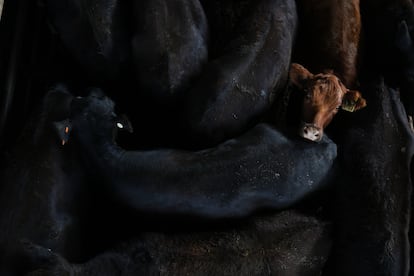
Among the requirements for Argentine beef exported to Europe under the Hilton quota is that the animals be grass-fed in open fields, not kept in feedlots. It also must not come from deforested land and must meet the same sanitary standards required of local producers. Consultant Víctor Tonelli points out that only 35 of the 340 meatpacking plants across Argentina are authorized to export to the EU. “Those authorized to export to the EU are practically authorized to export to any destination in the world,” he emphasizes.
The EU is the highest-value market for Argentine beef, and only the best cuts are imported, such as ribeye and ribeye steak. “We can’t import bone-in meat, so we can’t compete with the Galician ribeye,” Tonelli explains. In terms of volume, however, beef exports to the EU market have fallen far behind the main destination, China, which receives more than 400,000 tons from Argentina each year. Cattle ranchers are optimistic about the new opportunities offered by the Mercosur agreement. In case it stalls again before coming into effect, they are continuing to explore other markets, such as the United States.
Sign up for our weekly newsletter to get more English-language news coverage from EL PAÍS USA Edition


