
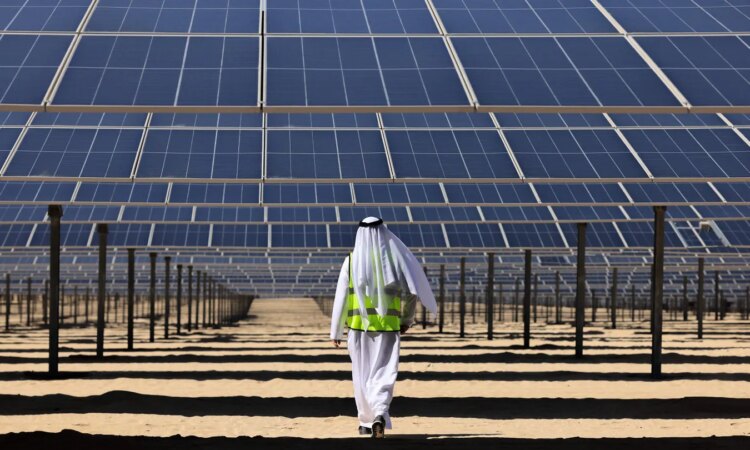

An Emirati man walks beneath photovoltaic panels at al-Dhafra solar power project south of the UAE capital Abu Dhabi. (Photo: Karim Sahib)
AFP via Getty Images
The Middle East is on track for high renewable energy capacity growth, according to fresh research unveiled on Wednesday, just as the United Arab Emirates announced an eye-catching green power milestone.
In its latest Global Energy Transition Outlook released at the World Future Energy Summit in Abu Dhabi, global assurance and risk management provider DNV said variable renewable energy capacity in the Middle East and North Africa is projected to grow around tenfold by 2040, and may continue rising through to 2060.
It also said that renewable energy will likely become a central source of regional power supply in the coming decades. “By 2060, electricity is expected to meet 35% of total energy demand in the region, with most of that electricity generated from renewables.”
The DNV report indicated that solar and wind power together are projected to generate around 85% of electricity by that time, with solar accounting for around 45% and wind around 40%.
It also said the development is largely being driven by economics as “renewables now provide low-cost electricity, and clean power is becoming necessary for competitive industry and future hydrogen production.”
UAE’s Renewables Champion Hits 65 GW Capacity
Regional impetus is thought to be coming from the UAE which is pouring billions of dollars into renewable energy infrastructure. On Tuesday, it was revealed that Masdar – the country’s international renewable energy company – had hit a portfolio capacity milestone of 65 GW.
Responding in a speech to the Abu Dhabi Sustainability Week, Dr Sultan Ahmed Al Jaber, chairman of Masdar, said the milestone offered ample confidence that the company would meet a 100 GW capacity target by 2030 as planned.
Much of the progress in the UAE, as well as in promising markets like Saudi Arabia and the wider MENA region may also likely depend on energy storage capacity.
Dr Sultan Ahmed Al Jaber, chairman of Masdar, reveals the company’s latest renewable energy capacity milestone at the Abu Dhabi Sustainability Week on January 13, 2026.
ADNOC / MASDAR / ADSW 2026
Speaking at a panel at the same event on Wednesday, Jad Abdel Masri, senior director of group supply chain and procurement at Masdar, said, “While it will not be without challenges, we believe battery-storage will increasingly replace thermal power plants as the main source of short-term power flexibility.
“Regional interconnections will also support system balancing and electricity trade as renewable energy’s share of mix increases.”
For its part, the DNV report projects that energy storage capacity in the region will likely soar from about 36 GWh at the moment to around 9,500 GWh by 2060.
Technology Will Continue To Be An Enabler
Elsewhere, speaking at the same event, Ahmed Al Falasi, energy efficiency executive director at Abu Dhabi Department of Energy, noted that as solar and storage expand, the real test is reliability when the sun is not shining – and this is where system design becomes critical.
“Digital transformation must sit at the centre of this evolution. Artificial intelligence-enabled platforms that integrate electricity, water, cooling and operational data into a single trusted view can shift us from reactive management to predictive decision-making.”
This will improve forecasting, optimizing dispatch, and identifying inefficiencies in the renewable energy chain before they become system risks, Al Falasi concluded.


