Minnesota bill seeks to prohibit dominant retailers from owning livestock and meat processing interests – Agweek
ST. PAUL — Vertical integration is the practice of combining more than one stage of production under one company. That can be looked at as efficiency, or, as a bill passing through the Minnesota Legislature looks at it, as a tool to remove competition and assert control over an industry.
A grocer union, a beef producer and a meat processor all offered testimony in support of that bill meant to bring back competition in the meat industry. No one from the public testified in opposition.
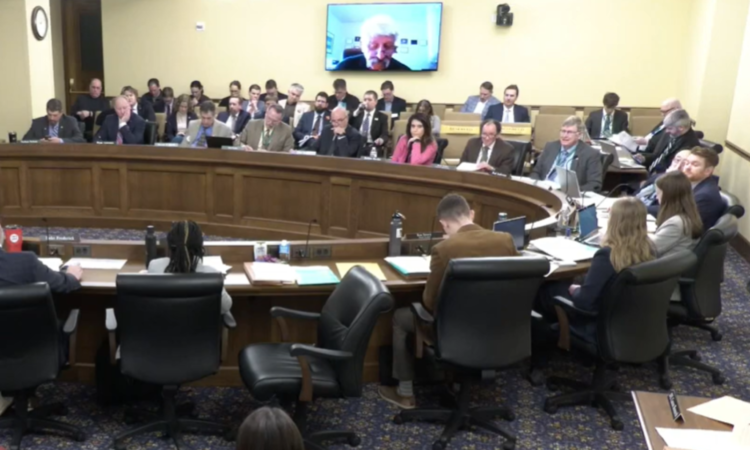
The bill authored by Rep. Rick Hansen, DFL-South St. Paul, was heard Wednesday, March 18, by the House Agriculture and Finance Committee. Hansen said the bill sought to bring back competition and offer independence for smaller producers.
states that certain retailers, specifically dominant retailers, are prohibited from obtaining an ownership interest in livestock dealers or meat packing companies, and certain exclusive contracts are prohibited. The Senate Agriculture, Veterans, Broadband, and Rural Development Committee has a companion bill to the House version, SF4393, authored by committee chair Sen. Aric Putnam, DFL-St. Cloud.
Though the bill names no dominant retailers, testimony from groups like Minnesota Farmers Union pointed out that companies like Walmart are not only dominating the grocery industry that was once filled with smaller, independent grocery stores, but they are also, in some states, looking to own the very meat processing companies that supply the meat to their grocery stores. Testimony shared by a national group of agriculture policy non-profits shared an example of
Costco opening a chicken plant in Fremont, Nebraska,
and Walmart acquiring beef processing and slaughter plants in Kansas, Georgia and Nebraska.
It’s a form of consolidation that brought several testifiers to speak up for independent meat producers, processors and grocery stores that see the dominant retailers as a threat not only to them but to small towns.
Testifying via Zoom during the hearing was Redwood County livestock producer Leon Plaetz. He said when he started in livestock production 50 years ago, there was competition for his product, about five separate entities he could sell to. As the competition disappeared, the basis widened, cutting back on his profits. He was down to one processor buying his cattle.
“We need competition to allow independent producers to exist,” he said. “Vertical integration only makes money for the entities integrating. The producers who supply products and the people who purchase them lose out.”
On behalf of the United Food and Commercial Workers International Union, Robert Lopez testified that lawmakers should not be fooled by notions that vertical integration is all good and no harm. He said, in the meatpacking sector, it reduces
leads to job loss, destroys small and independent businesses and makes it harder for workers to form a union in the meatpacking sector.
Hansen continued to focus back on the point that in some regions, producers only have one option for processing, which gives the processor control. He referenced his hometown as a place that was once a meatpacking powerhouse, but was now controlled by just one company.
“I think it’s very unique for us, we’ve just had testimony from Farmers Union, grocers and the workers. We usually don’t get all three, and I think that shows the importance of the issue,” Hansen said.
Hansen recognized that more work was needed with the bill and noted that it still had two more committees to visit and much more discussion ahead of it. He was asking to have the bill passed on to the state government and finance policy committee as amended because he felt that there was bipartisan support to at least make some momentum toward the issue of consolidation in the state.
The bill needed to be heard by another committee because the enforcement would involve the attorney general’s office on behalf of the Department of Agriculture.
Questions for Hansen ranged from how the attorney general could enforce it, how it would work for those doing business across state lines, and what costs may be associated with this bill. There was a pending fiscal note on the bill.
Rep. John Burkel, R-Badger, and Rep. Nathan Nelson, R-Hinckley, both questioned the portion of the bill that said it prohibited an exclusive contract. Nelson said a contract is something that usually allows an individual to negotiate and can be very beneficial to them.
Hansen understood the concern for the producer who has that exclusive contract and recognized that that was an area to be further discussed, but he felt that they needed to make ground on addressing the issue of consolidation in agriculture. He noted that when there is only one company to work with, the producer loses negotiating power with or without an exclusive contract.
Rep. Paul Anderson, R-Starbuck, brought his own concerns about the bill, but ultimately supported it moving ahead and out of this committee. A majority agreed to send it on with the understanding that more discussion was needed.

Michael Johnson is the news editor for Agweek. He lives in rural Deer Creek, Minn., where he is starting to homestead with his two children and wife.
You can reach Michael at mjohnson@agweek.com or 218-640-2312.