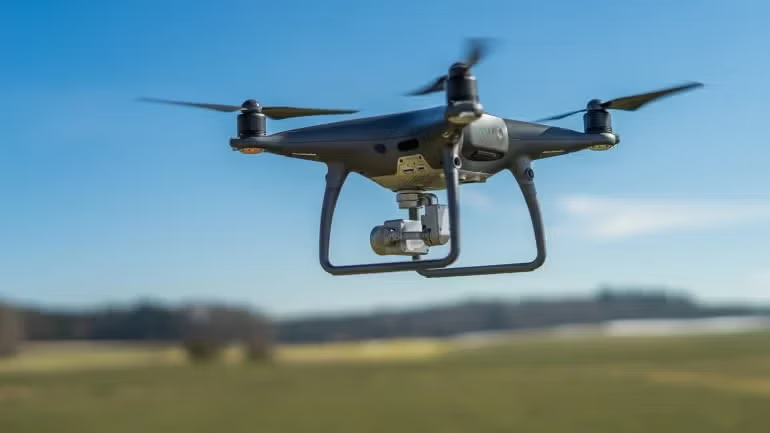

The New York Power Authority has received a waiver from the Federal Aviation Administration allowing expanded use of drones to inspect energy infrastructure, including dams, transmission lines and other power assets across New York State.
The waiver enables NYPA-certified pilots to operate unmanned aircraft systems beyond the visual line of sight of the pilot and introduces a new operational model in which a single pilot can oversee up to four drones simultaneously.
NYPA operates a large fleet of hydropower and transmission assets in the state, and drones are already used to inspect dam infrastructure, including spillways where they can map potential erosion, as well as transmission corridors and vegetation near power lines.
“This increased capability will streamline inspection processes, expedite data collection and bolster the Power Authority’s capacity to monitor its energy infrastructure across New York State,” the authority said.
NYPA’s drone program currently supports drone inspections across 1,550 miles of power transmission as well as generation facilities and infrastructure operated by the New York State Canal Corporation.
“The New York Power Authority is one of the first utilities in the nation to receive this expanded four to one waiver,” said NYPA Robotics Program Manager Peter Kalaitzidis. “Conducting standardised four-drones-to-one-pilot operations at our sites will allow for more consistent inspection workflows across our energy assets and electric grid regions. We are currently creating Standard Operating Procedures (SOPs) and validating the technology to ensure we are fully prepared and have all safety protocols in place to implement expanded observation activities.”
NYPA first received approval from the FAA in 2022 to conduct limited beyond-visual-line-of-sight drone flights using one drone per pilot. Those operations have already been used for transmission drone inspections, vegetation management and dam spillway erosion mapping.
The authority currently has 146 employees certified as drone pilots and plans to invest more than $37m in the drone program through 2028.
Under the new model, drones will fly autonomous missions along predefined routes, enabling inspections without continuous manual control. NYPA said this approach will allow monitoring to occur during overnight periods or in severe weather conditions, when thermal and visual data can be particularly valuable.
For example, drones can monitor infrastructure during ice storms or extreme cold conditions, when ground inspections may be difficult or hazardous.
The waiver was obtained with support from Skydio, which provides both drone equipment and regulatory advisory services. The approval authorizes operations through 2030 and applies specifically to Skydio systems.
“This latest approval enables a single operator to conduct up to four simultaneous missions, multiplying the safety and efficiency gains already achieved by the program and unlocking significant operational scale,” said Daniel Jenkins. “This milestone underscores the value of Skydio’s autonomy: putting machines in harm’s way instead of people, while delivering more reliable energy, and reducing response times for outages for all New Yorkers.”
NYPA said multi-drone operations will support continuous monitoring and automated alerts for abnormal conditions, allowing staff to intervene only when necessary. The system could also support aerial security patrols around critical infrastructure.
The program will be phased in over the coming years. NYPA plans to test four drone systems with the Northeast UAS Airspace Integration Research Alliance, which will evaluate inspection procedures and operational protocols to ensure safety before broader deployment.