FOR generations, cattle have been an inseparable part of the Mohamed family’s identity in Parika, East Bank Essequibo.
Set firmly in tradition yet open to innovation, brothers Gibron and Inshaan Mohamed represent a lineage of large-scale cattle farmers whose livelihood and heritage are deeply rooted in livestock production. Their story is one of resilience, adaptation, and cautious optimism amid shifting market realities for fresh cow’s milk in Guyana.

“Cattle farming is not something we just picked up,” Gibron said. “I came into this family and met cows. It started with my grandfather, passed through my parents, and it’s something that will always be part of us.”
The Mohamed family’s involvement in cattle rearing spans more than four decades, beginning with their grandfather and carried through successive generations. Growing up, Gibron recalls that cattle were always present in the family; they were not merely livestock, but a way of life. Today, among the ten siblings, four brothers and one sister remain actively involved in cattle farming, ensuring that the family legacy continues.

“Out of all of us, five stayed fully in cattle,” he explained. “We’re all invested in keeping this going.”
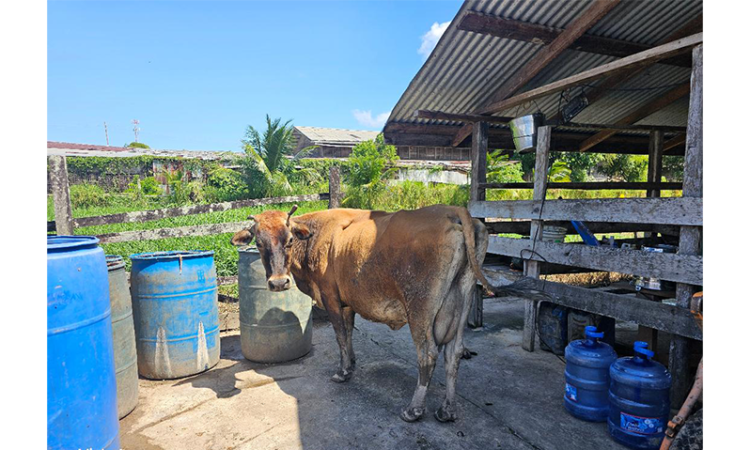
Collectively, the family manages approximately 500 heads of cattle, housed between their Parika homestead and Hogg Island in the Essequibo River, Region Three (Essequibo Islands–West Coast Demerara). Their herd includes Holstein, Zebu, and Jersey crosses, reflecting a dual-purpose operation focused on both milk and beef production. While beef contributes to the enterprise, milk production remains the family’s most immediate source of income.
“Milk is what gives you cash every day,” Gibron noted. “Beef takes time, but milk helps you meet expenses quickly.”

At full capacity, the Mohameds have at least 30 milking cows capable of producing up to 300 pints of milk daily. However, that level of production has not been sustained in recent years. According to Gibron, a steady decline in demand for fresh cow’s milk, driven largely by increased consumption of powdered milk, has forced the family to scale back.
“People don’t buy fresh milk like before,” he said. “Powdered milk changed everything.”
At present, daily production averages about 30 pints, most of which must be sold through informal channels. Occasionally, Spanish-speaking residents in the community purchase the milk to make mozzarella cheese for personal use.
“Sometimes they come and buy to make cheese for their homes,” Gibron shared. “But that can’t sustain large-scale production.”
Gibron believes that renewed consumer education could help reverse this trend, noting that fresh cow’s milk offers clear nutritional advantages. Fresh milk is naturally rich in protein, calcium, and essential vitamins, contains beneficial enzymes, and is free from preservatives and heavy processing.
“Fresh milk is straight from the cow,” he said. “You know where it comes from.”
Despite these market challenges, the family maintains high standards of animal care. Dairy cows are washed before milking, hygiene is prioritised, and animal welfare remains central to the operation. The herd is predominantly grass-fed, with most cattle grazing freely on Hogg Island. Minimal supplemental feeding is done at the Parika location using molasses and a mix of “banks” feed and wheat middlings.
“We rely a lot on pasture,” Gibron said. “The cows do well on grass, especially on Hogg Island.”

While the Mohameds possess extensive generational knowledge, they have also embraced the national livestock development agenda, particularly the genetic improvement programme led by the Government of Guyana through the Ministry of Agriculture and the Guyana Livestock Development Authority (GLDA). The family is a beneficiary of the bull rotation programme, having received a Brahman-breed bull, and is awaiting inclusion in the embryo transplant programme. They are eager to participate in the Girolando embryo transplant programme offered by the GLDA.
“These programmes are really helping farmers,” Gibron said. “You see the difference in the animals.”
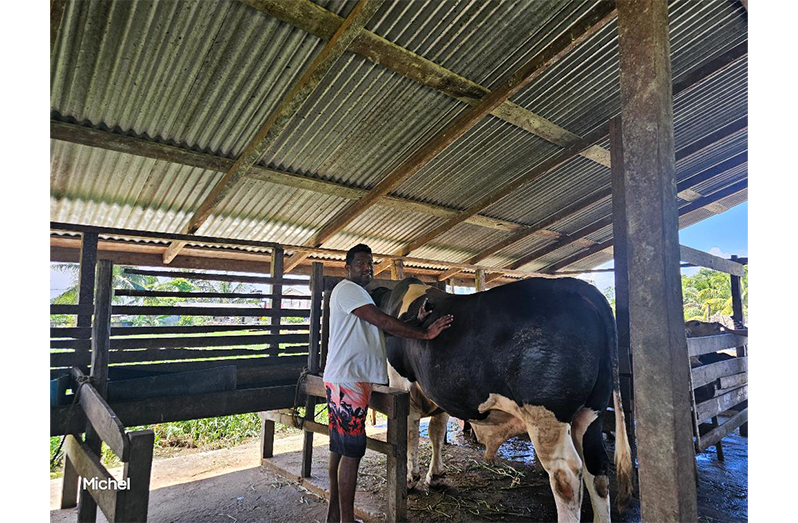
At present, the family also has a prized Holstein bull available for sale, a decision taken to prevent inbreeding within the herd.
“The bull comes from a strong line of milk producers,” Gibron explained. “But you have to rotate to protect your herd.”
He added that platforms such as the Ruminant Show and livestock expos are essential for marketing quality animals and strengthening the local breeding market through networking.
“Those shows help farmers connect and sell,” he said.
Although he did not personally participate, Gibron praised Hon. Zulfikar Mustapha, Minister of Agriculture, and Dr Dwight Walrond, CEO of the GLDA, for the Ruminant Expo held in October last year, describing it as timely and encouraging for livestock farmers nationwide.
Beyond milk production, the Mohamed family operates a modest but hygienic butchery, selling fresh beef from locally reared bulls only. Gibron takes pride in the quality of the meat produced.
“Our beef is better than imported meat,” he asserted. “The animals are fresher and better bred.”
He attributed these improvements to sustained government intervention under the PPP/C Administration, led by President Dr Irfaan Ali, through the Ministry of Agriculture.
The operation also provides employment for several people in Parika and on Hogg Island, with workers engaged daily in milking, feeding, animal care, and butchery operations.
“Even when sales are slow, we still have to pay workers,” Gibron said. “People depend on this farm.”
For farmers in Region Three, Gibron noted that the newly constructed Bharat Jagdeo Demerara River Bridge, which links Regions Three and Four, has fundamentally changed market access. The ease and timeliness of crossing the river now allow producers to supply markets in Region Four more efficiently, reducing spoilage risks and transportation delays.
He is hopeful that, with improved logistics, agencies such as the Georgetown Public Hospital Corporation, along with mining companies and other large institutions, will increasingly look to local farmers for consistent supplies of fresh milk.
“That bridge changes things for farmers in this region,” he said. “We can now get fresh milk across quicker and more economically.”
He added that, with the support of GLDA officers, regular on-farm surveillance is conducted to ensure compliance with good agricultural practices, while food safety and biosecurity remain paramount.
“We have regular checks,” Gibron explained. “Biosecurity is very important, especially if you want to access bigger markets.”
Importantly, Gibron explained that expanded market access must go hand in hand with traceability and food safety compliance. He acknowledged the benefits of the national livestock traceability system currently implemented by the GLDA, noting that proper animal identification and record-keeping strengthen disease control, improve herd management, and build confidence among buyers.
“These systems help us grow,” he said. “Traceability and food safety are what will open doors.”
Gibron said the family is eager to work closely with the Guyana Food Safety Authority (GFSA) to ensure their milk meets requirements at every level of the market, from roadside sales to institutional and commercial buyers. He believes that strong traceability and food safety systems are not barriers but enablers that will accelerate the growth of Guyana’s livestock industry, support value-added dairy processing, and help position locally produced milk and meat as safe, reliable, and competitive alternatives to imports.
Looking ahead, the family remains optimistic. While access to a consistent commercial market remains their biggest challenge, they are actively exploring value-added dairy production.
“Once we get a steady market,” Gibron said confidently, “we can go right back to producing 300 pints a day.”
A past winner of ruminant competitions, Gibron is enthusiastic about the continuation of national livestock exhibitions, which he believes help farmers market animals, share knowledge, and build networks.
For the Mohamed family, cattle farming is about heritage, hard work, and hope that, with improved infrastructure, strong regulatory systems, and continued support, Guyana’s livestock industry is well-positioned for accelerated growth and long-term sustainability.