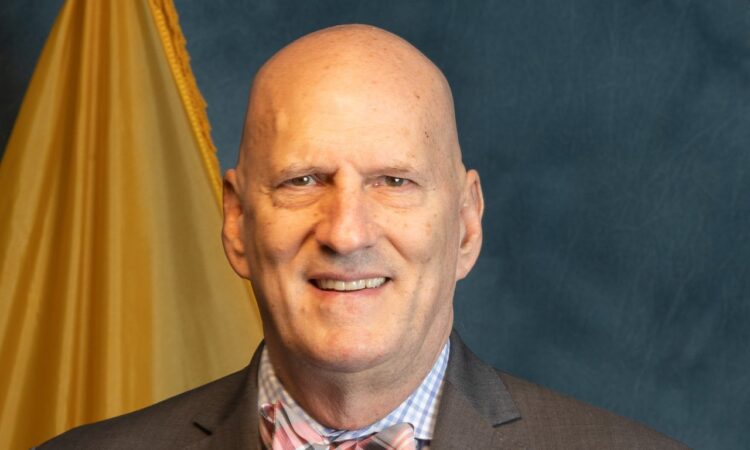
Gov.-elect Mikie Sherrill is recommending that Ed Wengryn stay on as New Jersey Secretary of Agriculture, a cabinet post with a complicated selection process.
In 2024, the New Jersey Board of Agriculture picked Wengryn, a 26-year staffer at the New Jersey Farm Bureau, to fill a vacancy caused by the retirement of Douglas Fisher. Murphy had affirmed the appointment.
“I am pleased to have Ed Wengryn continue to serve as the Secretary of Agriculture in my administration. Ed has a strong track record strengthening New Jersey’s agricultural economy, supporting local farmers, and expanding access to locally grown produce,” said Sherrill. “I look forward to working together with Ed and the entire Board so the Department of Agriculture can continue to help combat food insecurity for New Jersey families, empower local farmers, and increase production to lower grocery costs for our state. We’re known as the Garden State for our tomatoes, blueberries, corn, cranberries, and so much more – I am excited to have Edward leading the charge to continue that legacy.”
The grandson of Ukrainian immigrants, Wengryn, grew up in Somerset County and worked on his family’s dairy and field-crop farm in Hillsborough. He grew and sold pumpkins and pick-your-own strawberries, and spent summers selling tomatoes to delis in the area.
The 62-year-old Wengryn is unaffiliated with any political party and has made minimal campaign contributions. He donated to Rep. Leonard Lance (R-Clinton Township), and stepped his donations up a notch last year, boosting the coffers of Senate Democrats.
An obscure deal with South Jersey to get votes for the ratification of the New Jersey State Constitution in 1947 gave Murphy limited say over the selection of the State Board of Agriculture makes the appointment, and the governor merely approves their pick. This is a throwback to an era when state boards exercised considerable authority, especially in health, education, the environment, and alcoholic beverage control. It’s also a reminder that all politics is local, which is how Gov. Alfred Driscoll cobbled together enough votes to get the new Constitution he wanted.
Members of the state’s agriculture community elect the eight members of the Board of Agriculture at the annual State Agricultural Convention. The governor traditionally appoints the choices of the convention to four-year terms on the Board, with the advice and consent of the State Senate. Unlike other cabinet posts, where the Commissioner runs the department, the agriculture secretary is essentially the secretary to the Board.
The Board of Agriculture sets policies that the Secretary of Agriculture and the New Jersey Department of Agriculture follow.
State law gives the top four commodity groups in the state, based on a “two-year average of the gross value of production,” seats on the Board. Based on those numbers, nursery, hay and grain and livestock farmers each have two seats, with additional two seats going to fruit and vegetable farmers. As a result of the reapportionment, dairy and aquaculture farmers have lost their seats in recent years.
Some governors have maneuvered their way through the process to press the Board of Agriculture to accept their candidate, especially when the agricultural community understands the politics.
In 1982, when the post opened up for the first time in 36 years, newly-elected Gov. Thomas Kean picked Atlantic County Agricultural Agent Arthur Brown, who was popular with South Jersey farmers in his own right. Kean and Brown had an influential ally in then-Assemblyman Bill Gormley (R-Margate), who was skilled in the power of persuasion.
Brown remained in the post for 20 years; when he retired, the state board picked Charles Kuperus, a farmer and Republican freeholder from Sussex County, to replace him. At the time, New Jersey Sierra Club President Jeff Tittlel opposed the choice, saying Kuperus and the board were too cozy with developers buying farmland.
But the new governor, Democrat James E. McGreevey, signed off on Kuperus after receiving assurances that he would support the administration’s mission to preserve farmland.
Kuperus resigned at the end of 2008, ten months after Gov. Jon Corzine announced in his budget address that he would eliminate the Department of Agriculture. Fisher opposed the proposal, and Corzine later backed off when the legislature agreed to cut the department’s budget by $500,000 as long as the Secretary of Agriculture remained a cabinet-level post.
A deal was worked out where the agriculture board name Fisher, then serving his fourth term as a Democratic assemblyman from the 3rd legislative district, to serve as the new Secretary of Agriculture. One of the key players in that deal was then-Senate Majority Leader Steve Sweeney, Fisher’s running mate.
A year later, after Corzine lost re-election, Gov.-elect Chris Christie planned to replace Fisher with Hal Wirths, then a Sussex County freeholder. He believed he had the support of the Board of Agriculture to make the switch.
But Sweeney, the incoming Senate President, pushed Christie to keep Fisher. Instead, Christie named Wirths as his Commissioner of Labor.
Gov. James Fielder created the New Jersey Department of Agriculture in 1916 and named a Rutgers agriculture professor, Alva Agee, the first secretary. Nine years later, Agree left and was succeeded in 1925 by William Duryee, a peach farmer from Upper Freehold who wielded political clout as a state Milk Control Board member.
(The Milk Control Board was formed at the suggestion of Gov. A. Harry Moore, in 1933, to regulate the production and distribution of milk, set dairy prices, and prevent New York dairies from interfering with the New Jersey market. Duryee was the first chairman.)
Duryee was succeeded in 1938 by Willard Allen, a poultry farmer from Hunterdon County and a professor at Rutgers’ College of Agriculture. He remained in the post under five governors before retiring for health reasons in 1956.
Phillip Alampi, a former TV farm reporter for ABC and NBC in New York, replaced Duryee in 1956 and held the post until his retirement in 1982. Alampi is the longest-serving member of the governor’s cabinet in state history.