
Many visitors come to the Pennsylvania Farm Show for the food or to see attractions like livestock, but Wednesday saw a host of politicians, including gubernatorial candidates, attend the event to discuss the Keystone State’s agriculture sector and the impact of tariffs and regulations on farmers.Gov. Josh Shapiro, a keynote speaker at the Farm Bureau’s banquet Wednesday morning, toured the event and visited farmers and growers who contribute to the $132.5 billion worth of economic activity in the state each year.The governor, a Democrat running for re-election this year, said he and his administration have been working to cut red tape for farmers amid the challenging impact from tariffs and trade conflicts with countries like China that prompted $12 billion in bridge payments offered by the Trump administration to help offset losses in 2025.”It’s no secret that the president’s tariffs are hurting farmers here in Pennsylvania and across the country, and by the way, don’t take my word for it. Go look at the, what the president has said. The president has been offering farmers a handout because he has seen how these tariffs have shut down markets and made their prices go way up,” he said.State Sen. Elder Vogel echoed concerns raised by other Republicans, like Congressman Glenn “GT” Thompson, about whether the funding would be enough to offset losses suffered last year. “I just got everything in my mailbox. It’s like $38 an acre for soybeans and $42 an acre for corn. That doesn’t come anywhere close to covering anything,” he said.When asked about supporting farmers in 2026 and beyond, Shapiro also touted efforts to reform environmental permitting during his first term in office, including a deal struck with Republicans in the current budget to reduce the time in which permits are issued.”I think what we’ve got to do is double down on our investments, particularly at a time where the federal government is jacking up costs on our farmers just to feed that some of our farmers rely on soybean feed, and otherwise those costs are going way up because of tariffs,” he said.But others, including Shapiro’s Republican rival for the governor’s office this year, there’s still work to do on helping farmers cut through burdensome red tape.”I know we talk about we’ve done a lot with permitting reform, but if you talk to any farmer here, they all say it still takes a really long time to get a permit,” said State Treasurer Stacy Garrity (R).Garrity, who is likely to be the Republican nominee for governor in 2026, said she would like to see some changes at the federal levels to tariffs to help keep local farmers competitive, but also wants to see the state’s inheritance tax eliminated or altered so it doesn’t impact families that pass down farms through the generations.”Ninety percent of states do not have an inheritance tax, for goodness sakes. New York State doesn’t even have an inheritance tax — and unfortunately, this hurts disproportionately our farmers because, as you know, most of our family farms, they are asset-rich but cash poor. It hits them right when they don’t need it,” she said.Shapiro, when asked by reporters about proposals to eliminate the state’s inheritance tax, said his administration has had internal discussions about the issue and was open to dialogue on it.”I think we recognize that it can be really onerous and burdensome on some. We also recognize there’s a price tag with it. You always have to balance the two,” he said.
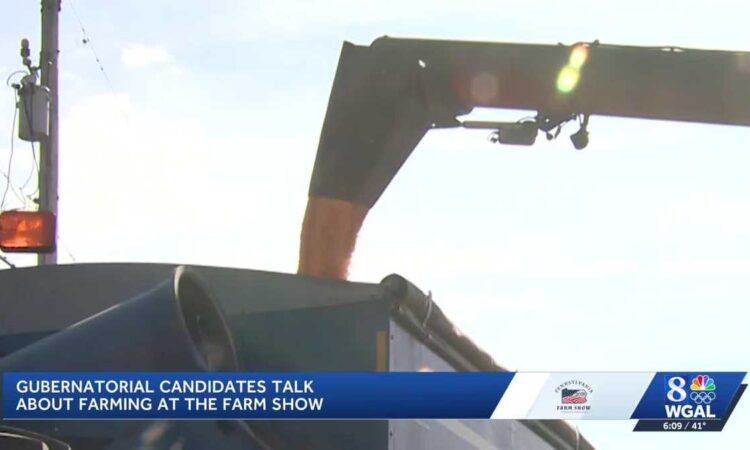
Many visitors come to the Pennsylvania Farm Show for the food or to see attractions like livestock, but Wednesday saw a host of politicians, including gubernatorial candidates, attend the event to discuss the Keystone State’s agriculture sector and the impact of tariffs and regulations on farmers.
Gov. Josh Shapiro, a keynote speaker at the Farm Bureau’s banquet Wednesday morning, toured the event and visited farmers and growers who contribute to the $132.5 billion worth of economic activity in the state each year.
The governor, a Democrat running for re-election this year, said he and his administration have been working to cut red tape for farmers amid the challenging impact from tariffs and trade conflicts with countries like China that prompted $12 billion in bridge payments offered by the Trump administration to help offset losses in 2025.
“It’s no secret that the president’s tariffs are hurting farmers here in Pennsylvania and across the country, and by the way, don’t take my word for it. Go look at the, what the president has said. The president has been offering farmers a handout because he has seen how these tariffs have shut down markets and made their prices go way up,” he said.
State Sen. Elder Vogel echoed concerns raised by other Republicans, like Congressman Glenn “GT” Thompson, about whether the funding would be enough to offset losses suffered last year.
“I just got everything in my mailbox. It’s like $38 an acre for soybeans and $42 an acre for corn. That doesn’t come anywhere close to covering anything,” he said.
When asked about supporting farmers in 2026 and beyond, Shapiro also touted efforts to reform environmental permitting during his first term in office, including a deal struck with Republicans in the current budget to reduce the time in which permits are issued.
“I think what we’ve got to do is double down on our investments, particularly at a time where the federal government is jacking up costs on our farmers just to feed that some of our farmers rely on soybean feed, and otherwise those costs are going way up because of tariffs,” he said.
But others, including Shapiro’s Republican rival for the governor’s office this year, there’s still work to do on helping farmers cut through burdensome red tape.
“I know we talk about we’ve done a lot with permitting reform, but if you talk to any farmer here, they all say it still takes a really long time to get a permit,” said State Treasurer Stacy Garrity (R).
Garrity, who is likely to be the Republican nominee for governor in 2026, said she would like to see some changes at the federal levels to tariffs to help keep local farmers competitive, but also wants to see the state’s inheritance tax eliminated or altered so it doesn’t impact families that pass down farms through the generations.
“Ninety percent of states do not have an inheritance tax, for goodness sakes. New York State doesn’t even have an inheritance tax — and unfortunately, this hurts disproportionately our farmers because, as you know, most of our family farms, they are asset-rich but cash poor. It hits them right when they don’t need it,” she said.
Shapiro, when asked by reporters about proposals to eliminate the state’s inheritance tax, said his administration has had internal discussions about the issue and was open to dialogue on it.
“I think we recognize that it can be really onerous and burdensome on some. We also recognize there’s a price tag with it. You always have to balance the two,” he said.


