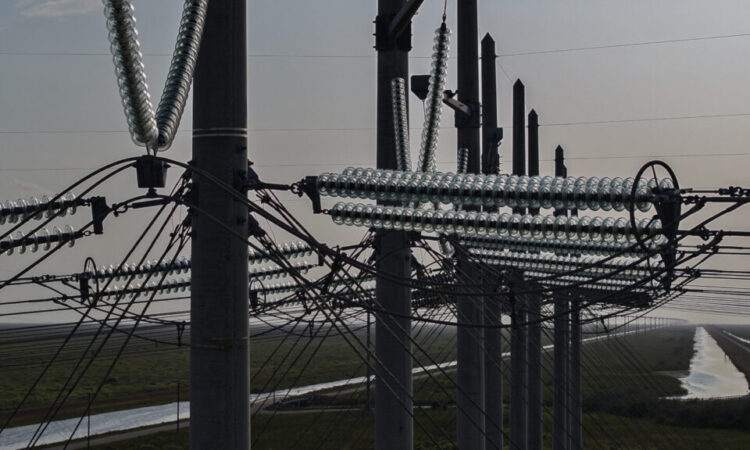
A House bill would expand ratemaking principles in Iowa. (Photo by Joe Raedle/Getty Images)
Lawmakers advanced an energy policy bill Thursday from a House subcommittee, but asked for suggestions to improve the bill from utilities and ratepayer organizations who voiced concern about the bill.
House Study Bill 519 would expand the projects eligible for certain ratemaking principles in Iowa and encourage nuclear energy and energy storage projects.
While major utilities MidAmerican Energy Company and Alliant Energy Corporation registered as undecided on the bill, lobbyists from both utilities expressed concerns with the bill.
Matt Hinch, speaking on behalf of MidAmerican Energy, said Iowa already has “one of the best regulatory structures in the nation.” Hinch said the proof of that is “in the pudding” as Iowans have some of the lowest rates in the country. According to MidAmerican figures, Iowa electricity rates are 44% below the national average.
“Anytime you’re looking at these policies, we would ask you to just do so cautiously, because what we have in place here in the state of Iowa is working,” Hinch said. “It is protecting customers, and the rates prove it out.”
Bob Rafferty on behalf of Iowa Business for Clean Energy said the bill “significantly enlarges” the advanced ratemaking process. This process allows the Iowa Utilities Commission to preauthorize the recovered costs from eligible facilities as a means of addressing uncertainty from rate-regulated utilities toward certain generation projects.
Rafferty said expanding the projects eligible for advanced ratemaking is “not a bad idea” but he said before that can be done, the state needs to reform the advanced ratemaking process. He the current process does not have strong standards to keep ratepayers from bearing the cost of new investments.
“I would suggest if we’re going to expand advanced ratemaking, we make sure that investment, the standard, is it’s in the best interest of the ratepayer,” Rafferty said.
Ted Stopulos, representing Alliant Energy, said while the company agreed with changes to ratemaking in the bill, it had “concerns” with a section of the bill that would tie a utility’s return on equity for wind and solar systems to the utility’s most recent rate proceeding.
Stopulos said this could cause a utility’s return on equity to be “applied in an unjust manner” or be unreflective of current and future market conditions. He asked the committee to remove the provision from the bill.
“We believe an all-of-the-above energy strategy is the best strategy, and putting the thumb on the scale one way or another hinders that policy objective,” Stopulos said.
Robert Palmer, speaking on behalf of the Iowa Business Energy Coalition – a group advocating for business energy users – echoed the sentiments of Stopulos and suggested the Iowa Utilities Commission continue to evaluate utilities’ return on equity rather than tie it to a rate proceeding.
Palmer also highlighted a section of the bill that reads: “It is also the intent of the general assembly to encourage the development of nuclear electric power generation within the state.” He said the wording may lead to the IUC prioritizing nuclear projects, even in circumstances where “other technologies may be valuable.”
The bill is similar to a section of Gov. Kim Reynolds’ 2025 energy bill, which energy groups like Rafferty’s and several former members of the Iowa Utilities Commission opposed. Opponents of the bill argued last spring that it would give utilities freedom to add capital investments at the expense of ratepayers.
The subcommittee chair, Rep. Hans Wilz, R-Ottumwa, said there was not an intentional move, on his part, to split apart sections of the governor’s bill into new bills this session.
“I didn’t go back and look at old bills, I look at what’s in front of me,” Wilz said. “I think every one of those sections has ideas that have been past, present and soon to be future.”
After briefly closing the meeting so lawmakers could confer in private, subcommittee members said they would advance the bill, but asked all of the interested and attending stakeholders to send the subcommittee representatives an email explaining suggestions that “would make this better.”