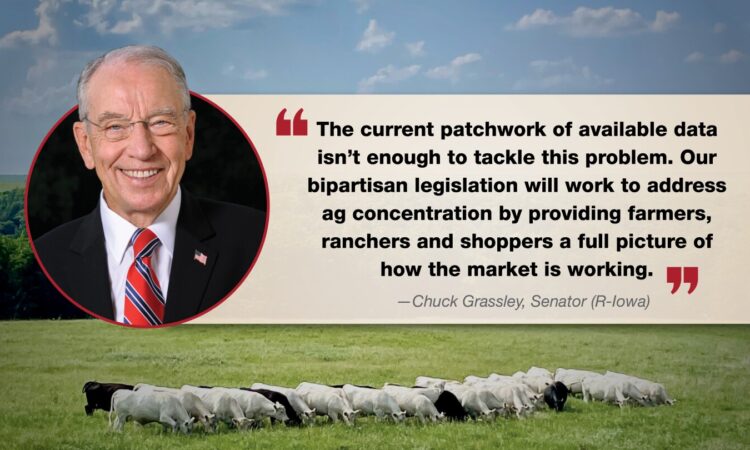
Senate Agriculture Committee members Chuck Grassley (R-Iowa) and Tina Smith (D-Minn.) have introduced the Livestock Consolidation Research Act, bipartisan legislation to support research into the economic impact of livestock market consolidation on farmers, ranchers and consumers.
“Consolidation in the meat and poultry industry impacts Iowa producers and consumers alike, and right now, they’re feeling the squeeze,” Grassley says. “The current patchwork of available data isn’t enough to tackle this problem. Our bipartisan legislation will work to address ag concentration by providing farmers, ranchers and shoppers a full picture of how the market is working.”
According to Grassley’s press release, “Cattle producers often make pennies on the dollar due to a lack of transparency and competition in the cattle processing industry, where just four companies control 85% of the market. The lack of competition means farmers get less for their products, while consumers pay more at the grocery store.”
The senators’ goal with the act is to move beyond existing research to discover the impact of this consolidation on farmers and ranchers, as well as the downstream impacts on consumers. The legislation directs the USDA Economic Research Service to conduct this research.
“Just a handful of large companies dominate the meat and poultry processing industry, which means higher prices for consumers and shrinking earnings for farmers. On top of that, farmers and ranchers are dealing with the worst farm economy in 30 years, skyrocketing input costs, and a cost-of-living crisis at home. We can all see that this market concentration spells disaster,” Smith says. “Our bipartisan bill would bring to light the impact of this consolidation on farmers and consumers and help us create the best possible solutions to fix the problem. I look forward to working with Sen. Grassley and my colleagues to pass this legislation as part of a farm bill.”
Grassley and Smith plan to push for the bill’s inclusion in the research title of the farm bill, which could form a base of data to inform future decisions.
Regulatory Concerns: The Economic Impact of Increased Oversight
“Significant liquidation of cattle herds has brought U.S. cattle numbers to a 70-year low and pushed prices and subsequently, cow-calf returns, to record highs,” says John Nalivka, Sterling Marketing Inc. president. “At the same time, Sterling Marketing’s estimate for beef packer margins is to average — $191/head during the first quarter of 2026.”
Nalivka says consolidation has become a top news headline in livestock and meat industries quite often lately.
“As I read about this [proposed legislation], I once again become concerned about the information that leads to this research effort,” he says.
He stresses packing capacity is a significant factor in the market.
“Consequently, I maintain a rather significant database of plants and their capacities for both the beef and pork industries. This database goes back to the late 1980s when I started focusing on capacity and its impact on the market,” he explains. “I adamantly point out that the importance of capacity in the beef and cattle market goes beyond the packing industry to include all aspects of the supply chain from production to packing and processing to the retail meat case.”
Nalivka has often pointed out that consolidation in any industry is the result of businesses growing larger to achieve economies of scale.
“This is extremely important as it has a direct and beneficial impact on the cost structure of a business and ultimately, its financial success,” he says. “It is related to and has an impact on production capacity and ultimately, the ownership of capacity across the supply chain.”
He predicts with Tyson’s closure of the Lexington plant and reducing Amarillo to one shift, the total U.S. beef packing capacity (including both fed cattle and cows) is 36.7 million head. He adds the strike at JBS’s Greeley, Colo., plant brings annual fed cattle plant capacity down to 27.3 million from 28.9 million.
“This leaves my estimate for the four-firm fed cattle plants concentration with the Greeley plant included at 75.7%,” he says. “That is a notable difference from the quoted figure of 85%.”
Nalivka says a study such as the one proposed by Grassley and Smith should not be taken lightly considering the definite potential for increased regulatory activity.
“For those who do not believe that increased government oversight leads to greater government regulations, in 2025, there were 243 volumes in the Federal Register, proposed and final rules and regulations, which begs the question — Is this too much government oversight?”