Arbitrage Funds vs. Liquid Funds: Where to park cash after the STT hike? – Money Insights News
If you are looking to park your hard-earned money for the short-term – say a couple of weeks, a couple of months or even up to a year – a savings bank account is one of the options.
But as you know, interest rates on a savings account have gone downhill in the last couple of years to around 2.5-3.0%. Even some popular high-yielding savings accounts have been cutting down on returns.
In such a situation, where should you park your funds?
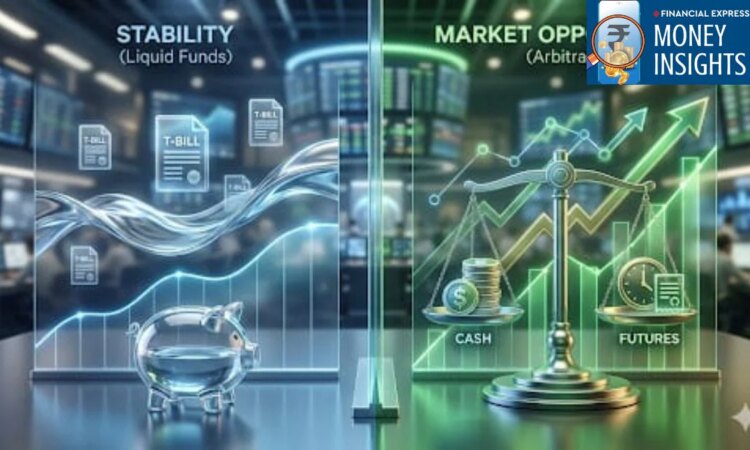
Two types of funds come to mind – arbitrage funds and liquid funds.
These sub-categories of mutual funds are designed to minimise risk and offer decent returns.
Which of the two is better – Arbitrage Funds or Liquid Funds?
Let’s start with Liquid Funds and understand the basics.
These funds invest in debt and money market securities with a maturity of up to 91 days only. They are classified as debt mutual funds, as per the regulatory guidelines.
Typically, your money in a liquid fund is invested in Treasury bills (T-bills), call money, repurchase agreements, short-term debt securities issued by the government, certificates of deposits (CDs), commercial papers (CPs), and term deposits.
These instruments carry low-interest rate risk and low credit risk. For this reason, these funds are placed at the lower end of the risk-return spectrum.
Their investment objective is capital preservation and ensuring liquidity through judicious investments in the money market and debt instruments.
They usually benchmark their performance against the Crisil Liquid Debt Index and/or Crisil 1-year T-bill Index.
For this reason, treasuries of corporates also invest in liquid funds.
Should you consider liquid funds?
If you are in the low income-tax bracket, risk-averse, and your focus is capital preservation or keeping money aside for contingencies, then probably liquid funds are an appropriate choice.
You can expect slightly more respectable returns than what you earn from a savings bank account.
As the RBI cut the policy repo rate by 125 basis points (bps) in 2025, liquid funds delivered 2.9% and 6.4% absolute returns in the last 6 months and 1-year, respectively, as of 5 February 2026.
Moreover, they have kept the risk low (as denoted by the standard deviation) and fared well on risk-adjusted return (as indicated by the Sharpe ratio).
Risk-Returns Advantage: Arbitrage Funds v/s Liquid Funds
| Absolute (%) | CAGR (%) | Risk-Ratio | |||
| 6 Months | 1 Year | 3 Years | Std. Dev (%) | Sharpe Ratio | |
| Avg. of Arbitrage Funds | 3.2 | 6.8 | 7.5 | 0.4 | 3.33 |
| Avg. of Liquid Funds | 2.9 | 6.4 | 7.0 | 0.2 | 3.57 |
Standard deviation is a measure of risk, while the Sharpe ratio indicates risk-adjusted returns.
The Risk Measures have been calculated using calendar month returns for the last three years, and are as of 31 January 2026
source: fund factsheets.
But mind you, the capital gains on redemption in a liquid fund are taxable as per your income-tax slab. If you are in the high-income tax bracket, this could be discouraging.
Tax Advantage: Liquid Funds v/s Arbitrage Funds
| Liquid Funds | Arbitrage Funds | |
| MF Category | Debt-oriented | Hybrid |
| Taxation Category | Non-equity/debt oriented | Equity-oriented |
| STCG Tax | As per income-tax slab | 20% |
| LTCG Tax | As per income-tax slab | 12.5%* |
This is where arbitrage funds come in.
Arbitrage Funds
These funds, as per the regulatory guidelines, are classified as hybrid funds. Meaning, they invest in a mix of equity (minimum of 65% of assets) and debt & money market instruments.
Now you may say: Doesn’t the 65% allocation to equities make it risky, particularly when you are parking money for the short-term?
Well, the differentiator here is the compulsory arbitrage strategy required to be followed by these funds.
Arbitrage refers to exploiting the price differences (called spreads) between the cash and futures segments of the equity market. If executed sensibly, it’s relatively risk-free.
If you are technically inclined, what happens in arbitrage funds is this – the fund manager buys a stock in say the cash market and simultaneously sells the same stock in the futures market.
Effectively, the net holding of the stock is zero; but he gets to pocket the difference in price between the futures market and the cash market. This is just one type of arbitrage.
Again, in technical parlance, what this means is that the arbitrage fund’s investments in equities are usually fully hedged. It does not matter how stocks move once the trade is done.
Within the 65% equity allocation, the fund manager has the freedom to invest, but mainly pursuing arbitrage strategy.
As regards the remaining 35% of the total assets, an arbitrage fund invests its money in debt & money market instruments. This could be AAA-rated debt papers like sovereign bonds, state government bonds, certificates of deposits, commercial papers, treasury bills, etc.
So, with this overall arbitrage approach, the objective of an arbitrage fund is to try to generate a return that is relatively better than that of a liquid fund — without necessarily taking on any irrational risk.
Over the years, arbitrage funds have gained popularity among risk takers.
The volatile and uncertain market conditions in the last couple of years (due to the geopolitical tensions, Russia-Ukraine war, military conflict in the Middle East, Trump 2.0 protectionist policies, tariff wars, interventionism, etc.) have made available arbitrage opportunities.
But now the STT rate hike is a spoiler.
The Impact of STT on Post-Tax Returns
The government has increased the securities transaction tax (STT) rate in the Union Budget 2026 as follows:
- On futures to 0.05% from 0.02% currently
- On options premium to 0.15% from 0.1 percent at present
- On exercise of options to 0.15% from 0.125%
This is mainly to deter millennials and Gen-Z from indulging in F&O trades.
But it will also impact arbitrage funds by way of increased transaction costs for the sheer volume of transactions performed.
As a result, it may also have an impact on the potential returns you could expect from arbitrage funds.
Currently, arbitrage funds, on average, have delivered 3.2% and 6.8% absolute returns in the last 6 months and 1 year, respectively, while the 3-year compounded average growth rate (CAGR) is 7.5%, as of 5 February 2026.
Arbitrage funds are meant for slightly sophisticated and wealthy investors (in the high-income-tax bracket) who do not mind taking slightly more risk and looking at tax efficiency.
From a taxation angle, arbitrage funds are classified as equity oriented.
Thus, in the case of capital gains on redemption, the short-term capital gains (holding period of 12 months or less) are taxed at 20%, and long-term capital gains at 12.5% only if the gain is over Rs 1.25 lakh in a financial year.
Final Verdict: Choosing Your Short-Term Shelter
Even legendary investor Warren Buffett invests a portion of his portfolio in short-term US treasuries.
Make sure you, too, are managing your short-term needs sensibly, considering your investment horizon, risk appetite and the tax bracket you happen to be in.
Remember, when you’re parking money for the short-term, your objective should not be high returns but essentially, preserving your capital.
Happy investing!
Disclaimer:
Note: We have relied on data from www.valueresearchonline.com, www.financialexpress.com, and the factsheets published by the respective fund houses throughout this article. Only in cases where the data was not available, have we used an alternate, but widely used and accepted source of information.
The above content is for informational purposes only. Mutual Fund investments are subject to market risks. Please consult your financial advisor before investing.
Rounaq Neroy has over 20 years of experience in the financial markets and investments. He is a close observer of the Indian economy and writes deeply on the capital markets, mutual funds, stocks, precious metals, asset allocation, wealth management, and investment strategy. His editorials provide interesting, actionable investment ideas to guide readers in the journey of wealth creation and make wise decisions. Rounaq was the Head of Content at PersonalFN (Quantum Information Services Pvt. Ltd.), which also owns Equitymaster.com – India’s oldest and trusted equity research house.