One big job move to start: Roelof Botha, who has led Sequoia Capital since 2022, is stepping down from his role as managing partner after a period of upheaval at the premier Silicon Valley investment firm.
And a scoop: Deutsche Bank is exploring ways to hedge its exposure to data centres after extending billions of dollars in debt to the sector to keep up with demand for artificial intelligence and cloud computing.
Welcome to Due Diligence, your briefing on dealmaking, private equity and corporate finance. This article is an on-site version of the newsletter. Premium subscribers can sign up here to get the newsletter delivered every Tuesday to Friday. Standard subscribers can upgrade to Premium here, or explore all FT newsletters. Get in touch with us anytime: Due.Diligence@ft.com
In today’s newsletter:
-
Private credit blow-up warnings, squared
-
The powerful banks you’ve never heard of
-
How quant funds dominated London
Everyone is warning about private credit
Everyone has an opinion on how, or why, the booming private credit markets will unravel.
Andrew Bailey, governor of the Bank of England, has warned of “alarm bells” in private credit after a series of high-profile defaults such as car parts roll-up First Brands.
JPMorgan chief Jamie Dimon recently predicted more credit blow-ups after his bank lost hundreds of millions of dollars financing defunct auto lender Tricolor Holdings. “When you see one cockroach, there are probably more . . . everyone should be forewarned on this one.”
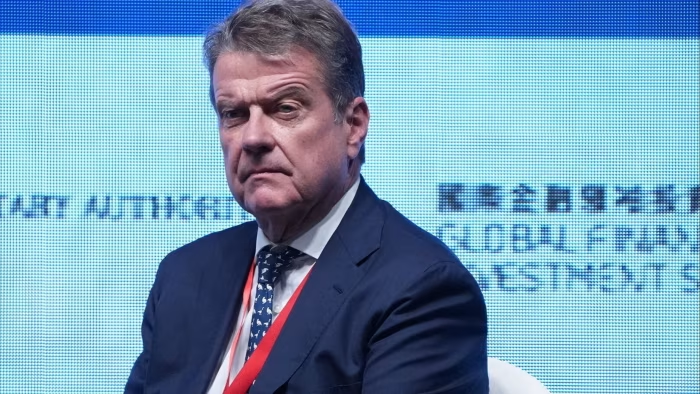
Not to be outdone, UBS chair Colm Kelleher, on Tuesday, offered the newest private credit warning, which was provocative enough to yield a separate alert from an industry titan.
Kelleher said at a prominent Hong Kong conference that the private capital-owned insurers were using ratings shopping on their fast-growing loan portfolios to create a “looming systemic risk” to global finance.
The former Morgan Stanley finance chief was highlighting smaller rating agencies that are increasingly being used by private equity backed insurance companies to get high ratings on their private assets. He compared it to the ratings shopping on subprime loans before the 2008 financial crisis.
“What you’re seeing now is a massive growth in small rating agencies ticking the box for compliance of investment,” said Kelleher.
His comments were quickly rebutted by Apollo Global chief Marc Rowan as it reported strong third-quarter earnings.
“Colm is just wrong,” said Rowan on a conference call, stating that Apollo’s insurer Athene does not use Egan-Jones, a small agency that has rated thousands of private loans, and predominantly has assets rated by the three large rating agencies, Moody’s, S&P Global Ratings and Fitch.
Yet Kelleher’s comments triggered a separate credit warning from Rowan, but directed elsewhere.
The multi-billionaire architect of Apollo’s strategy to match insurance liabilities with high-octane private credit assets said a bust could come from jurisdiction shopping as late entrants to the nexus of private credit and insurance seek regulatory arbitrage.
Rowan pointed to insurers’ increasing push towards the Cayman Islands and other potentially lax regulatory climes, versus Bermuda, where Apollo’s insurer is situated.
“I continue to believe, as I’ve said previously, that we have offshore jurisdictions of significant size that have not produced the kind of regime that is consistent with US ratings and US state based regulatory reform. And we continue to highlight Cayman Islands because it is the largest, but there are others.”
“So, Colm is not wrong at this point in the credit cycle to say that there are systemic risks piling up,” Rowan added.
Trump’s favourite banks
Asked by the FT in September whether his family had already made about $1bn in profits from crypto, Eric Trump said the true figure was “probably more”.
A significant chunk of that sum was generated with the help of two little-known but prolific boutique banks that have worked closely with the Trumps over the past year.
Dominari Holdings and Yorkville Advisors are far from household names. Until recently, neither bank had much of a record advising or financing digital asset companies.
But connections with Eric Trump, his elder brother Donald Trump Jr and senior executives at Trump Media & Technology Group, which runs Truth Social, have catapulted them into the spotlight as the president’s family has moved at speed to expand its crypto empire.
Based in Manhattan’s Trump Tower two floors below the Trump Organization’s headquarters, Dominari advises small companies looking to list, merge with a Spac or mount a reverse takeover.
The Trump brothers joined the company’s board of advisers in February, a few years after meeting Dominari’s top executives through charity events hosted at New York golf clubs.
American Bitcoin, a crypto miner valued at about $4bn and backed by the president’s sons, was originally a wholly owned Dominari subsidiary.
From its more modest office in Mountainside, New Jersey, Yorkville extends equity lines of credit to small, often cash-strapped companies at a prodigious rate.
TMTG is by far its best-known client, though the lender also has financial relationships with right-wing media mogul Christopher Ruddy’s Newsmax and crypto exchange Bakkt.
(Last year the FT reported that TMTG came close to buying Bakkt.)
In other words: Dominari and Yorkville are suddenly riding high. And the president’s embrace of digital assets means their trajectory is likely to follow wherever the price of bitcoin leads.
Where London’s winning in finance
A lot has been made of London’s decline over the past couple of decades. Yet in one corner of finance, the UK capital is winning.
Over the past decade, a number of quantitative finance groups have sprung up in London and are now minting billions of pounds in revenues and turning heads with the huge pay packages they’re handing to 20-something maths whizzes.
XTX, an algorithmic trading firm, together with quant investors Qube and Quadrature have each netted more than £1bn in revenues, according to filings by their UK entities.

They’re part of a new breed of trading groups and hedge funds that suck up huge volumes of data and funnel them into mathematical models, which they use to spot correlations and make bets.
They’ve snatched business from the trading divisions of banks and quietly grown to dominate markets.
Qube’s main focus is market making and statistical arbitrage trading, which uses data to assess price differences between securities. Its UK entity posted net revenues of £2bn last year, nearly seven times more than it made in 2020.
XTX, meanwhile, earned more than £1.3bn in profits after tax, a 54 per cent jump from 2023.
It uses machine learning to forecast the price of stocks, bonds, crypto and currencies. It has its roots in foreign exchange markets, a sector which London dominated for years. (For more on the other groups, read the FT’s full piece here).
Part of the story is a wealth of AI and maths talent at the UK’s best universities that’s flowing freely into the world of quants.
In the US, top engineering and computing grads often join Big Tech. Across the pond, that’s not always the case.
Quant groups have stepped in and feature prominently at hackathons and student society events at top university campuses, hoovering up talent — and paying eye-watering sums.
Alvaro Cartea, director of Oxford university’s quantitative finance institute, said almost all his students ended up working at trading firms, with salaries from £250,000 to £800,000.
“If you get offered a salary less than £250K, you’re kind of the sad guy,” he said.
Job moves
-
Latham & Watkins has hired Max Klupchak as a partner for the firm’s M&A and private equity. He was formerly general counsel at The Sterling Group.
-
White & Case has hired Joshua Teahen as a partner in Houston for M&A and its private capital group. He previously worked for Kirkland & Ellis.
Smart reads
Bean counters Starbucks has ducked for cover in China’s coffee war, which has become the hottest showdown in global retail, Lex writes. With local rivals undercutting further and further on price, it can no longer rely on brand prestige alone.
Loosened grip For the first time in more than three decades Izzy Englander has let go of part of Millennium, which could have big implications for the hedge fund giant, Bloomberg writes.
Relegation battle Billionaire oilman Cody Campbell has spent millions paying students to play football at Texas Tech, helping to make it one of the top college football teams in the country, The New York Times reports. Now he’s fighting to save college sports from billionaires like himself.
News round-up
JPMorgan discloses US inquiry into alleged debanking practices (FT)
Novo Nordisk and Pfizer sweeten offers for Metsera as bidding war intensifies (FT)
First Brands sues founder Patrick James over alleged fraud (FT)
Bank of America 3.0? Moynihan set to pitch strategy refresh to investors (FT)
Sam Bankman-Fried’s lawyer says FTX founder’s trial was ‘fundamentally unfair’ (FT)
Norway’s oil fund to vote against Elon Musk’s $1tn pay deal at Tesla (FT)
BDO quit role supporting Singapore family office linked to scam empire (FT)
ABF explores spinning off Primark fashion chain (FT)
Due Diligence is written by Arash Massoudi, Ivan Levingston, Ortenca Aliaj, Alexandra Heal and Robert Smith in London, James Fontanella-Khan, Sujeet Indap, Eric Platt, Antoine Gara, Amelia Pollard, Kaye Wiggins, Oliver Barnes and Jamie John in New York, George Hammond and Tabby Kinder in San Francisco, Arjun Neil Alim in Hong Kong. Please send feedback to due.diligence@ft.com