Startups are making it possible to 3D print large objects, speed production
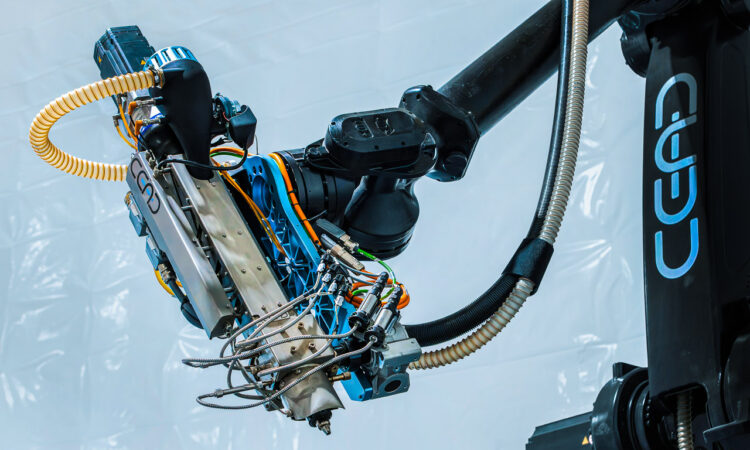
A “large format” 3D printing company manufactures large objects such as boat molds and components. Another composites startup is advancing industrial production rates of a class of structural composite materials.
A “large format” 3D printing company manufactures large objects such as boat molds and components, drawing on the experience of its four co-founders, whose work at the University of Maine’s Advanced Structures and Composites Center included leading major programs in the marine sector.
Evergreen Additive Inc. is one of two startups to emerge from the center over the past year. The other is ReForm Composites Inc., which is advancing industrial production rates of a class of high-performance structural composite materials called continuous fiber reinforced thermoplastic.
The Advanced Structures and Composites Center, led by founding executive director Habib Dagher, has spun off a number of companies over the years.
“One of our goals is to take the technology and make sure it works for people in the state of Maine and to make jobs in Maine,” says Dagher.
Past spinoffs include Compotech in Brewer, one of 15 Maine companies ranked this year among the nation’s fastest-growing private enterprises; and Global Secure Shipping in Old Town.
‘Large format’ printing
Joan Ferrini-Mundy, president of the University of Maine, has said the Evergreen Additive’s launch “represents an exciting moment for Maine and for the University of Maine.”
Evergreen Additive Inc. specializes in large-format additive manufacturing for maritime applications, manufacturing large objects such as boat molds and components to serve the commercial marine tooling and defense markets. The startup is establishing operations in the Brunswick Landing industrial park.
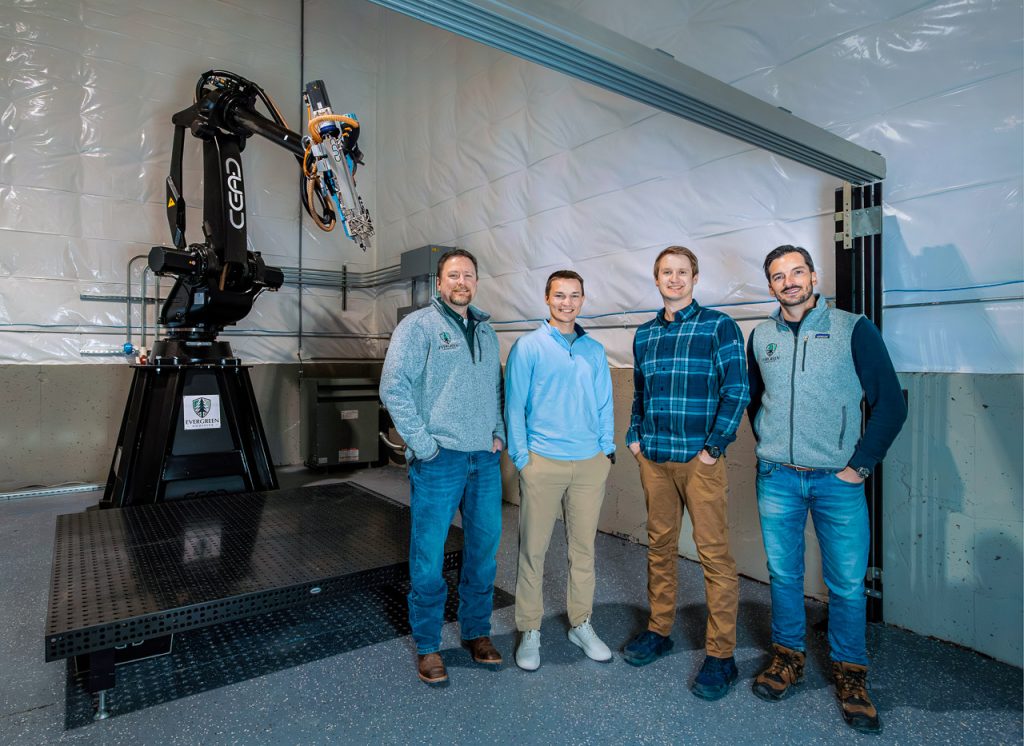
“Large-format additive manufacturing offers a path forward by automating production while maintaining the quality and performance Maine manufacturers are known for,” said Kyle Warren, Evergreen’s CEO.
The company’s work exemplifies Maine’s economic development strategy goals, Jake Daniele, small business development manager at Maine’s Department of Economic and Community Development, has said.
“By pioneering advanced manufacturing for maritime composites in Maine, they are helping to build a future-ready workforce, strengthen Maine’s economy and anchor high-quality jobs here at home,” Daniele said.
Vessel test
Evergreen Additive offers advanced manufacturing consultation, rapid prototyping services and production manufacturing.
The company was founded by Warren, Peter Drown, Andrew Gifford and Benjamin Steva. Each has worked at the Advanced Structures and Composites Center for at least a few years and together bring extensive experience leading and managing advanced manufacturing research and development projects for both government and industry.
Last year, the team led university-based research that developed and tested two unmanned surface vessels built using large-format additive manufacturing for the U.S. Navy’s Office of Naval Research.
The team has since established a headquarters at Brunswick Landing and leased about 8,000 square feet of space at 180 Orion St. to set up manufacturing. Several weeks of work went into making the space suitable, including deep-cleaning and sealing the floor and upgrading the electrical system to accommodate a “large format” robotic additive manufacturing machine. The current machine is about six-by-six feet, which will get significantly larger and more capable in Q2.
Capabilities include 24/7 production with minimal supervision and the potential to work on several large projects per week.
The initial investment in equipment is about $1 million, funded by the founders and private investors. The company won a $42,000 award when it was selected for a highly competitive spot within the Defense Innovation Unit “dual-use university accelerator,” a program focused on startup companies within an academic setting. It is also supported by MTI Business Innovation funding.
Over the coming three years, it’s expected there will be about $5 million of capital investment into the facility. The team said they will be looking to finance these investments through a combination of private sources and revenue through tooling sales and federal contracts.
Over the next five years, the company plans to create at least 10 to 12 full-time jobs, including the four founders.
Leg work
Gifford, Evergreen’s CTO, has been in the large format 3D printing space for about a decade — “pretty much since the inception of the technology,” he said. The technology has reached the point where equipment and feedstock costs have come down enough to make the technology attractive for commercialization for numerous applications, he said.
“We have a lot of customers that are interested in looking at the technology,” said Gifford. “The leg work has been done.”
The founders are building a sales pipeline for commercial tooling.
Complementary markets
The goal is to serve two complementary markets.
The first is to produce tooling and manufacturing aids for boatbuilders, with tooling delivered 50% to 75% faster and more cost effectively than traditional methods. Tooling examples include patterns and direct-use molds for large boat components such as hulls and decks, and small parts for recreational, commercial and custom watercraft.
The second market is the making of expendable unmanned systems for the U.S. Department of Defense.
Last year, the company, along with a research team at the University of Maine, designed, manufactured and tested two 6-meter unmanned surface vessels on Casco Bay. The hulls and/or components were produced using robotic large-format additive manufacturing.
“This wasn’t a laboratory experiment,” said Ben Steva, Evergreen’s COO. “We put multiple vessels in the water, operated them in real conditions, and proved that the technology works outside of the laboratory.”
Maine boatbuilders are “constrained by long lead times for tooling, skilled labor shortages, rising material costs and unpredictable supply chains,” says Gifford. “We aim to overcome these challenges through our advanced manufacturing technology workflow and deliver high quality tooling in half the time.”
Peter Drown, Evergreen’s CFO, said the company has been engaging with boatbuilders along the East Coast. The primary focus is on those in Maine. The team attended the Miami International Boat Show in February to network with boatbuilders and clearly understand the demand signals.
“We’ve been spreading the word and advertising our capabilities,” said Drown. “We also have a defense focus, working with our partners at the Defense Department.”
Evergreen says it maintains a close partnership with the University of Maine, including the Advanced Structures and Composites Center where the co-founders met. They plan to work collaboratively with the University on workforce development needs in Maine and to pursue joint projects that advance the state of advanced manufacturing.
Alternative to steel
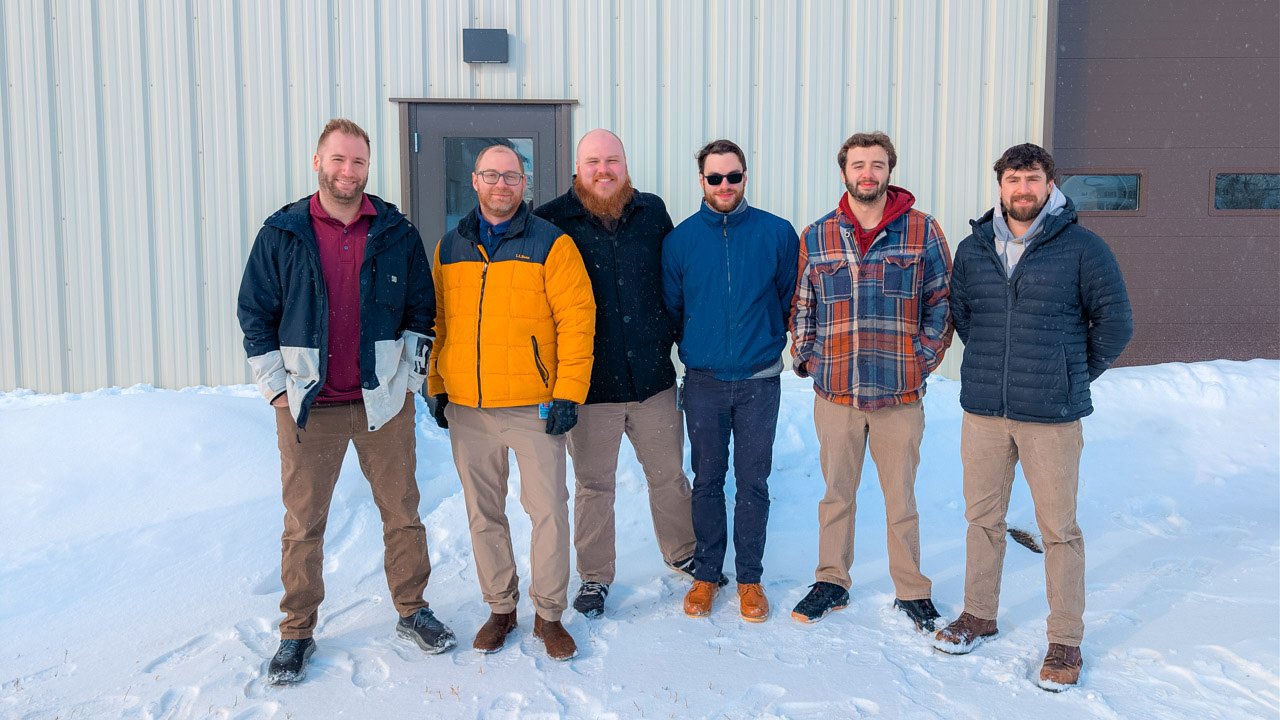
ReForm Composites Inc. was founded in fall 2024 to build on research and engineering developed at UMaine’s Advanced Structures and Composites Center to advance industrial production rates of a class of high-performance structural composite materials called “continuous fiber reinforced thermoplastic.”
The product can be reheated, reshaped, welded and recycled while carrying structural loads, and offers an alternative to steel, aluminum and traditional composites in demanding structural applications, says Cody Sheltra, ReForm’s founder and CEO.
The startup was recently selected as one of 20 global finalists in the Paris-based JEC World Startup Booster, an international competition recognizing emerging innovation in the composites industry.
“Much of the next generation work in advanced composites has historically taken place in Europe, so as a group that grew up in Maine, we’re especially proud to help put the U.S. on the map through our home state,” Sheltra says.
‘Continuous forming’
Although the material class has existed for decades, manufacturing economics have limited its use in markets where cost sensitivity is critical, he says.
To address that gap, ReForm is advancing a patented high output “continuous forming” system for construction, infrastructure and industrial applications. The process enables the high-output formation of complex shapes at industrial scale.
Concrete flatwork
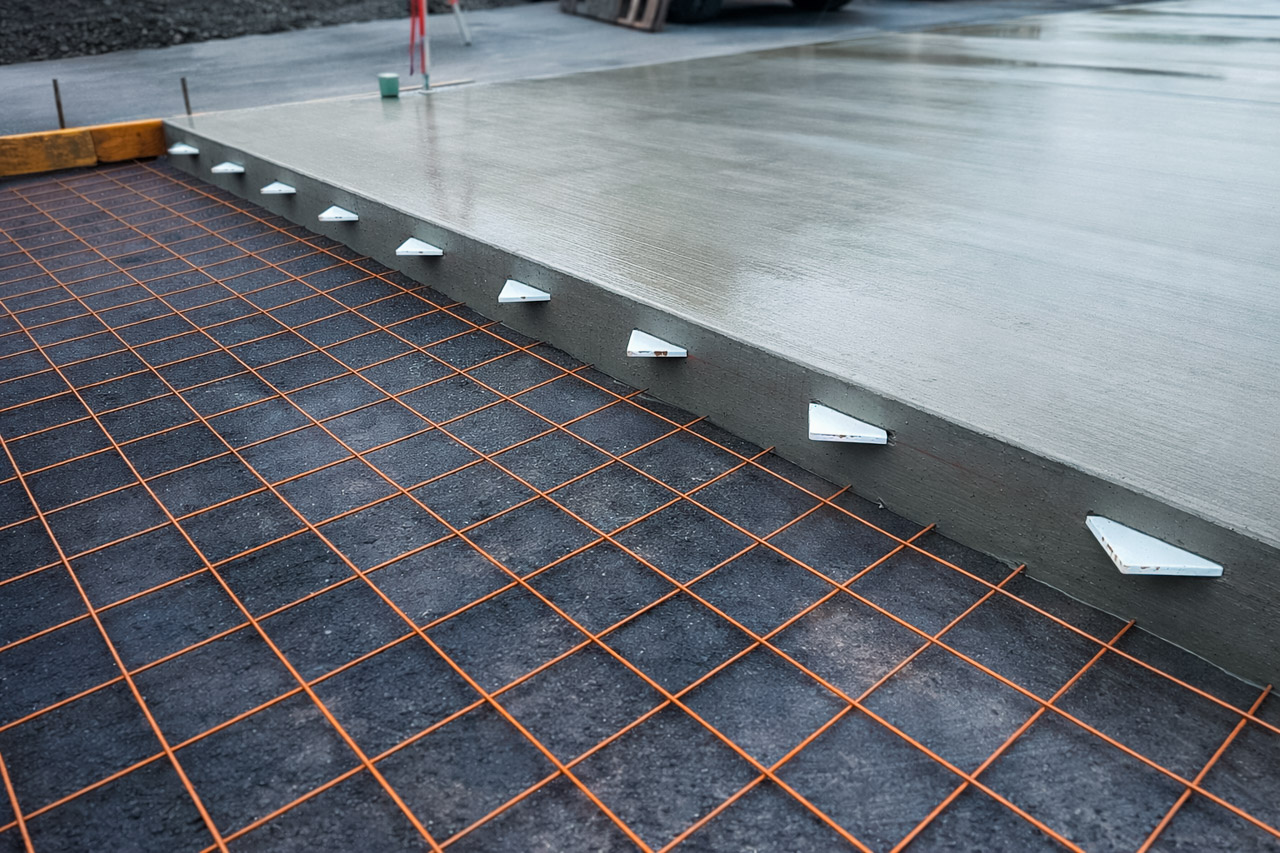
ReForm’s first commercial product, PolyDowel, was made for concrete flatwork such as sidewalks and industrial flooring. PolyDowel is engineered to perform the same function as traditional steel plate dowels used by the concrete industry, but weighs roughly one-fifth as much and eliminates corrosion.
A Fortune 50 firm installed PolyDowel at its property as a demonstrator project. A public space in Port St. Lucie, Fla., called Heart in the Park, also used PolyDowel. Recently debuted at the World of Concrete trade show in Las Vegas, PolyDowel represents ReForm’s first real-world deployment of continuous fiber reinforced thermoplastic in concrete applications.
“It’s a big deal,” says Sheltra. “CFRTP isn’t new, but it’s new to construction because it’s been expensive. Over the past couple of decades, various companies have driven the price down.”
With a background in composite mechanics and manufacturing systems, Sheltra played a key role in advancing continuous forming technology from early concept to a scalable manufacturing platform supporting real-world deployment.
Sheltra began his career in composites 15 years ago at UMaine’s Advanced Structures and Composites Center where, as part of a research program, he led development of the continuous forming process initially for field-bendable composite rebar.
Commercialization
With a goal to commercialize, Sheltra was mentored through UMaine’ s Office of Strategic Partnerships, Innovation, Resources and Engagement, or SPIRE, whose programs are designed to move university research into real-world use. Through SPIRE-supported market research and customer discovery, it became apparent there was a demand for the new manufacturing process.
“It became clear there was meaningful market potential,” says Sheltra.
Relationships
“ReForm Composites is a new spinoff company from the Advanced Structures and Composites Center at UMaine,” says Dagher. “The start-up company licensed the groundbreaking thermoplastic pultrusion technology developed at the UMaine ASCC by faculty and staff, and ReFORM was formed to commercialize this technology.
“Staff and students were coached by UMaine-SPIRE to develop the business plan and strategy. Funding for the ASCC research that led to this new manufacturing technology was provided to UMaine by the US Army Corps of Engineers ERDC. We appreciate the support that Senator Collins provided to secure the US Army Corps grant that led to this promising invention and technology.”
Hampden buildout
ReForm is outfitting a facility in the Hampden Industrial Park at 43 Carey Circle. The installation of four production lines will support expanded manufacturing operations as programs move from development into production. The build-out includes floor and power installations for ReForm’s specialty equipment.
Financing has included a $50,000 grant from the Maine Technology Institute’s Business Innovation Fund, $350,000 with a required match of $350,000 from the Maine Technology Asset Fund program administered by MTI and earned revenue from engineering contracts and early manufacturing work.
“As these lines are brought online, ReForm is leveraging its engineering and R&D capabilities to develop new customer production streams as well as its own products, particularly for concrete construction applications,” says Sheltra. “As production capacity comes online, ReForm anticipates adding engineering and manufacturing roles over the next 12 to 24 months.”